Signs a Retaining Wall Should Be Rebuilt – Part I
Here on a website, we’ve looked at lots of different types of masonry conditions. We’ve also talked a lot about different options for rebuilds and building new and wholesale repointing. Sometimes small repairs might make sense, but often, full rebuilds or full-scale reporting is really needed based on the condition.
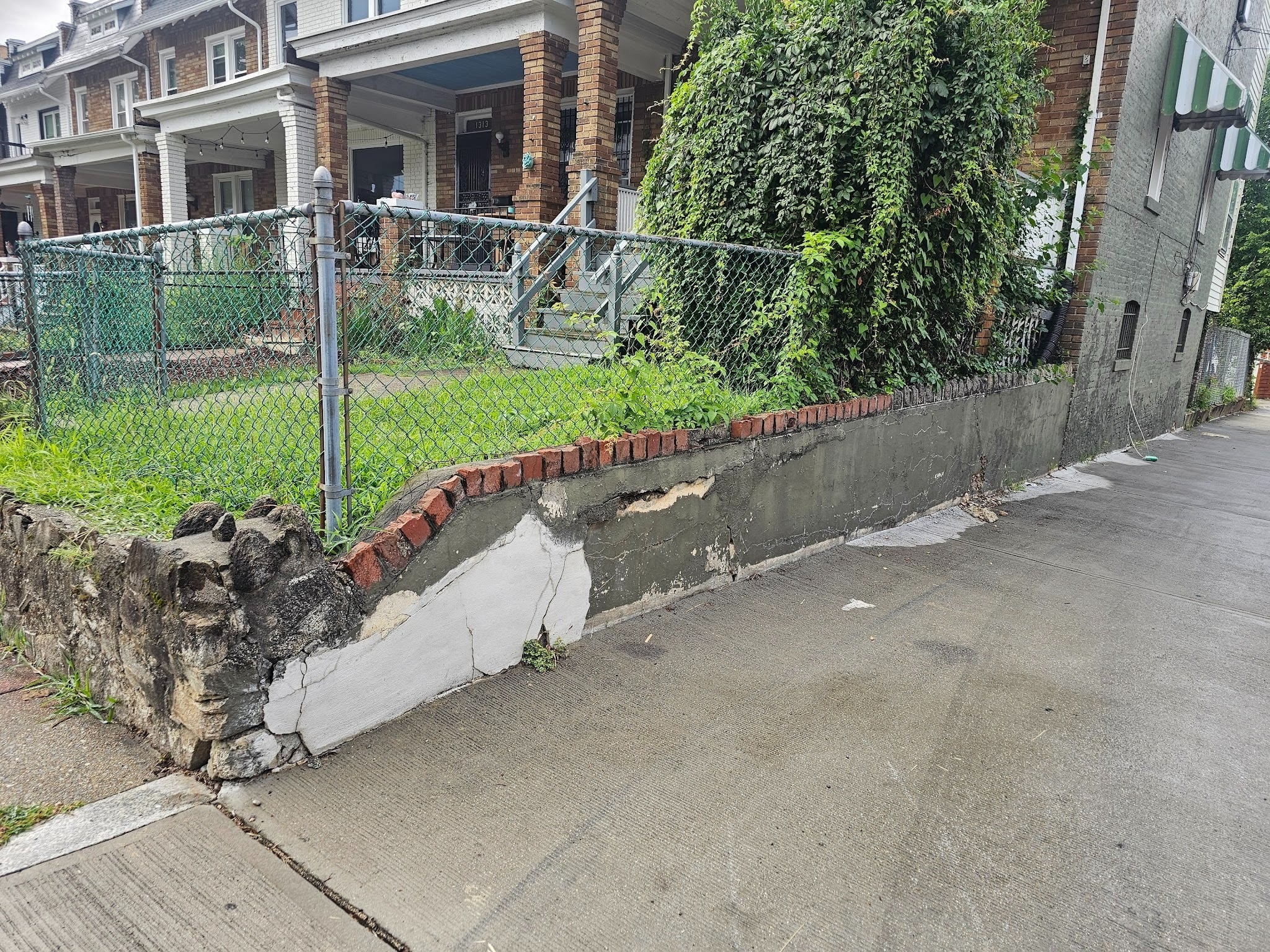
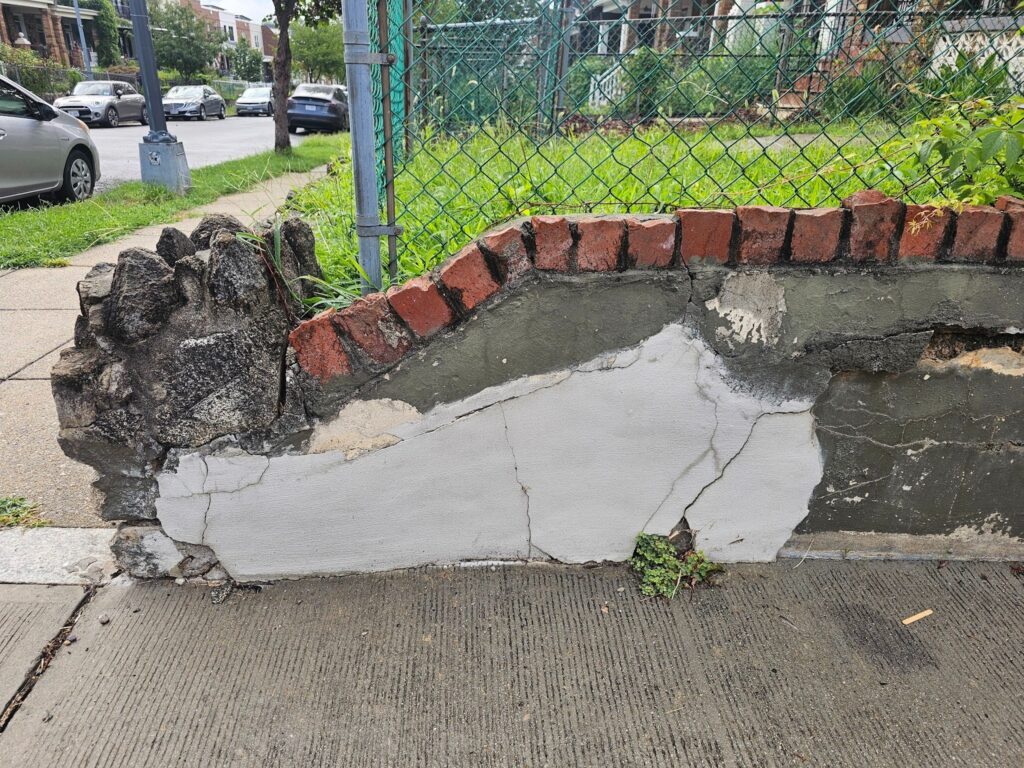
Today we’re looking at retaining walls. Sometimes the deterioration is so extensive that q full rebuild can’t be avoided for much longer. This particular retaining wall has had a handful of different repairs done to it over the years.
In some cases smart repair and restoration can go a long way to extending the life cycle of a building element.
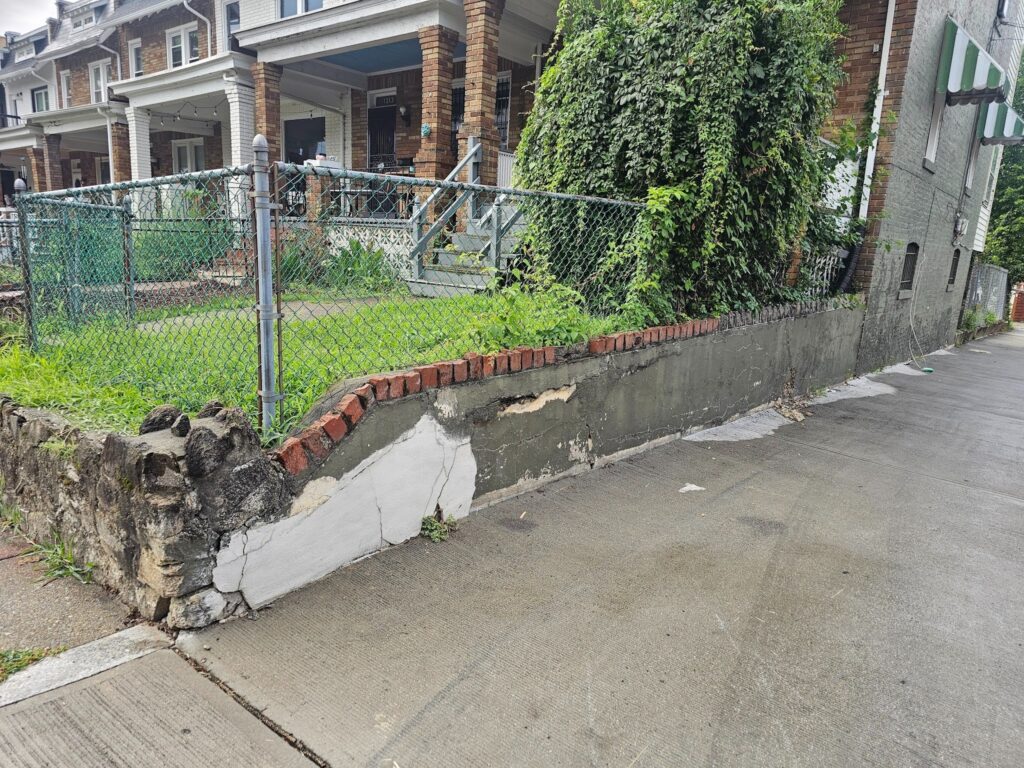
A large patch area is shown in the picture below. Here, the thinking, at the time, must have been that repairing the spot without rebuild would save cost. Sometimes, up front cost can be saved, but in another cases the repairs might not last as long as full rebuilds. The additional cost of a full rebuild might actually save money in the long term instead of multiple repairs.
The cost comparison depends on the individual work’s efficacy. During routine upkeep and maintenance, small repairs are cheap and can save a lot. After building elements hace significantly deteriorated and after maintenance has been neglected, repairs are generally ineffective from a financial perspective.
There are a few spots of deep spalling in the wall. Unlike most masonry walls that are put together with individual units, this particular wall has both individual brick units, but it also has a large body made up of cast in place concrete. There’s a parge coat on the surface that hides the underlying substrate. A parge coat is basically like stucco. One of the differences between parge coating and stucco is that often the parge coating will be just one application. By contrast, stucco is generally multiple applications that starts with a base coat and a second coat after the base coat and then a final coating to make everything close to perfectly consistent.
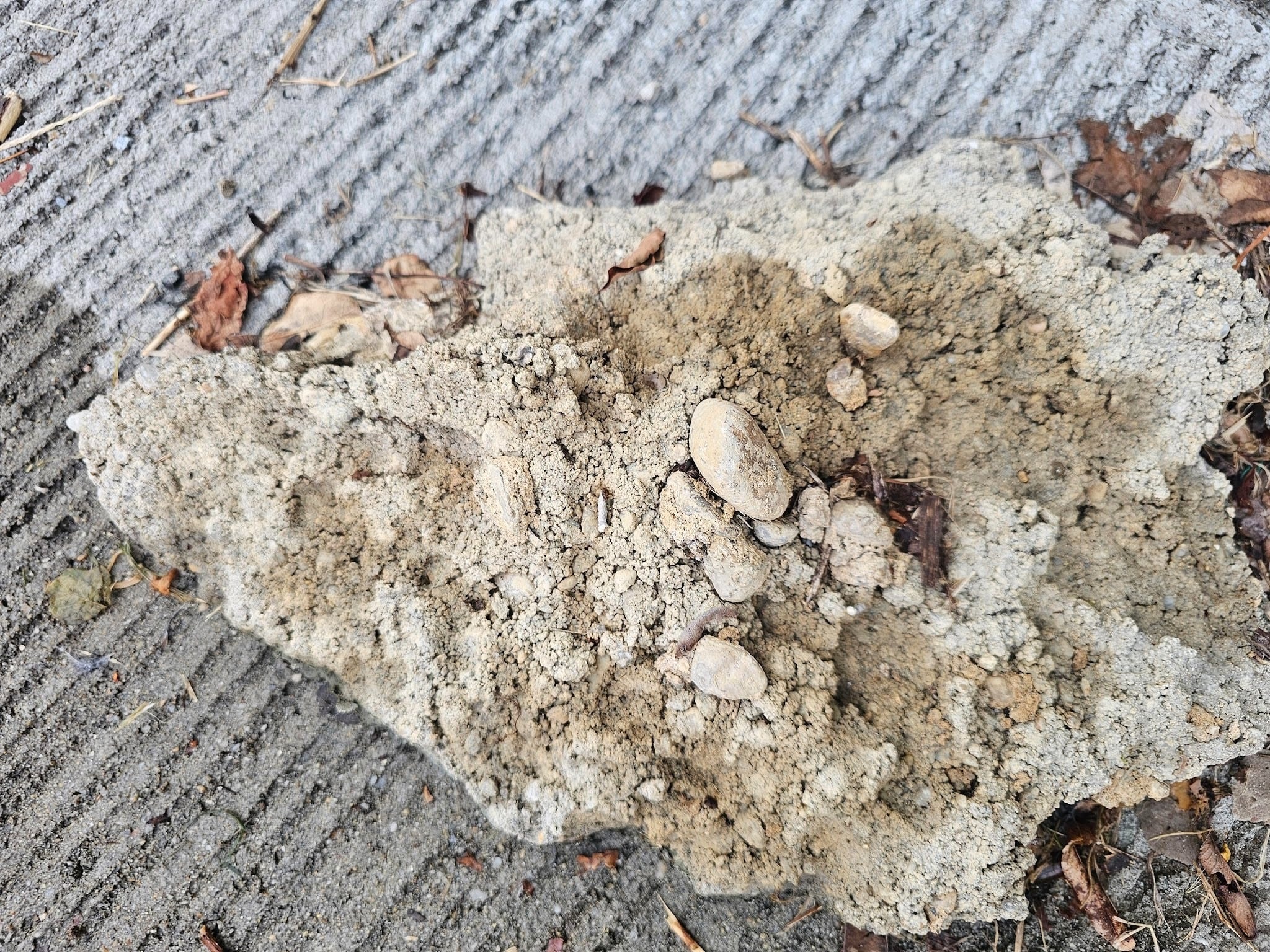
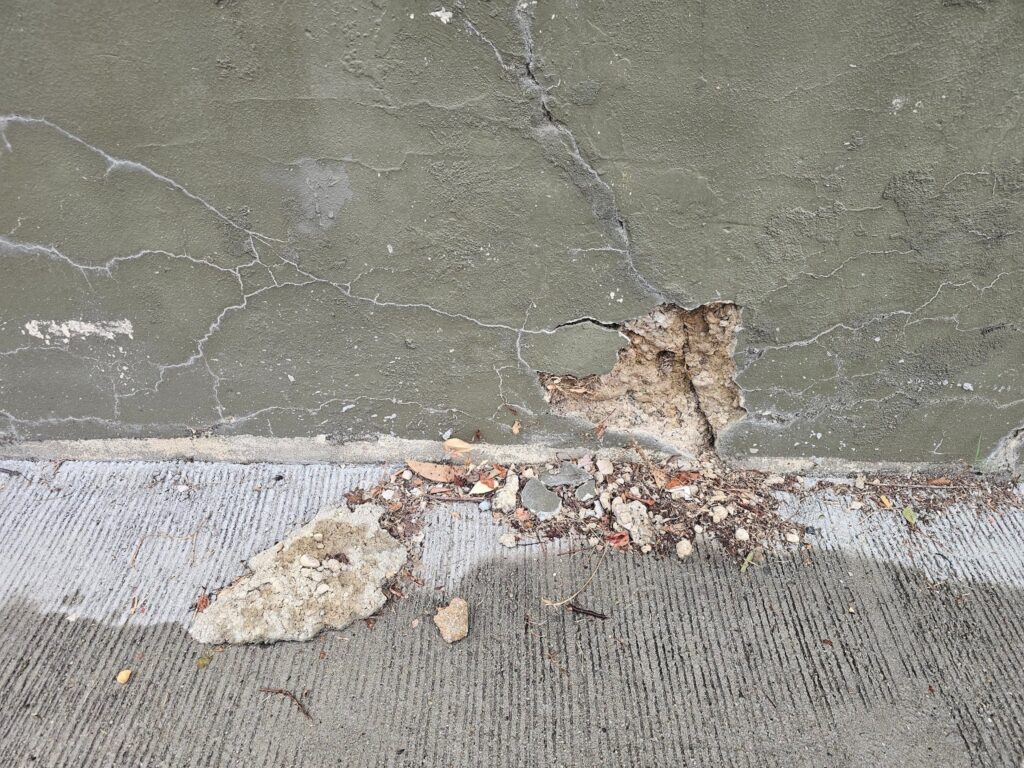
The picture below shows an area of significant spalling. From a distance the damage is obvious. A big chunk of the concrete or cementitious materials that comprises wall have fallen out and now lay strewn upon the the alleyway paving. We took this picture when we saw the damage, it looks like it hasn’t been sitting here, laying there, for long. That simple guesstimate indicates that this type of damage is bound to continue happening at other parts within the wall in sporadic unpredictable type of occurrences.
When masonry and cement, in many types of building materials, get to a point of significant deterioration, well beyond their expected lifespan, they may start breaking and crumbling unpredictably.
We, here, might say it’s unpredictable but it makes us think of the difference between random versus chaotic. We’ve talked about that here on our website and our blog before. The distinction is important when looking at building materials, and deterioration prediction modeling. Random means that it is truly unpredictable.
Something that’s random can happen in any way and in some type of conditions, at any time. In contrast, something that is chaotic maybe difficult to predict, on an instance per instance basis, but the trends of something that’s chaotic are generally predictable. That mathematical difference is important in understanding engineering and building science. At this stage in the building materials life cycle, small repairs won’t help as much as rebuild and replacement.
In this particular example, now this wall is getting close to the time where it’s worthwhile to switch gears and not consider this as something which is worth wasting money on in tune-ups.
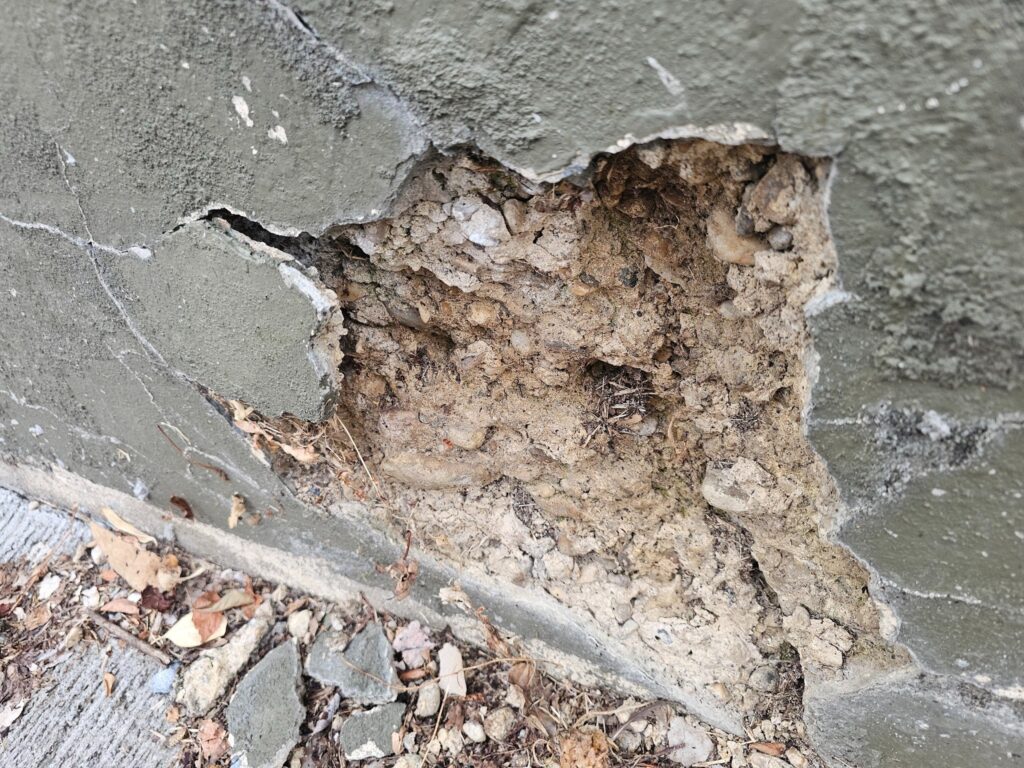
The picture shows a closer view. Here you can see the materials that are left behind look a bit sandy and chalky. They’ve lost a significant portion of their cohesive elements. In some cases the internal materials have deteriorated and even, at a micro-subcomponent level, have dissolved. As the bond between the small subcomponents have broken apart, much of the fine granular elements have decomposed and even washed away from their original position.
In this coming week we’re going to look at additional examples of the the smallest subcomponent elements and discuss why replacement or rebuilding is, although a large project, worth it, instead of band-aids, at certain points in a life cycle.
Since our company, Dupont Tuckpointing and Masonry, specializes in masonry restoration, historic brick repointing, and tuckpointing services in the Washington D.C. area, we make it a point to study these types of issues. These buildings are uniquely historic, and their preservation requires skilled masons who are technically trained in the best practices and knowledge of proper restoration techniques.
We understand the significance of maintaining the architectural integrity of these historic structures, and our team of experienced professionals is dedicated to delivering exceptional craftsmanship. Whether you require masonry restoration, tuckpointing, or brick repointing services, we are here to help.
At Dupont Tuckpointing and Masonry, we take pride in our work and strive to ensure that every project is executed with the utmost care and attention to detail. We are committed to preserving the rich heritage of Washington D.C.’s built environment for generations to come.
If you have any questions or needs regarding masonry restoration, historic brick repointing, or tuckpointing services, please do not hesitate to reach out to us. We would be delighted to assist you and provide you with the expertise and quality workmanship that your historic property deserves.
You can reach us by telephone at (202) 796-7644 and you can reach us by email from the contact form on our website.