Historic Rosette Medallion at I-Beam Header Part I
We are looking at historic rosette hardware used at a historic brick opening header. We started by looking at this from a wide angle. You can see several things in the picture below. There is a small or thin I-beam looking header that runs above an opening at a French style double door. The pair of doors swing inward. They are top-light doors with a solid panel in the bottom. A top-light door has the upper half made with a type of glass that allows for fenestration. In some cases the glass may be opaque but it generally allows some light to filter through.
In some cases, the glass is perfectly clear and allows complete visibility. This particular installation goes to a historic brick garage.
The door is on the alley side of the building. Generally at the alley side, it’s better for the doors and windows to not have glass that can be easily broken or viewed through to see the contents of the garage. As the economics of Washington DC have gone through extreme cycles and as disparity of wealth has increased significantly, crime has also increased. There have been periods and times where that trend has reversed. In fact, up until pretty recently, Washington DC has been going through an economic boom. That started about 20 years ago.
Currently though we’re in the middle of creating unnecessary wars abroad and destabilizing our own currency and using all sorts of policies that ruin our own economy so it’s likely things will get much tougher for the least stable of the DC population. That will lead to significantly more crime in the future. As a deterrent to crime, we would recommend installing solid doors at the alley side of a building. The alley facings generally gave less exposure and therefore a higher degree of susceptibility to crime. That thin I-beam looking metal surface is painted a color similar to the wood doors and therefore it almost blends together. They’re made from different materials, though.
The I-beam is made from steel or mild steel which is a type of iron and the doors are made of a mixture of wood and glass.
The most important part to understand about this type of masonry opening and most similar openings, whether wider or less wide, is that they require a support like this beam. The brick, by itself, will not hold up above an opening. Especially where the opening is wider than the width of more than a few bricks (or blocks), the opening needs to be supported by a header.
In some cases, in historic buildings of similar age, wood headers were used. In some cases, even masonry can be used to support a section of a masonry wall above. For example, in a Roman arch, relatively small masonry units can be assembled to sit in compression where they will be stable. The Roman or semicircle arch is a bit unique though. It’s one of the few naturally self-supporting arches without the addition or implementation of materials made with greater individual tensile strength.
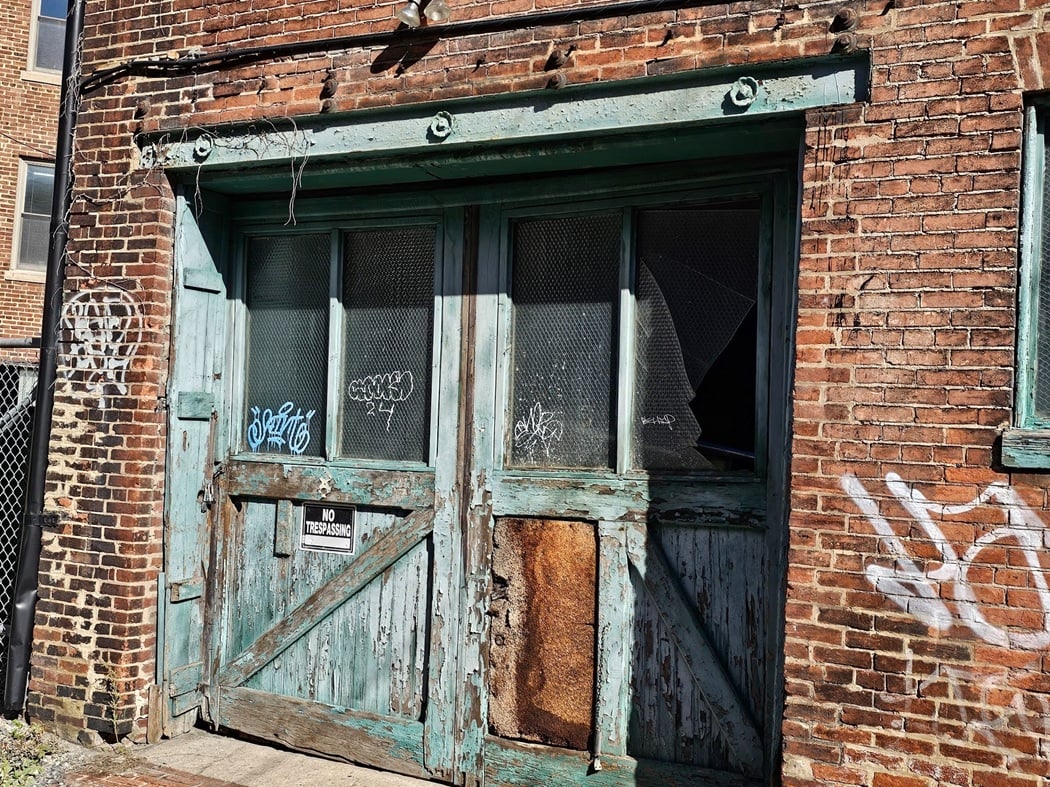
If you look closely at this header, you can see there are three rosettes installed along the width, from side to side. We referred to it as an I-beam looking steel support. It’s not really an I-beam though. Instead it is actually a pair of C-channels set back to back. C-channels are like hollow rectangles with one side open. When set back to back like this, the exposed side at the area above the opening, looks just like the side of an i-beam. Here though, the C-channels were used instead of an actual I-beam for a few reasons.
I-beams are very heavy and generally not manufactured in such a thin size. Most high beams would be thicker. That means they would set taller in the opening. Here, it’s important to have the opening be as tall as possible and with a tall I-beam, it takes away important space. The space is important because whether you’re storing a vehicle or carriage, most things stored inside of this garage need to be able to enter on wheels and have a height that won’t fit inside of short openings. Therefore making the structural support thin is essential.
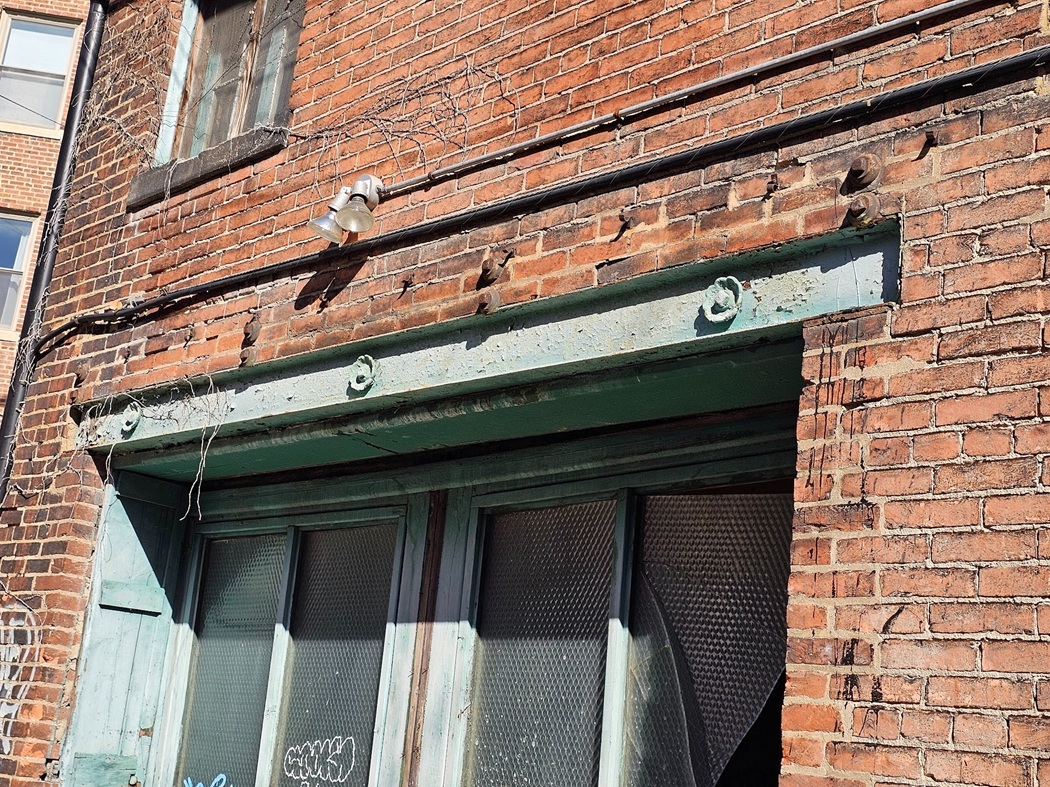
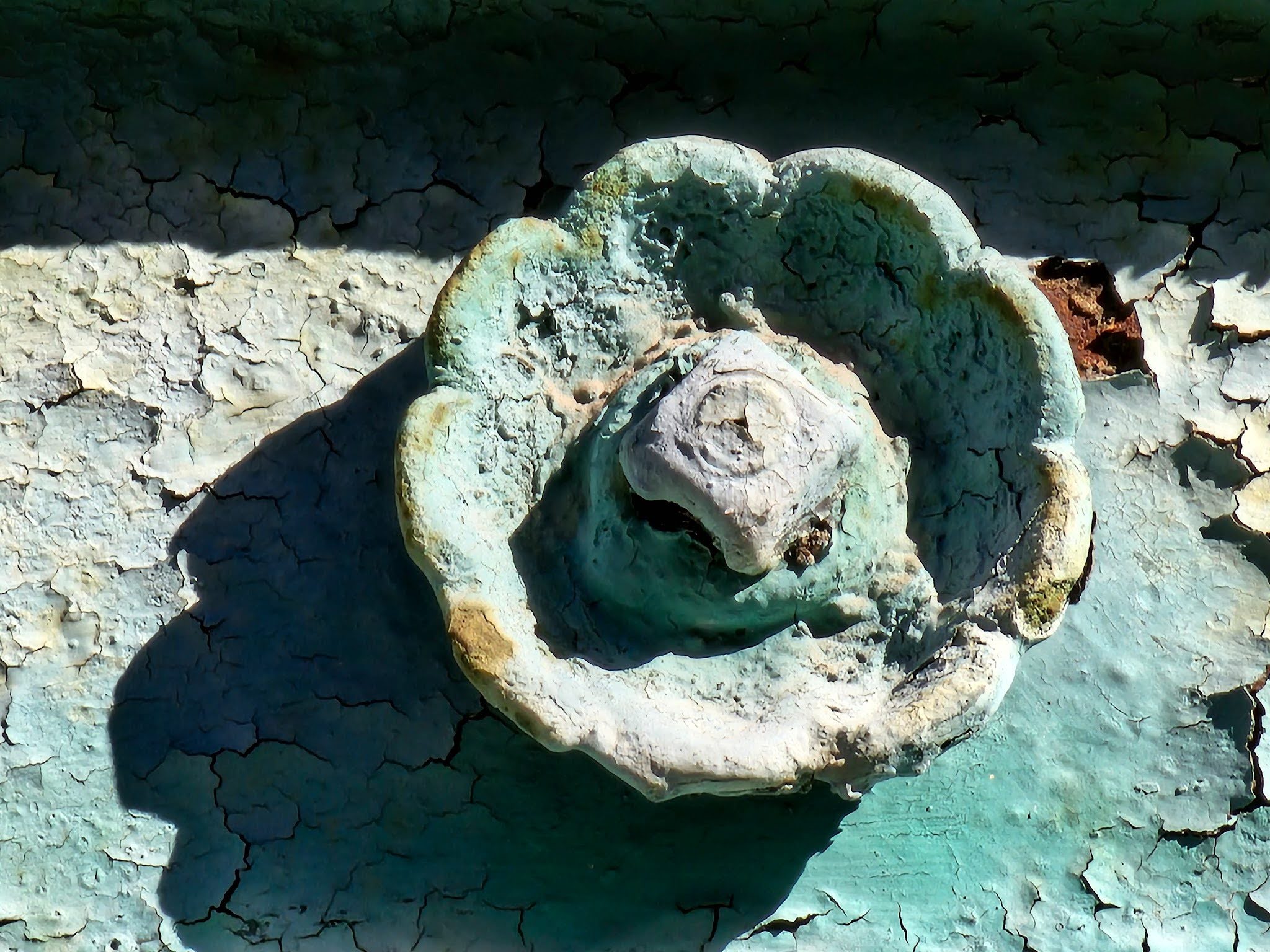
In this coming week we’ll talk about the decorative architectural aesthetics of the cast iron rosettes. You can see a close-up view of one of these rosettes in the picture below. It’s secured with a nut and a bolt that runs through from the front side to the back.
Since our company, Dupont Tuckpointing and Masonry, specializes in masonry restoration, historic brick repointing, and tuckpointing services in the Washington D.C. area, we make it a point to study these types of issues. These buildings are uniquely historic, and their preservation requires skilled masons who are technically trained in the best practices and knowledge of proper restoration techniques.
We understand the significance of maintaining the architectural integrity of these historic structures, and our team of experienced professionals is dedicated to delivering exceptional craftsmanship. Whether you require masonry restoration, tuckpointing, or brick repointing services, we are here to help.
At Dupont Tuckpointing and Masonry, we take pride in our work and strive to ensure that every project is executed with the utmost care and attention to detail. We are committed to preserving the rich heritage of Washington D.C.’s built environment for generations to come.
If you have any questions or needs regarding masonry restoration, historic brick repointing, or tuckpointing services, please do not hesitate to reach out to us. We would be delighted to assist you and provide you with the expertise and quality workmanship that your historic property deserves.
You can reach us by phone at (202) 796-7644 and you can reach us by email from the contact form on our website.