Brick to Block Union Metal Flashing Explained
Our company specializes in historic masonry restoration. In that effort, we do a ton of repointing work. As historic masonry deteriorates over long spans of time, the mortar between the bricks will deteriorate at the outer face. Repointing is the necessary action of removing the deteriorated mortar. Through the reporting process, a newer mortar with historic compatibility is put back into those joints to refresh the facade of the building. When done correctly it can prolong the life of the building for many decades.
Today, beginning a two-part series, we’re going to take a look at an interesting condition where an additional building was built next to an adjoining historic brick building. The newer building was built with concrete masonry units, more commonly known in layman parlance, as cinder block. You can see a picture of this vertical planer joint in the next picture below.
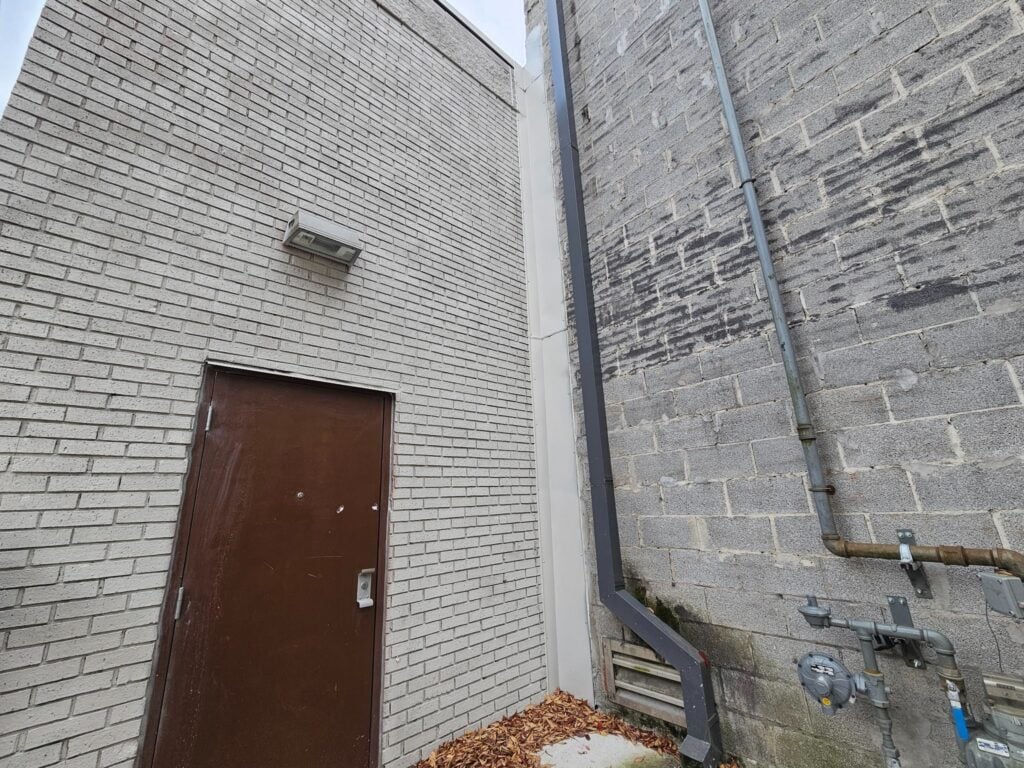
The problem here is that the brick in the cinder block we’re not built in an interlocked configuration. Instead, the block wall was just butted up right against the side of the cinder block. Without having interlocked or toothed-in masonry units, there’s a small gap. That small gap creates an interstitial void or open space. It’s easy for things like water to permeate or run right into that gap but it’s really hard to get that moisture out because it doesn’t have exposure to typical elements like wind and sunlight. Therefore it dries up very slowly. In the long exposures of time that that moisture has, stuck in that space, it causes damage.
Moisture like that that doesn’t dissolve, relieve, or evaporate will filter deeper into the inner parts of the masonry assembly and slowly cause damage mostly related to dissolution of the masonry subcomponents.
They’ve chosen to cover that joint with an aluminum flashing metal. Aluminum flashing metals like this are generally referred to as coil stock when purchased In a roll. As the metal is unrolled it can then be bent, and by bending it it goes from a somewhat flimsy type of shape to a more rigid piece of metal.
The bend itself stiffens it all up. As we talk about the moisture that’s trapped into that interstitial space, you could think of it festering. Organic materials, such as wood framing and many other types of building materials like drywall which is a sandwich of gypsum and cellulose paper, in time when subjected to excessive moisture that can’t dry up and dissipate away, will fester in rot. It’ll begin to have mold and as it breaks down plant material can even grow on top of the building materials which accelerates the ongoing breakdown.
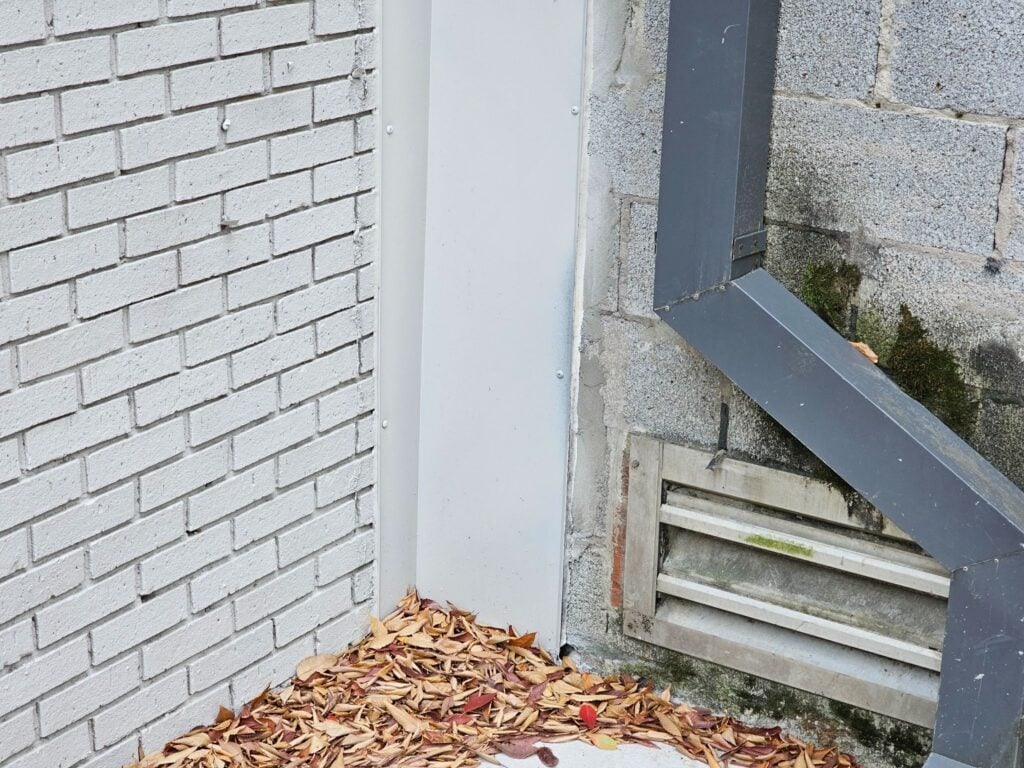
In these pictures, you can see the type of spanning continuous aluminum metal that they have used to overlap on top of both sides of the joint between the two different buildings. This metal works like a shield to keep out the elements. Rain and precipitation will essentially hit that panel of metal and run down without passing through into the trapped interstitial space. This might seem like a perfect solution, but it actually has some inherent shortcomings, and in the coming week we’ll talk about the inherent problems with joining new buildings to old, at property lines.
We’ll talk about methods that can be used to join existing buildings to new buildings by interlocking masonry and compatibility between large and small elements such as CMU cinder block and historic bricks.
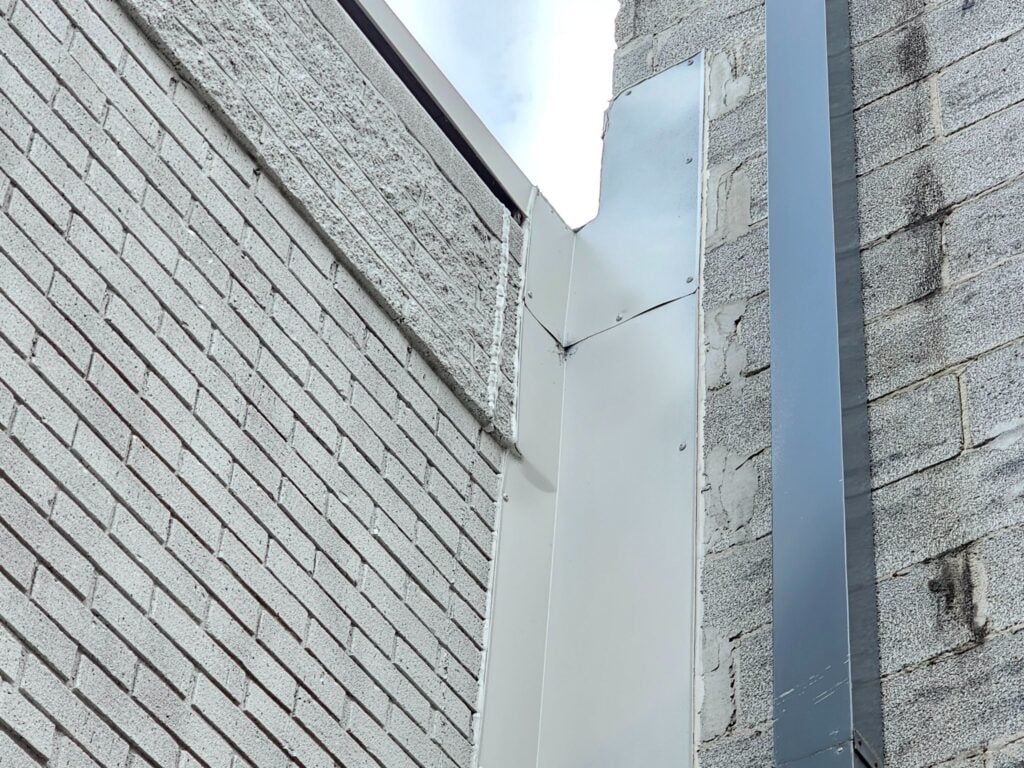
In the picture below, you can see the top of the lower, older building. The newer building runs past, above the older building and the aluminum flashing runs up a part of the area of the newer buildings wall even above the roof of the lower building.
Since our company, Dupont Tuckpointing and Masonry, specializes in masonry restoration, historic brick repointing, and tuckpointing services in the Washington D.C. area, we make it a point to study these types of issues. These buildings are uniquely historic, and their preservation requires skilled masons who are technically trained in the best practices and knowledge of proper restoration techniques.
We understand the significance of maintaining the architectural integrity of these historic structures, and our team of experienced professionals is dedicated to delivering exceptional craftsmanship. Whether you require masonry restoration, tuckpointing, or brick repointing services, we are here to help.
At Dupont Tuckpointing and Masonry, we take pride in our work and strive to ensure that every project is executed with the utmost care and attention to detail. We are committed to preserving the rich heritage of Washington D.C.’s built environment for generations to come.
If you have any questions or needs regarding masonry restoration, historic brick repointing, or tuckpointing services, please do not hesitate to reach out to us. We would be delighted to assist you and provide you with the expertise and quality workmanship that your historic property deserves.
You can reach us by telephone at (202) 796-7644 and you can reach us by email from the contact form on our website.