Exposed Rebar in Deteriorated Concrete
Here on our website, in the past, we looked at examples of how masonry and concrete construction has different types of strength characteristics. Both brick masonry, historic brick masonry included, and cementitious materials, like concrete, have an innate or intrinsic high resistance to compressive forces. We’ve looked at particular examples before. One of my personal favorite analogies though is a spaghetti noodle.
When it’s dry and you set it on a hard countertop you can press down on top of that noodle very hard before it’ll become crushed. That’s an example of compressive force resistance or compressive strength. In this case we’re just applying it to something that people are very familiar with. Almost every household in America has spaghetti every once in a while.
If you take that same spaghetti noodle and slide it halfway off the countertop and keep one finger pressed against it on the countertop and then take the other finger and lightly press downwards it takes almost no force or hardly any pressure to snap the spaghetti noodle in half. That example illustrates how tensile forces work.
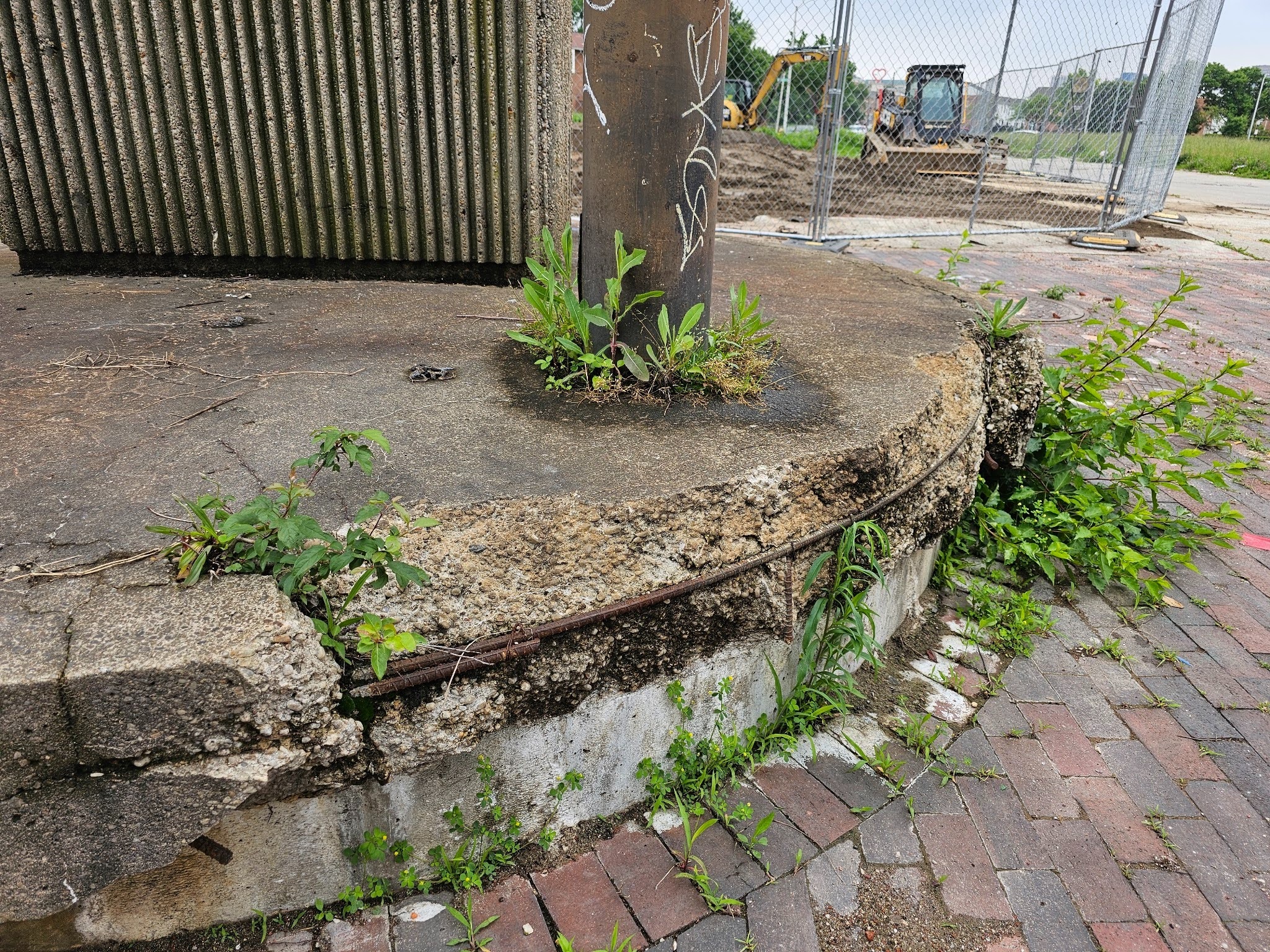
Another way to look at it, without using analogies as much is that compressive strength is the resistance to things being pushed together and tensile strength is the resistance to things being pulled apart. Concrete and masonry work in the same or similar way. In the picture below you can see an example of a radius curb where the edge has spalled. Spaling is the breaking off of the face or outer parts of a cementitious or concrete structural element.
Often, our company will work with brick spalling. When over-hydrated cementitious materials later experience conditions of freeze-thaw cycles, it’s common for deteriorated masonry to cause historic brick faces to pop off. In the industry, some people refer to this as exploding bricks. In reality though the bricks are not actually exploding. In fact in most cases it is generally just the outer face of the brick that pops off.
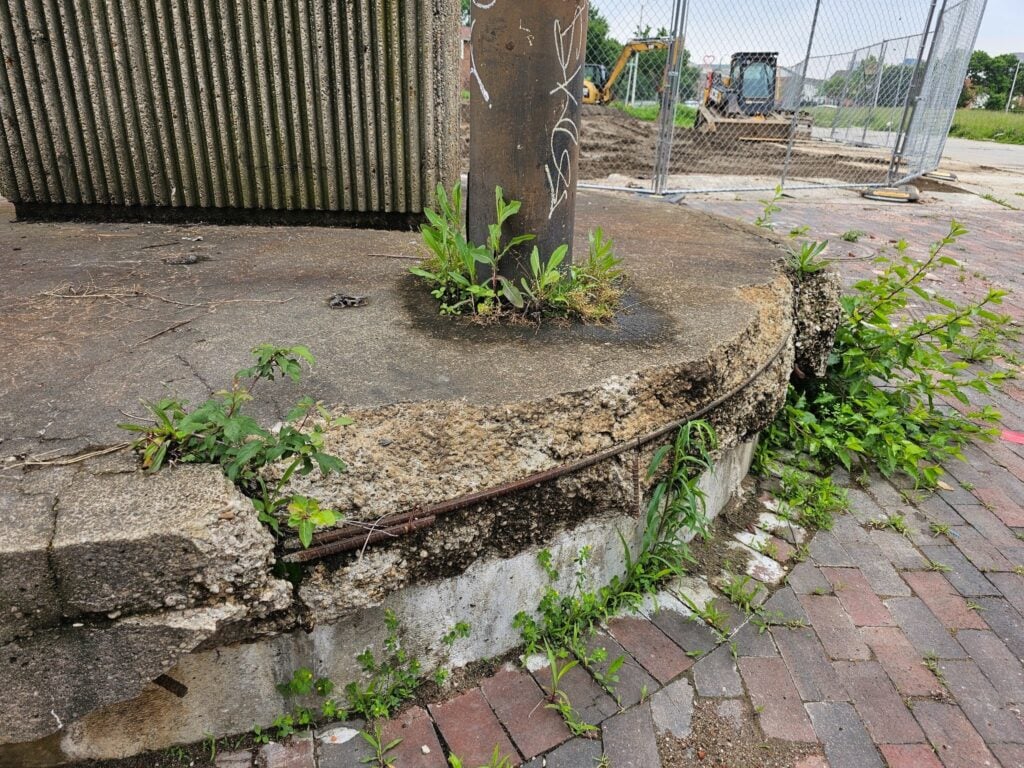
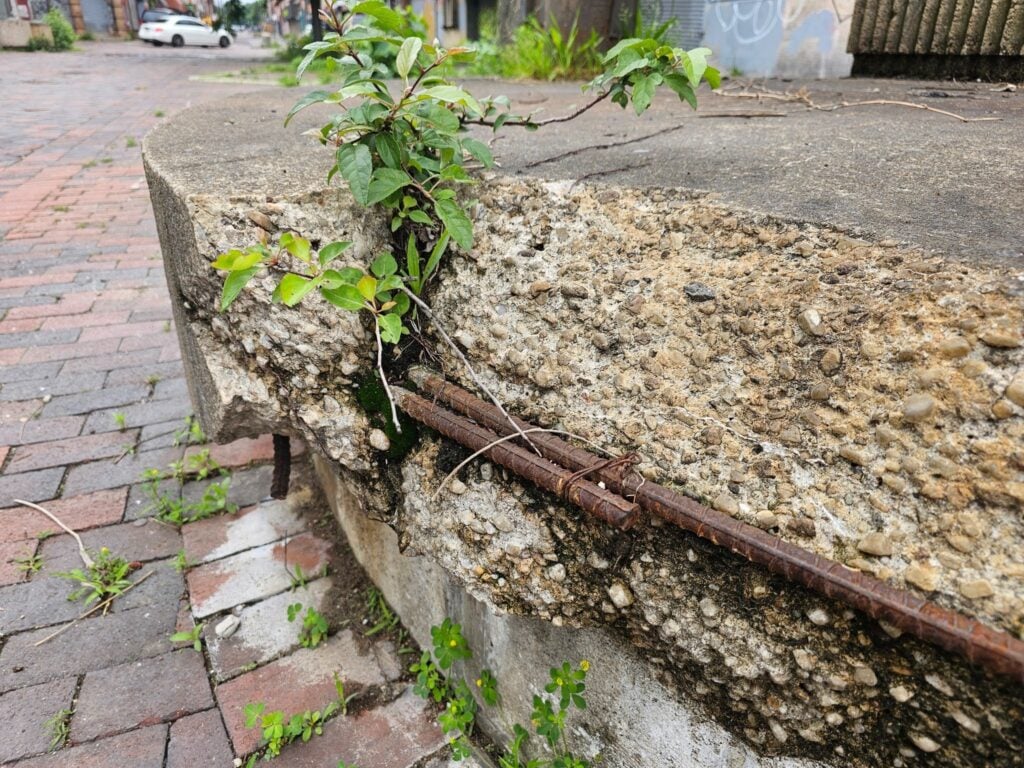
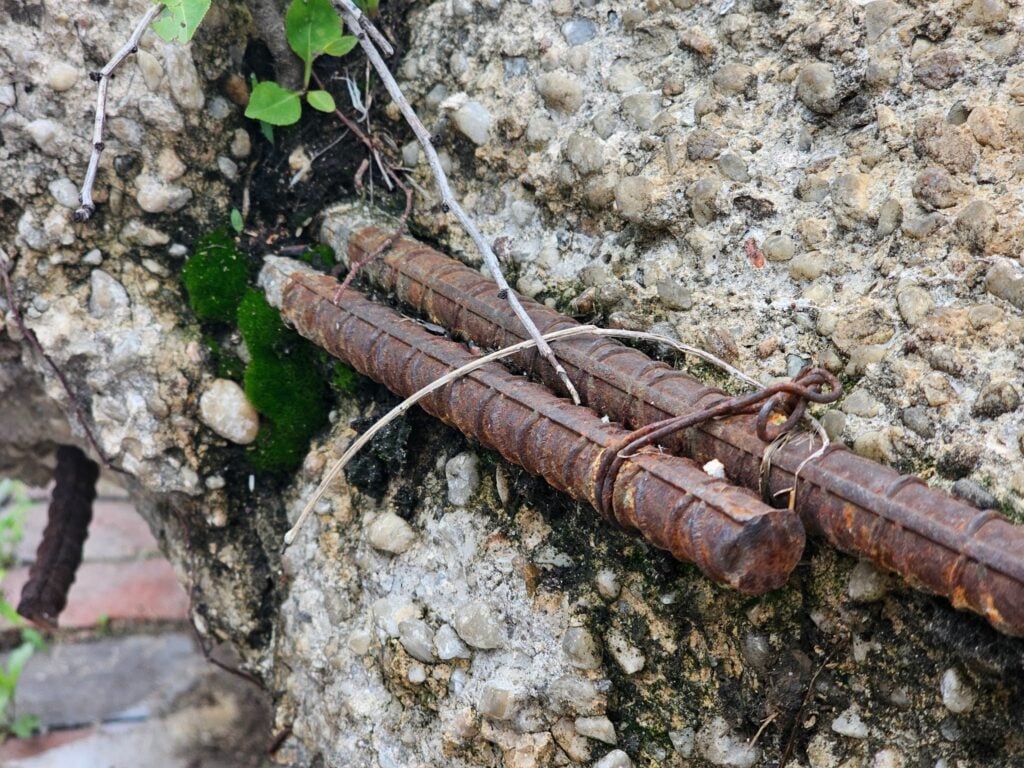
Here that same sort of spalling has happened to the concrete. This is an example of a lack of tensile resistance. The amount of initial hydration is really important when mixing both mortar and concrete. It’s kind of hard to accidentally mix mortar incorrectly. If you over-hydrate brick mortar when you’re initially mixing it, it will be very difficult to set the bricks.
If you’re trying to set bricks with mortar that’s over-hydrated, the mortar will be too soupy and the brick will not stay in the set position. Essentially when you tap down on that brick it’ll just smush the overly-hydrated mortar out from under it. Excessively over-hydrated mortar will just run out. The same condition applies to repointing. Even though repointing is different from brick laying, the principles are very similar at the core fundamentals of masonry construction.
If you mix the mortar with too much water when you are repointing, the mortar will not sit up in its vertical position. You essentially place the mortar into the joints with a pointing trowel. It’s a lot different than the typical type of trowel you may expect a mason to use. In fact, typically when repointing historic masonry, we’ll use a typical brick trowel and a pointing trowel in combination. The pointing trowel is very skinny. Depending on the type of brick, it can be roughly a quarter of an inch. That’s much thinner than a typical Masonry trowel. In fact if you’re laying block the masonry trowel, by comparison, might be massive.
It’s not so easy to identify when concrete has been over-hydrated. People who are familiar with the process of mixing concrete know the difference, but there aren’t built-in automatic safeguards such as the inability to use something when mixed incorrectly, in the case of concrete. Concrete, instead, is generally set into a form and can be placed into that form whether it’s been mixed correctly or incorrectly. There’s nothing automatically embedded in the process that makes it fail before placement. Unlike brick masonry laying or historic brick repointing, where mortar gets placed bit by bit, concrete can be placed in large batches.
In this coming week’s blog, we’ll take a look at some of the physical mechanisms behind why over hydrated concrete fails at an accelerated rate.
Since our company, Dupont Tuckpointing and Masonry, specializes in masonry restoration, historic brick repointing, and tuckpointing services in the Washington D.C. area, we make it a point to study these types of issues. These buildings are uniquely historic, and their preservation requires skilled masons who are technically trained in the best practices and knowledge of proper restoration techniques.
We understand the significance of maintaining the architectural integrity of these historic structures, and our team of experienced professionals is dedicated to delivering exceptional craftsmanship. Whether you require masonry restoration, tuckpointing, or brick repointing services, we are here to help.
At Dupont Tuckpointing and Masonry, we take pride in our work and strive to ensure that every project is executed with the utmost care and attention to detail. We are committed to preserving the rich heritage of Washington D.C.’s built environment for generations to come.
If you have any questions or needs regarding masonry restoration, historic brick repointing, or tuckpointing services, please do not hesitate to reach out to us. We would be delighted to assist you and provide you with the expertise and quality workmanship that your historic property deserves.
You can call us at (202) 796-7644 or use the contact form on our website to send us an email: Contact Dupont Tuckpointing & Masonry