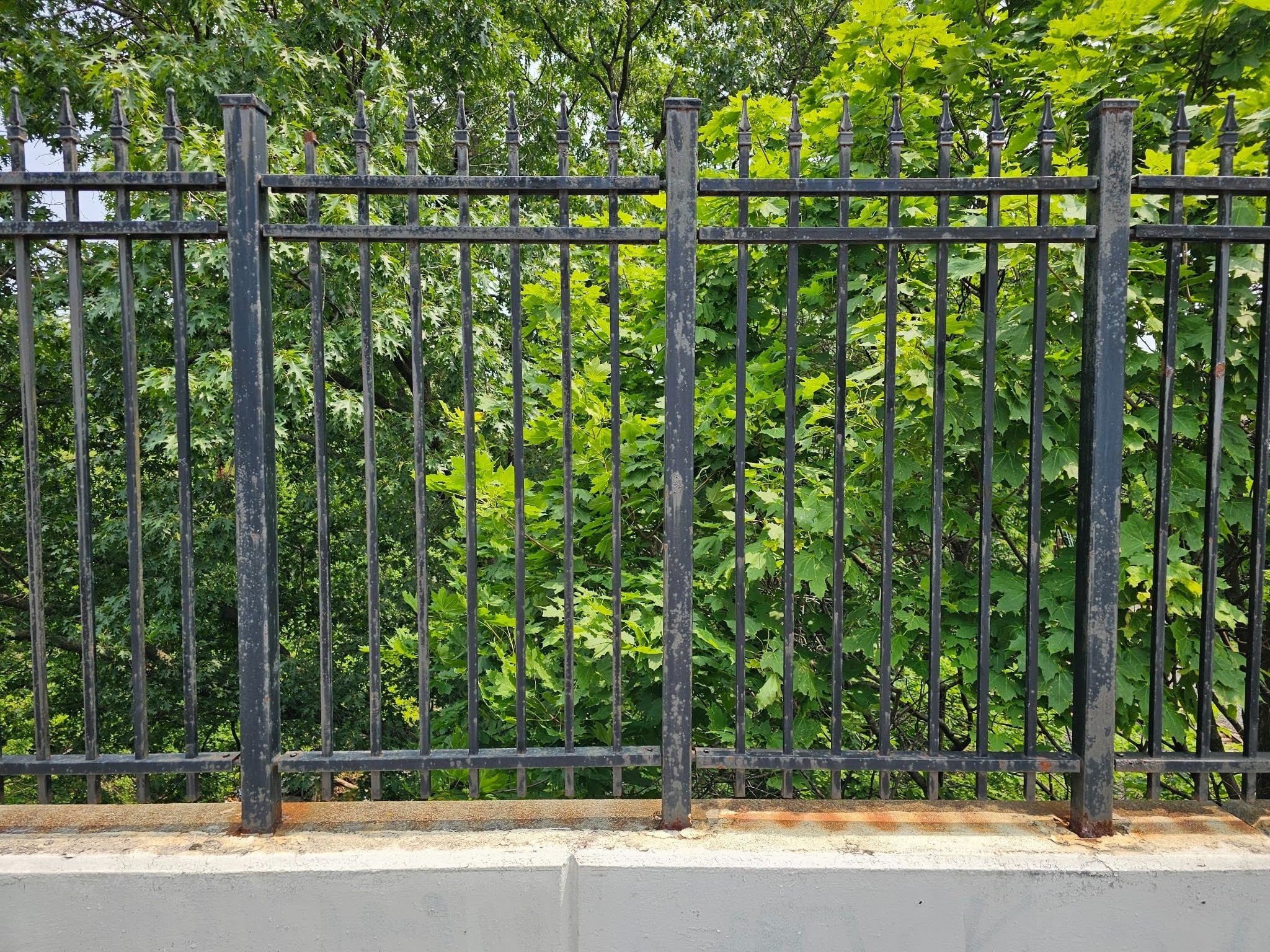
This past week, we talked about some really interesting structural concepts of fence posts and embedment into concrete. The similar concepts of structural resistance would apply if the fence was embedded into hardscaping soils or into a masonry substrate instead of a more continuous concrete substrate.
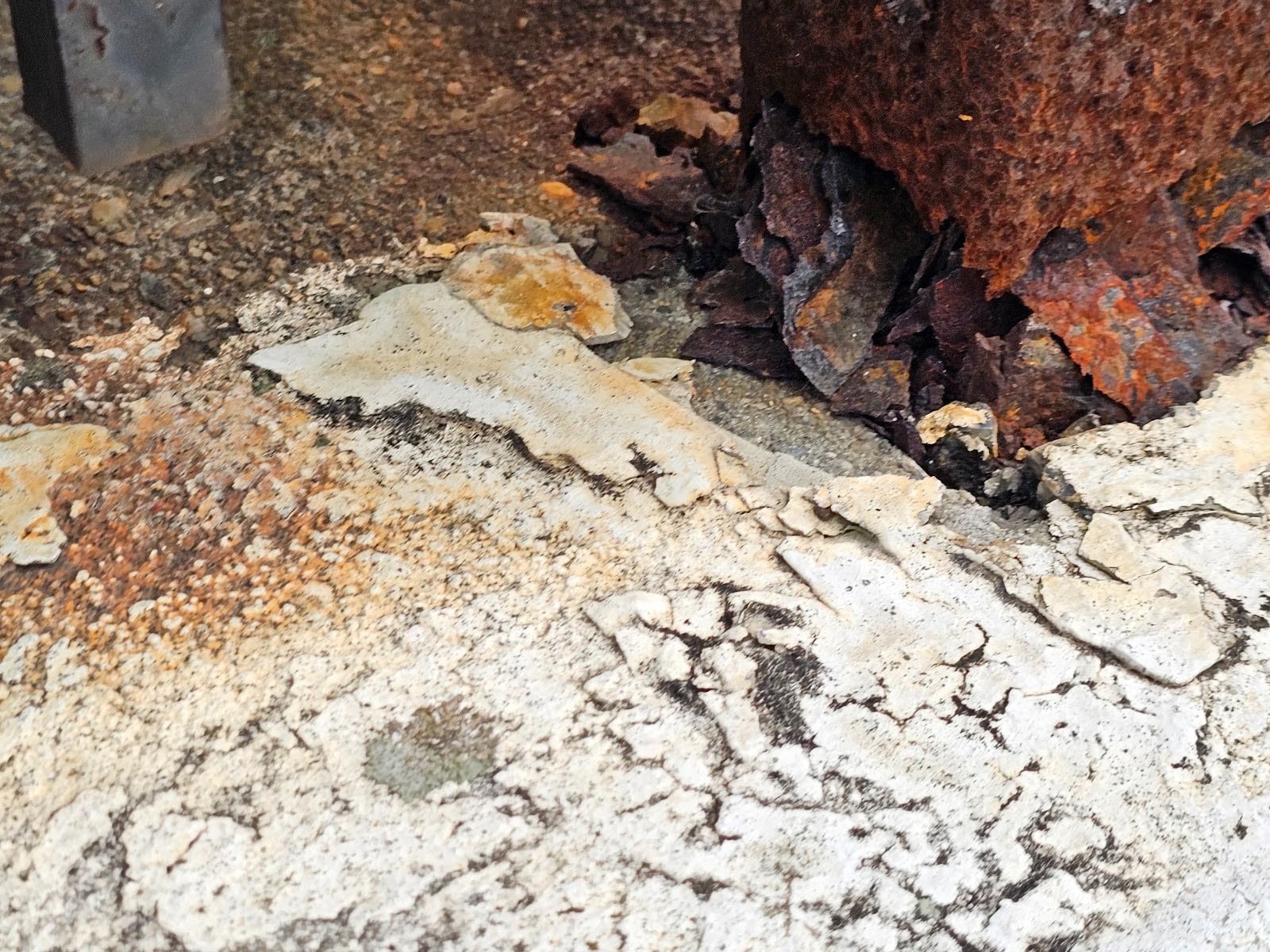
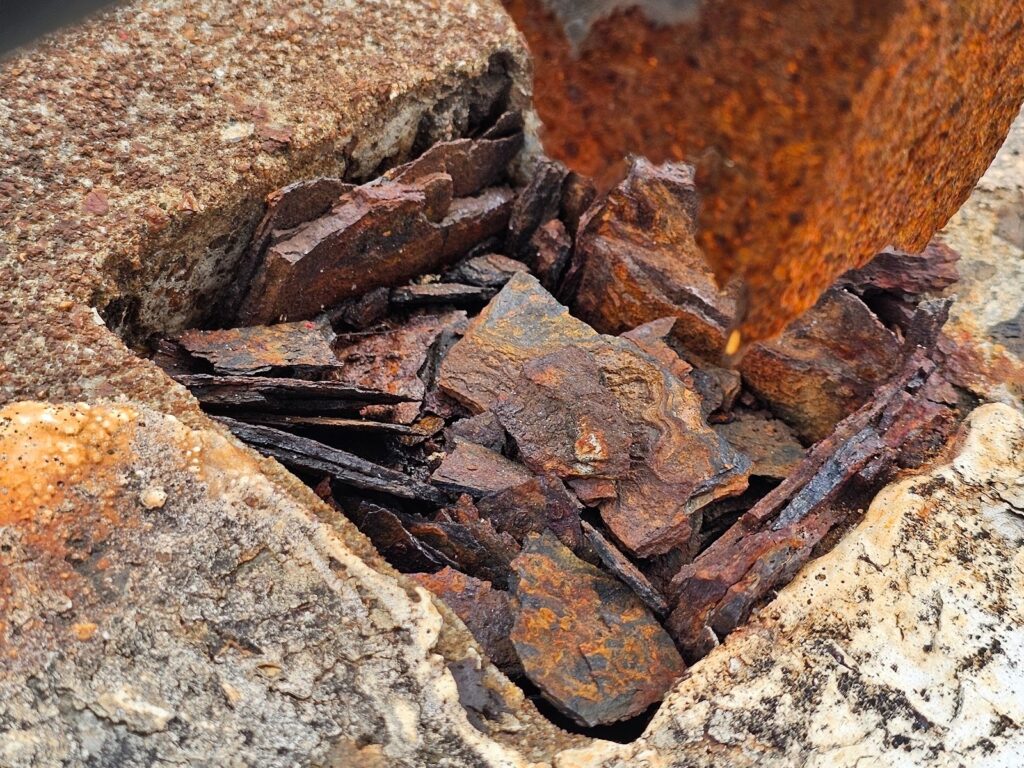
In addition to the details of structural embedment, there happens to be particular damage that has occurred through the life cycle of these posts. They have incurred significant rust and deterioration at the base of the posts. All types of masonry have at least some degree of permeability. Often, contractors or people mistakenly think of cementitious materials as being completely impermeable. That’s not correct though.
Even without specific permeation though, the base of the posts are exposed to higher amounts of hydration or moisture than the upper parts of the post. Water will naturally accumulate at the area at the ground, at the base of a post. By comparison the upper portion of the post, although it might get hit with some precipitation, will invariably dry out much faster.
Over the years, since the initial installation, the puddling up of water around the base of the post has led to rust and oxidation of the steel right at that connection point. It’s not that the upper portions would not also face the same types of deterioration, but the exposure to moisture is significantly reduced.
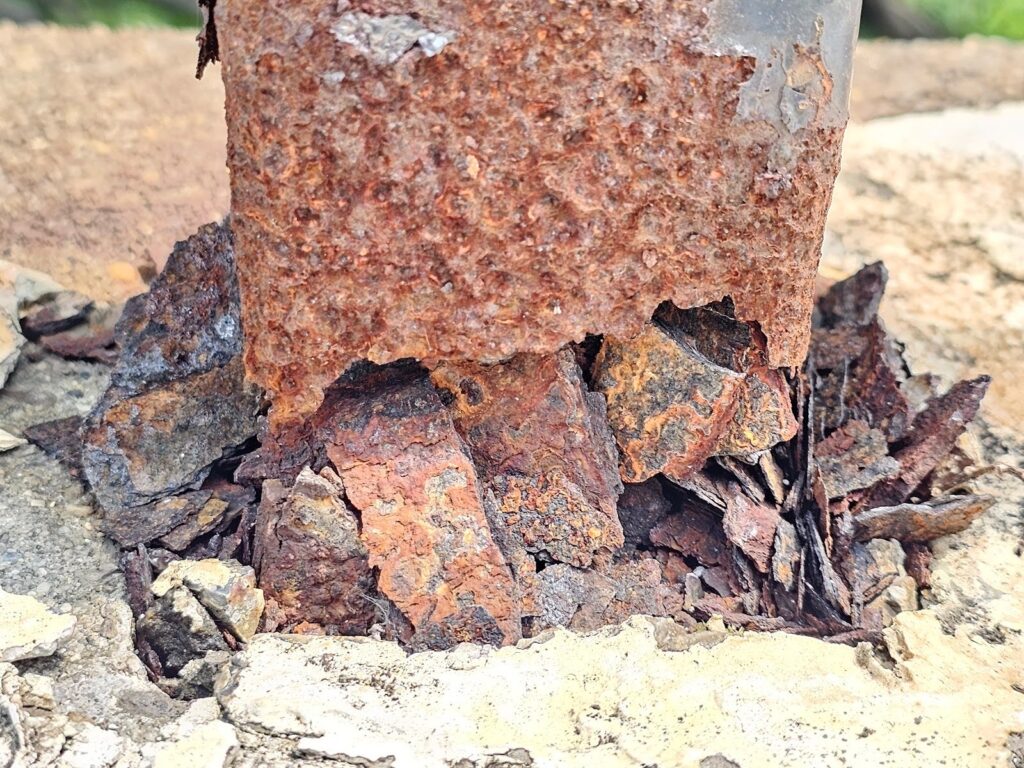
It might be obvious to most readers, but it’s probably important for us to mention that maintenance will greatly affect the longevity of a building detail like this. Where it is well maintained, it could last for multiples longer. In other words if a post like this without maintenance begins to rust through in just 10 to 15 years, with good maintenance it could easily last for 100 to 159 years before significant damage occurs.
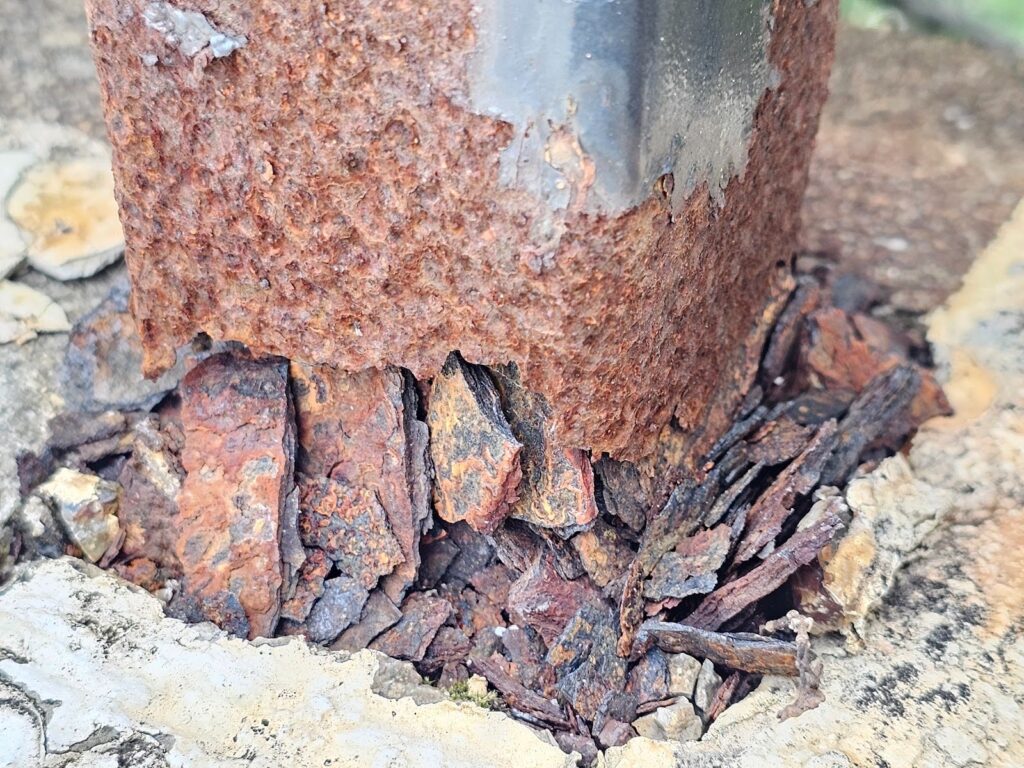
That’s a difference of 10 times as long. One of the interesting realities of long-term building maintenance is that building components, when well maintained, can last so long that they outlast the individual lifetimes of human beings. To build programs that have continuity across several lifetimes requires significant emphasis in the development of the building maintenance programs.
Buildings have to be very significant or at least cared for in a way that is very significant, for them to be able to have care programs that continue into the long-term future.
Here, we know though that this particular deterioration has occurred within just a few lifetimes, not over a century. We know that because the particular style of steel has only been available for way less than an entire century. The problems here come from a lack of care and upkeep. Those problems may have also been exacerbated by the use of ice melt salt. Ice melt salt is even worse than the regular salt that comes from the ocean.
The chemicals in the ice melt salt have a tendency to delaminate from substrate steel surfaces and cause the steel to oxidize and deteriorate. The deterioration leads to delamination of the paint coatings which leads to even more accelerated deterioration of the substrate metal.
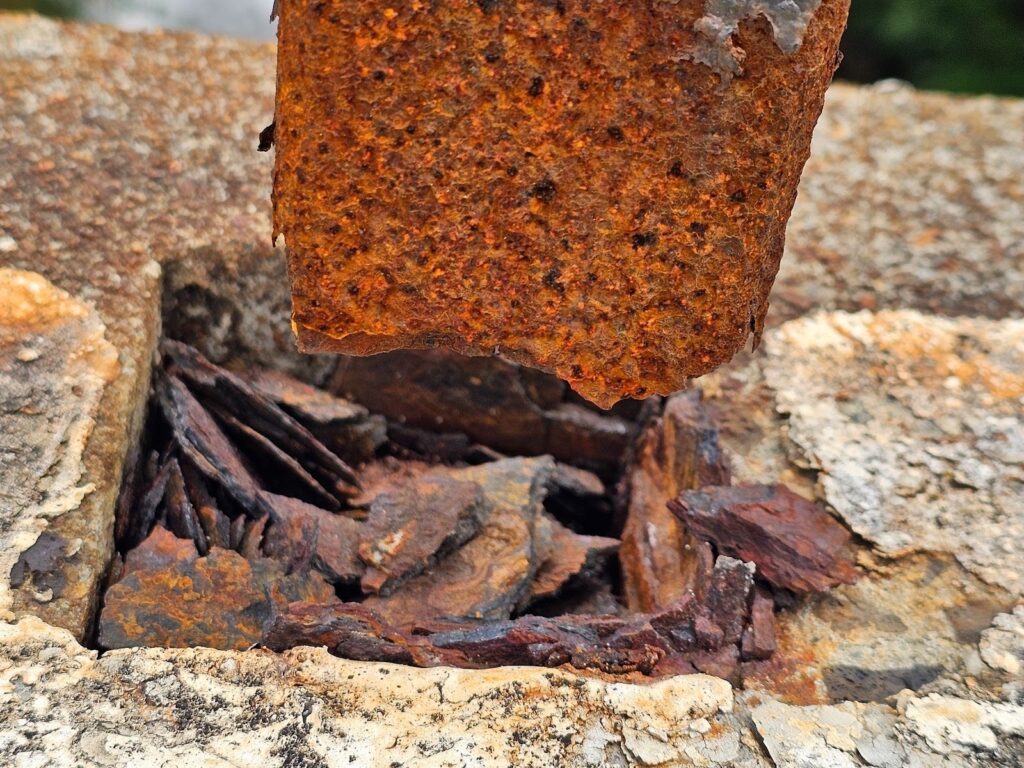
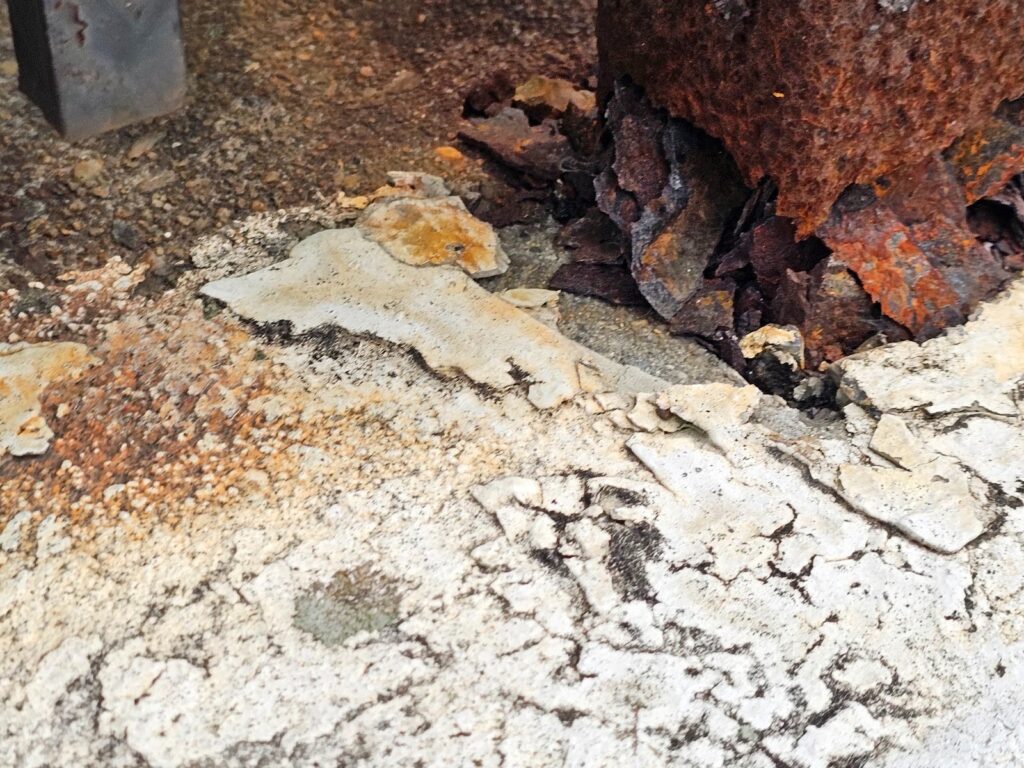
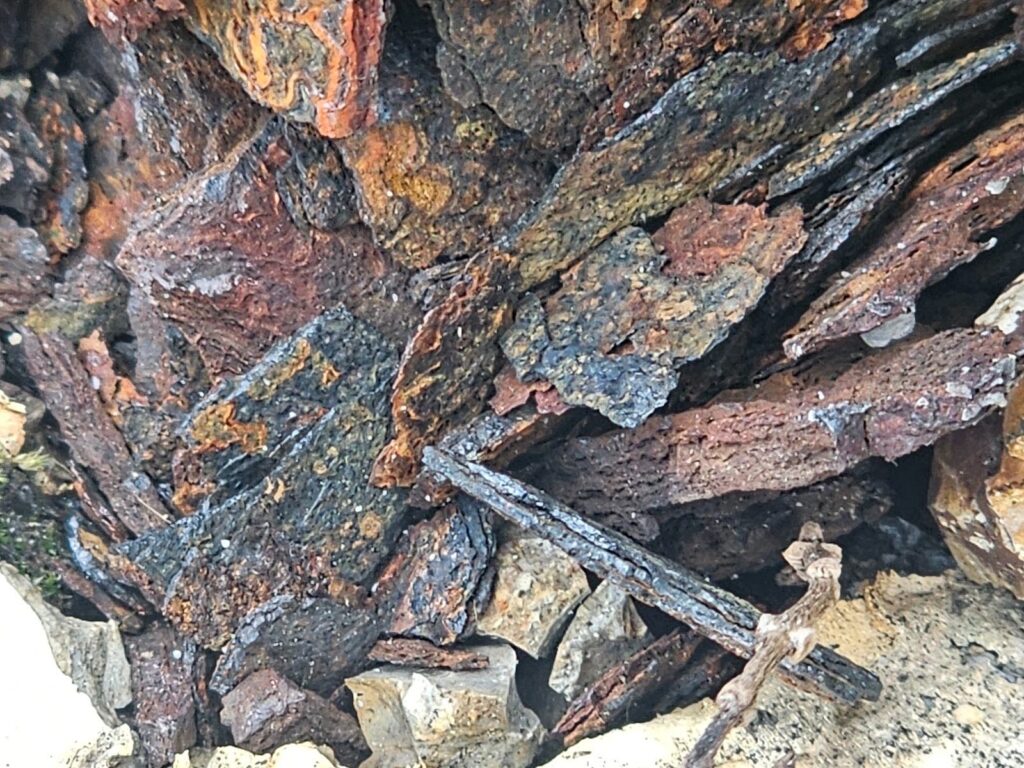
In the pictures above and below, you can see that the deteriorated steel metals have broken down into little chunks, almost like a crystalline structure. In addition to just repainting, the quality of the paint and coating materials are very important. Additionally, the joint at the embedment point of a post, into the concrete substrate, could also be treated with an application of elastomeric sealant. Well-applied elastomeric sealants, particularly when the surface preparation is done well through thorough both physical cleaning and applications of chemical cleaners, can help create a seal.
The nature of the sealant is important. If it’s able to resist movement, through intrinsic qualities of flexibility, it can work much better. If the coatings are hard and rigid, they will break in at least hairline fractures, even right at the first instance of slight vibration or movement.
Since our company, Dupont Tuckpointing and Masonry, specializes in masonry restoration, historic brick repointing, and tuckpointing services in the Washington D.C. area, we make it a point to study these types of issues. These buildings are uniquely historic, and their preservation requires skilled masons who are technically trained in the best practices and knowledge of proper restoration techniques.
We understand the significance of maintaining the architectural integrity of these historic structures, and our team of experienced professionals is dedicated to delivering exceptional craftsmanship. Whether you require masonry restoration, tuckpointing, or brick repointing services, we are here to help.
At Dupont Tuckpointing and Masonry, we take pride in our work and strive to ensure that every project is executed with the utmost care and attention to detail. We are committed to preserving the rich heritage of Washington D.C.’s built environment for generations to come.
If you have any questions or needs regarding masonry restoration, historic brick repointing, or tuckpointing services, please do not hesitate to reach out to us. We would be delighted to assist you and provide you with the expertise and quality workmanship that your historic property deserves.
Have questions about masonry restoration, tuckpointing, or historic brick repointing? Contact Dupont Tuckpointing and Masonry at (202) 796-7644, or send us a message through our convenient online contact form.