Areaway Drain Design Problems in Washington DC
Each building generally has a drain or two at the exterior areaways. Drains like this are common at the exterior floor and paving areas around DC buildings. Particularly where the entrances, or suppressed doors and windows, into these buildings are set below grade, there isn’t necessarily a way for the water to flow away by gravity alone without a drain set into the paving.
In the picture below, you can see an example of an areaway drain that’s at a landing outside of the door that allows for an entrance into the building. That door goes to a ground level hallway. From there, you can see several of the basement units. This particular building was originally a row home setup for a single family. In more recent years, like many of the buildings here in the historic parts of Washington, DC, the house was joined with the adjacent buildings and converted into a multi-unit condo building.
These types of conversions are all a bit unique but are so common here in Washington DC. There are many similarities between this building and so many other similar conversion flips. We find that these converted condo buildings often share many of the same challenges and defects.
It’s common for developers to try to build a bit of outdoor space at each of the new units. Originally, not all of the rooms and levels of the home had access to the exterior. In many cases, balconies will be added to mid-level floors at the front and rear of the building where there were no balconies before. In some cases those balconies will be installed on top of interior spaces, and those types of modifications are generally fraught with problems from the modern conversion.
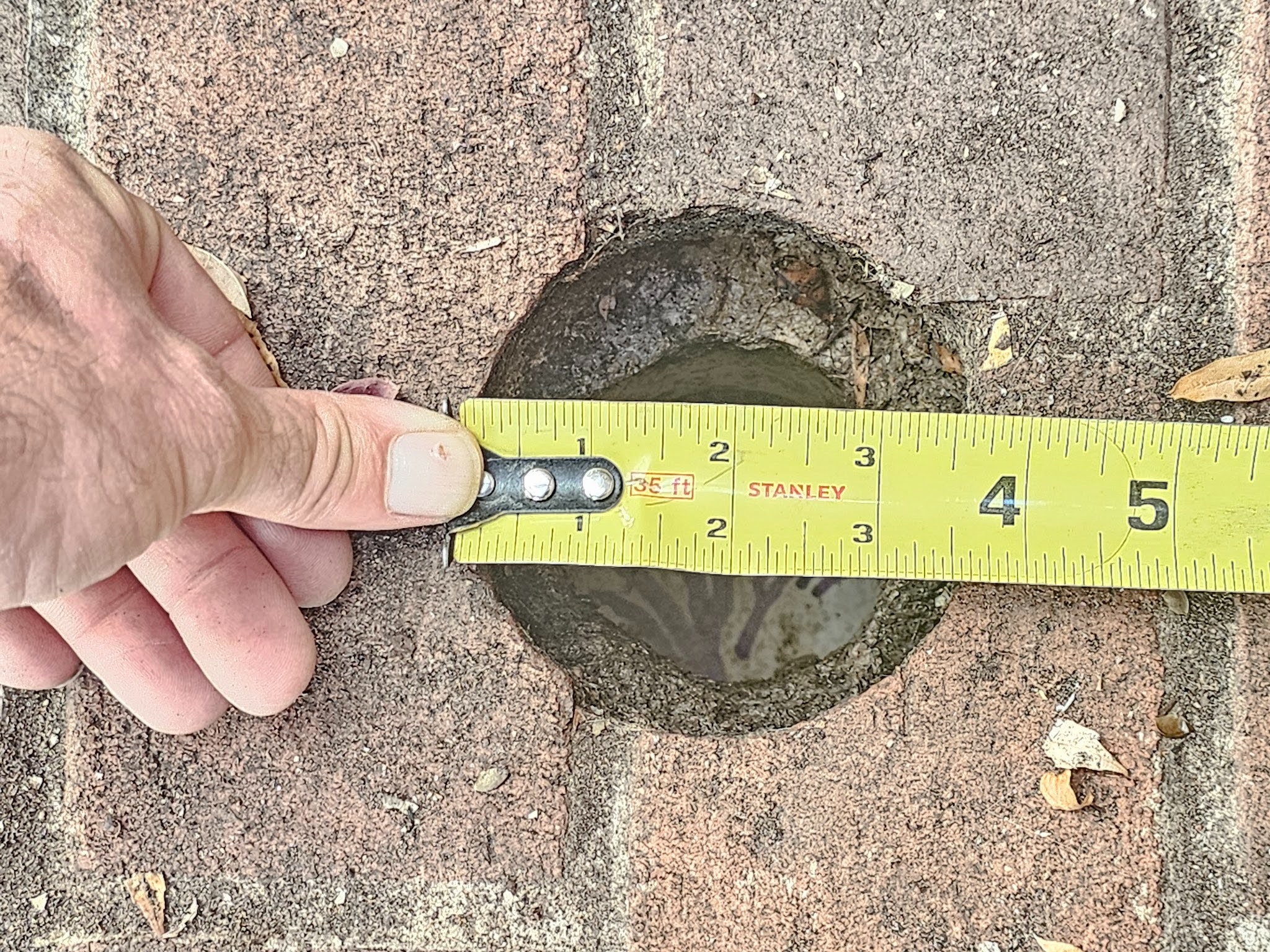
One of the big problems with the particular drain installation, shown in the picture below, is that it is too small for the size of the overall area. The drain is only 4 inches in diameter and that size areaway drain is just a bit bigger than the typical shower drain. It just can’t keep up with the flow of rainwater. In this particular case, the outdoor space that drains to this particular low spot happens to be a few hundred square feet. A typical shower is generally about 24 square feet, more or less.
In some cases showers can be as small as 6 SF and in other cases they can be as big as 30 SF. Around 20 to 24 SF is a reasonable average. When you compare 24 ft to 200 SF, the amount of water collected is significantly different. Also, it’s not really fair to compare the amount of water in a shower, to the amount of water in an exterior patio or entrance. Rainwater can be much, much heavier. And in this particular case, the water that runs this drain not only comes from the surrounding patio area, but it also comes down the stairway. That entire stairway surface is essentially feeding water towards this drain.
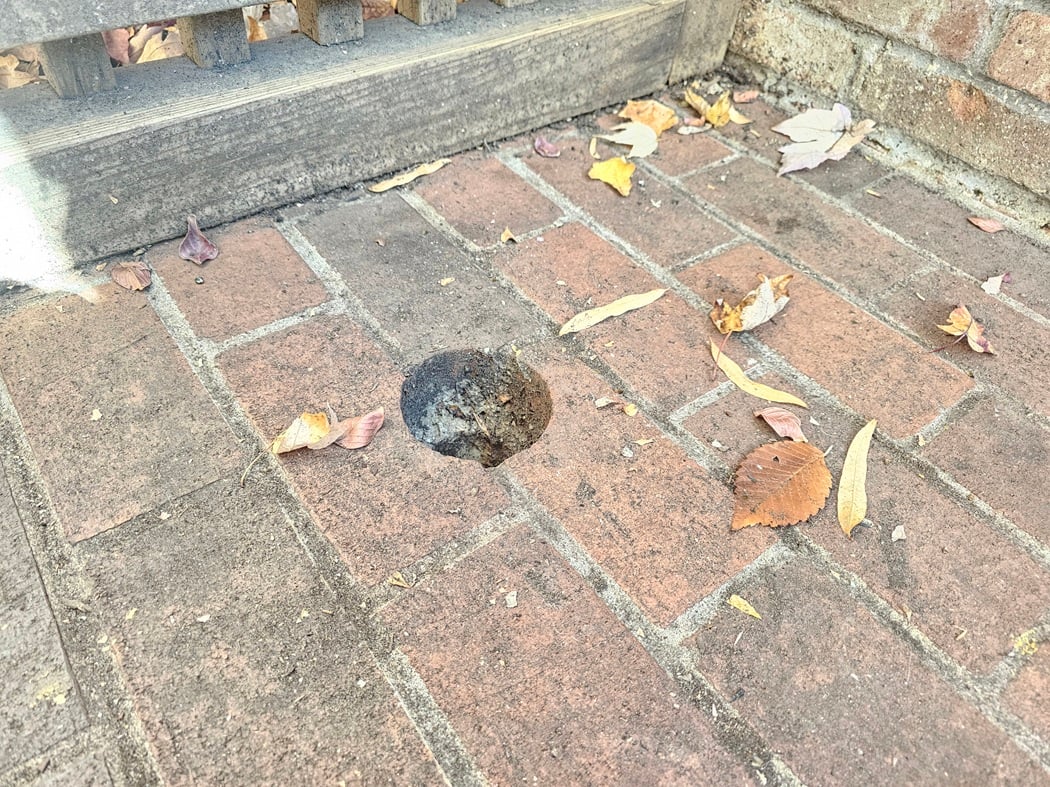
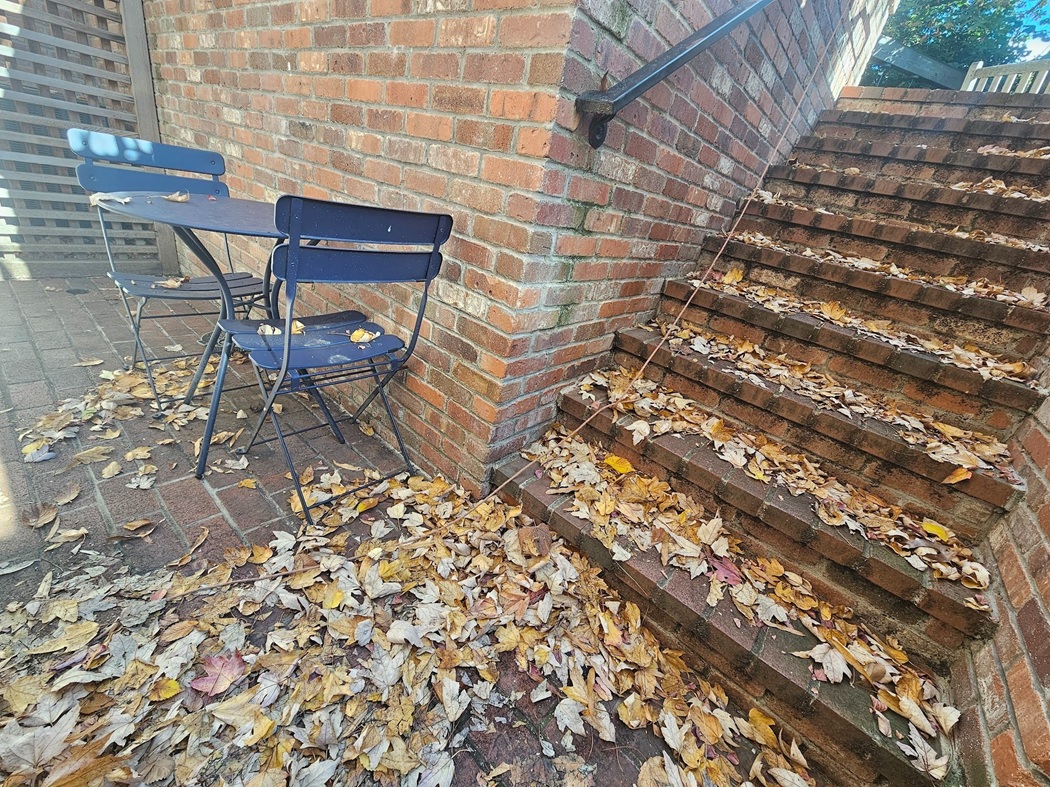
In the picture below, you can see the wide stairway that leads to this particular paved entrance area. Generally, when an entrance area is suppressed and below grade, there’s a stairway that allows access and egress to that area. Here, like many configurations, the stairway allows water to be captured and then directed towards the drain. That’s particularly problematic, not just for the purpose of accommodating the capacity of heavy rainfall, but also because all of the leaves that you can see in the picture below will also be carried towards that drain.
Small drains can be easily clogged. Generally, we recommend the installation of a linear slot drain. It’s a bit harder for linear slot drains to become covered and clogged by leaves and typical tree debris. Both the shape and the larger area can be helpful to avoid clogs.
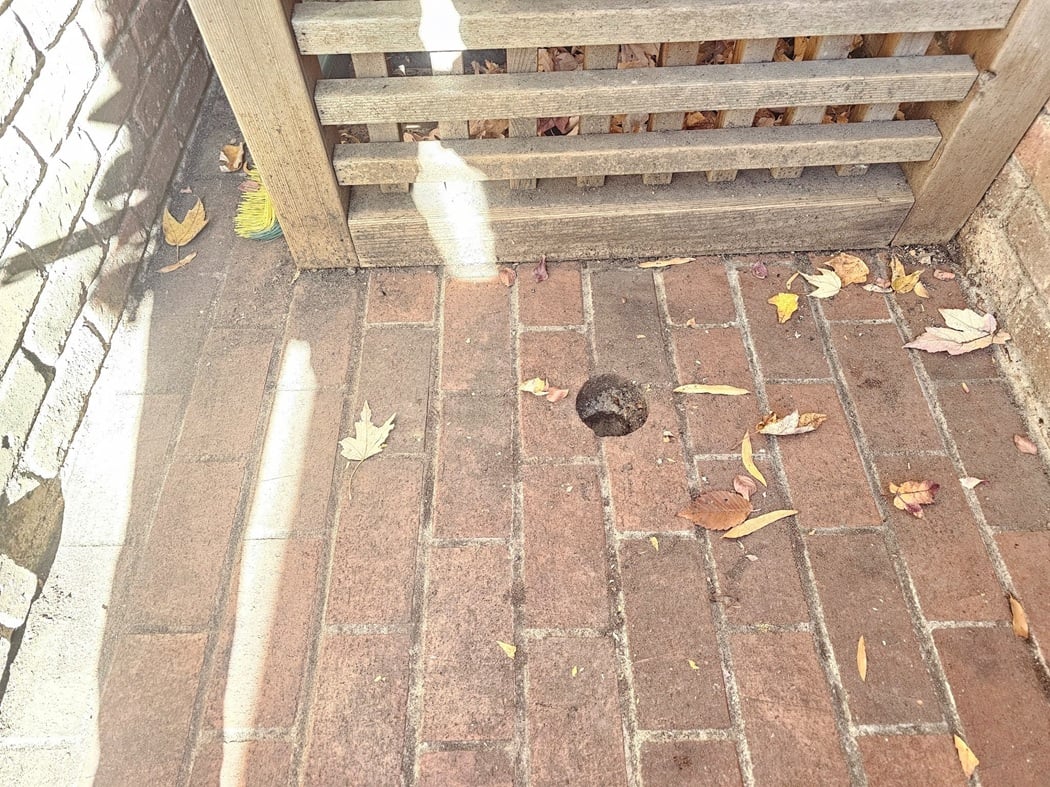
Another one of the big problems with this drain is that it doesn’t have a grate. They removed the grate, in this case because it was clogging too easily but without the grate it just lets the leaves go down into the underground drain piping. There is a trap underneath that drain orifice which has a relatively sharp bend because it makes a 180° turn around so that water can stay intentionally trapped. That bend is relatively difficult for large debris like twigs and leaves to pass through. It ends up being a blockage point.
In almost all cases though it’s better for blockages to occur at the trap itself then for those large debris materials to pass farther into the drain.
Beyond the trap the drain should run with a consistent grade of at least 1/8 of an inch per linear foot, depending on the applicable code. When a long run of a pipe has a relatively low slope, it leads to clogs and blockages that are more difficult to fix. In a few spots throughout the installation there should be clean-outs, but even when following the requirements of the building code those cleanouts don’t always make it easy enough to remove those blockages. Particularly where blockages are occurring with high frequency, and cases like this where there are design defects, it will be problematic.
Since our company, Dupont Tuckpointing and Masonry, specializes in masonry restoration, historic brick repointing, and tuckpointing services in the Washington D.C. area, we make it a point to study these types of issues. These buildings are uniquely historic, and their preservation requires skilled masons who are technically trained in the best practices and knowledge of proper restoration techniques.
We understand the significance of maintaining the architectural integrity of these historic structures, and our team of experienced professionals is dedicated to delivering exceptional craftsmanship. Whether you require masonry restoration, tuckpointing, or brick repointing services, we are here to help.
At Dupont Tuckpointing and Masonry, we take pride in our work and strive to ensure that every project is executed with the utmost care and attention to detail. We are committed to preserving the rich heritage of Washington D.C.’s built environment for generations to come.
If you have any questions or needs regarding masonry restoration, historic brick repointing, or tuckpointing services, please do not hesitate to reach out to us. We would be delighted to assist you and provide you with the expertise and quality workmanship that your historic property deserves.
You can reach us by telephone at (202) 796-7644 and you can reach us by email from the contact form on our website.