Stunning Statuary Niches in Historic Masonry Walls in Washington, DC
This past week we took a look at examples of statuary niches in historic brick walls. The examples we looked at this past week are very common or typical in many different installations here in Washington DC. We’re going to look at some more today that are typical of a different style of masonry but includes statuary niches. Some of the ones we will look at today actually had a statue set inside of them. Others are empty today, like the ones we looked at last week.
This past week we also talked about the headers and skills that are part of these niches. From an architectural perspective, they’re very similar to some of the components you’d find in a typical window opening.
The one we looked at this past week had a triangular type pediment. The one in the picture below is similar but different because it has a roman arch header instead of a pediment on top of the recess or opening. This roman arch header is semicircular. As a side note, headers like this are similar to segmented arches. Segmented arches are very common here in Washington DC, but the distinction or differences is that the Roman Arch is an entire half circle or more. The segmented arch is of greater radius, meaning it is less tall in relationship to the header span. The particular statue below depicts Charlemagne in the style of a classical deity.
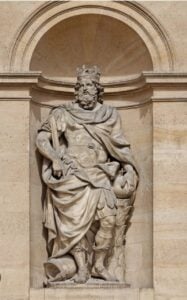
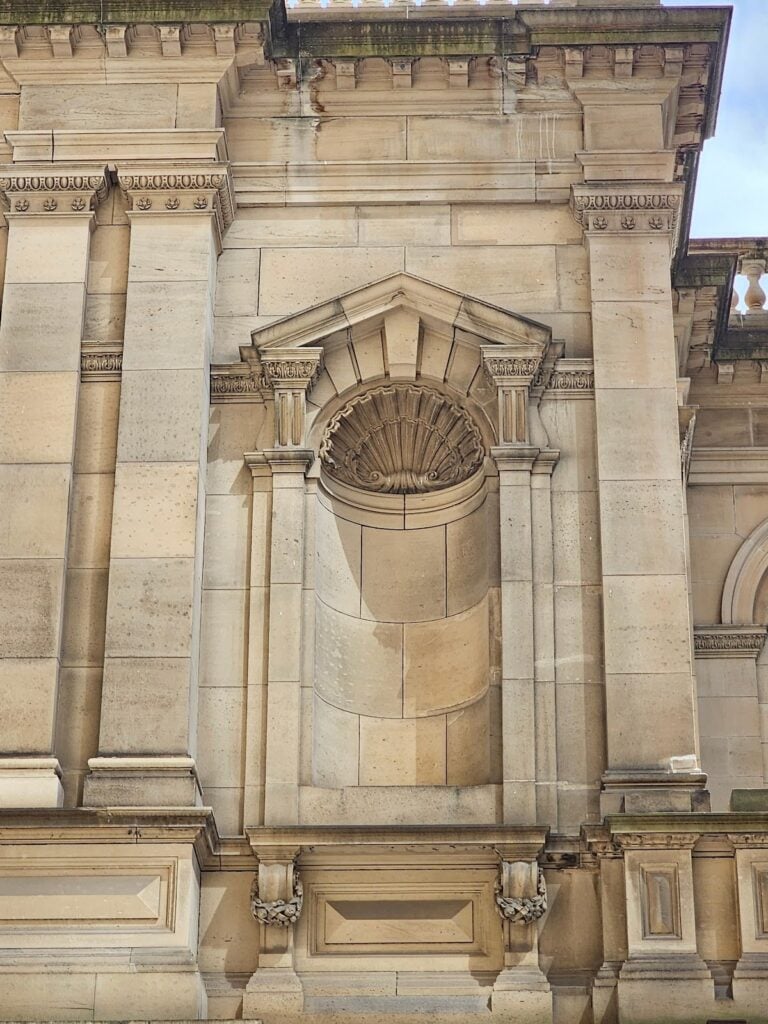
The word niche is derived originally from a latin word nidus which means nest, but possibly then through to the Italian word niccio which means sea shell, as in some cases the traditional concave tops of these niches are scalloped like a seashell. You can see a perfect example of a scalloped head at the top of the niche shown in the next photo below.
This particular header is also built almost in a triangular shape, like a timpanium, but more like a pediment with corbels at each of the two sides of the header. Underneath the triangular pediment there is a prominent center stone, similar to a keystone, in the segmented arch. Below that, there is a scalloped header which may be an example similar to some of the original wall niches which hearken back to the original name etymology.
The statuary niche in the picture below uses these sets of corbels in both the header construction and at the sill. In contrast, the ones shown further below have a built up slab like a plinth used to elevate the statue instead.
The next niche shown below was used in the construction of the same wall, but here you can see the architectural style has changed slightly. In many cases, in historic buildings, where they were intended to have prominent facades, a collection of niches would be installed, spaced, in series. Even though the architects will include variations in the styles, this is a perfect example of a statuary niche in a masonry wall.
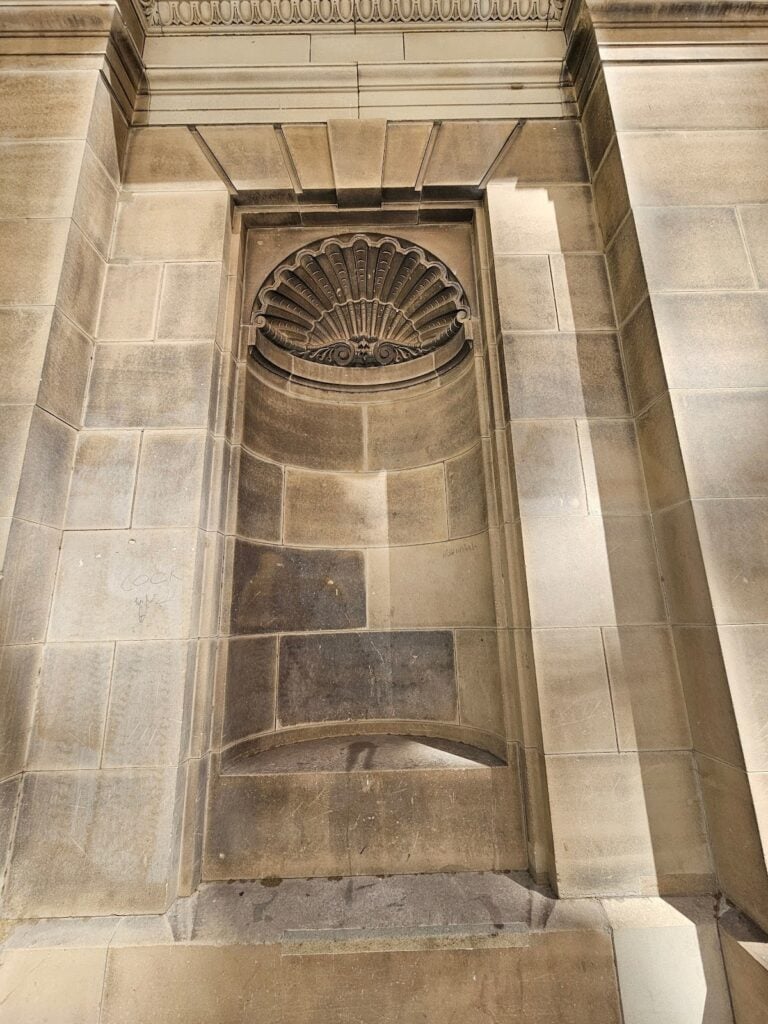
In some cases, to keep the consistent visual aesthetic of a series of niches, some may be built as blind niches which were never really intended to hold a statue. In fact many blind niches are created with similar looking architectural elements but work differently from a functional perspective because they’re originally too shallow to actually hold a statue.
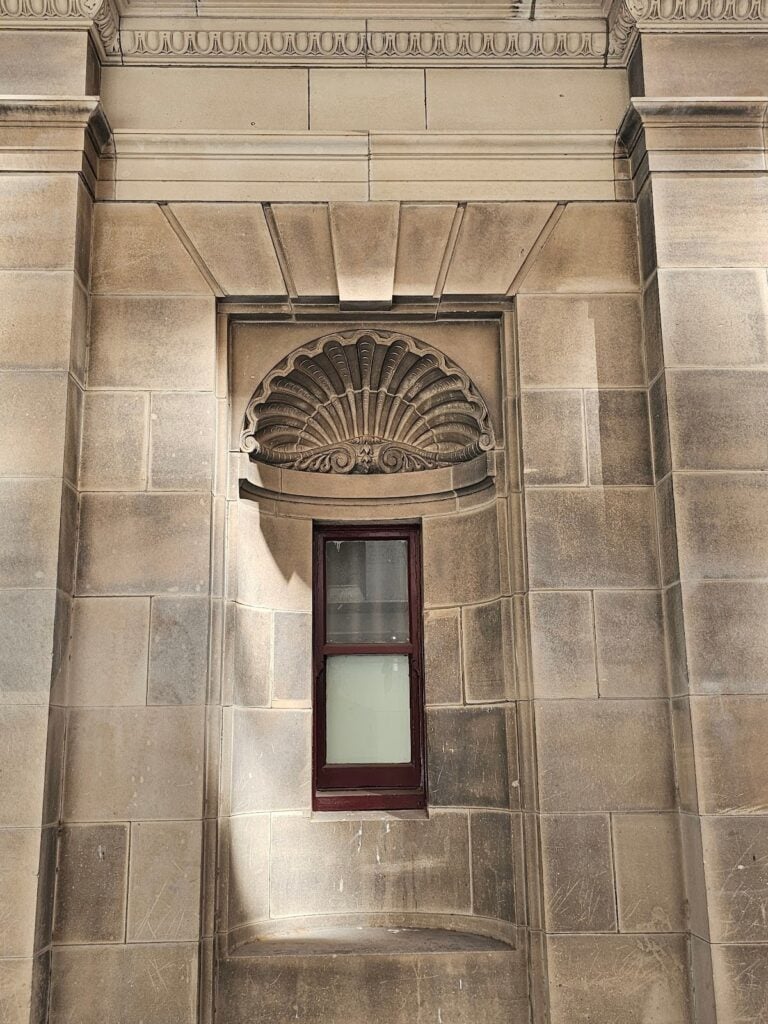
The statuary niche in the next photo below has a window that’s been cut into the center of the niche. It’s highly unlikely that this window is original to the initial construction of the building. It would be unlikely that the statuary niche was originally intended to have an opening for fenestration or a window.
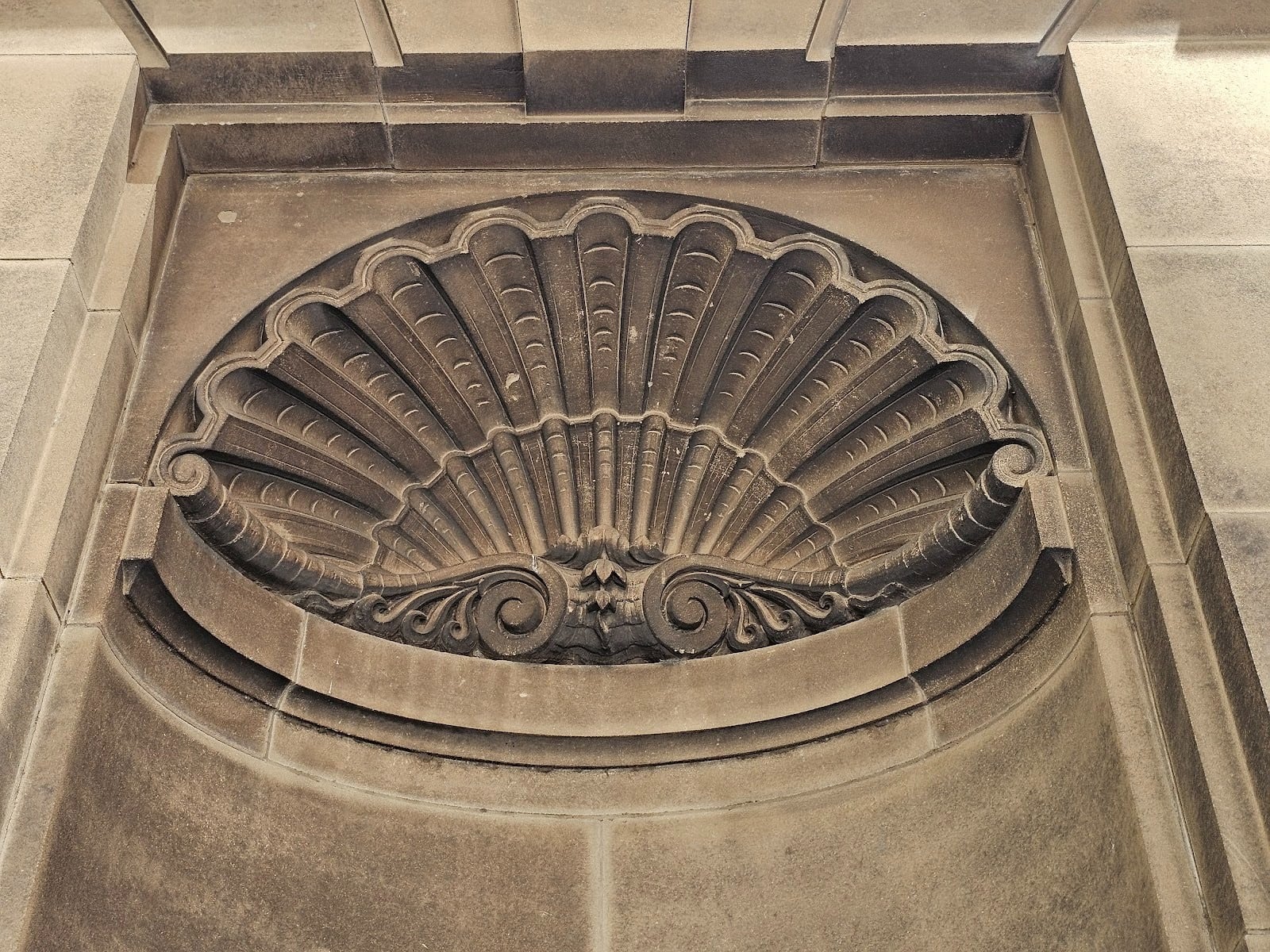
In this picture and the next picture below we’ll show a closer view of the underside of the scallop concave ceiling. The ceiling has this scalloped effect.
Here, you can see that they’ve mixed classical styles which is not uncommon in architecture. Sometimes one designer will borrow an interesting element from one time and place it together with another detail from a different time. This particular header happens to be from a style more commonly used around the 17th century. The building itself is newer.
Since our company, Dupont Tuckpointing and Masonry, specializes in masonry restoration, historic brick repointing, and tuckpointing services in the Washington D.C. area, we make it a point to study these types of issues. These buildings are uniquely historic, and their preservation requires skilled masons who are technically trained in the best practices and knowledge of proper restoration techniques.
We understand the significance of maintaining the architectural integrity of these historic structures, and our team of experienced professionals is dedicated to delivering exceptional craftsmanship. Whether you require masonry restoration, tuckpointing, or brick repointing services, we are here to help.
At Dupont Tuckpointing and Masonry, we take pride in our work and strive to ensure that every project is executed with the utmost care and attention to detail. We are committed to preserving the rich heritage of Washington D.C.’s built environment for generations to come.
If you have any questions or needs regarding masonry restoration, historic brick repointing, or tuckpointing services, please do not hesitate to reach out to us. We would be delighted to assist you and provide you with the expertise and quality workmanship that your historic property deserves.
You can reach us by telephone at (202) 796-7644 and you can reach us by email from the contact form on our website.