Leaking Scuppers and Masonry Damage in DC
This past week, we looked at a leaking scupper at a historic masonry facade. This particular facade is built with brick in a Flemish Bond type pattern or configuration. There has been some rework and masonry restoration here, over the years. However, one of the main factors of accelerated deterioration is this particular leak which seems to have remained unfixed for an extended period of time. We highly recommend that building owners either keep a close eye on their historic masonry facade for issues like this, or have a professional like ourselves check conditions.
If it’s difficult to DIY manage the care of a building, it’s easy just to talk to a contractor such as ourselves who takes care and pride in doing this kind of restorative upkeep and maintenance. Its just important to try to differentiate between people who care and study the techniques and history versus people who don’t.
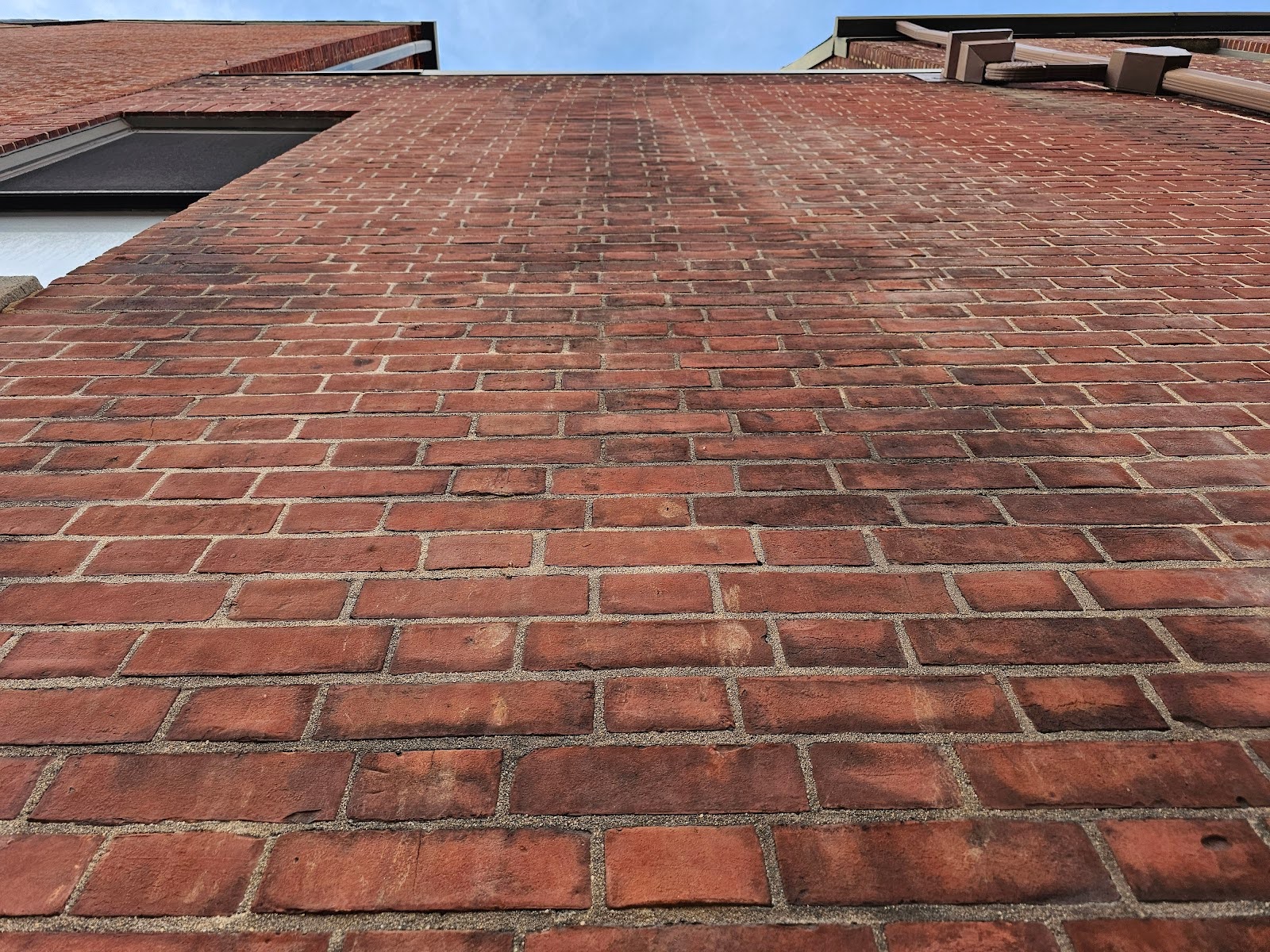
The picture below shows one of the water trails that just runs down the side of the building. You can see there’s a water trail that comes from the parapet coping and then another one further to the right that comes from the scupper. These trails are stains from repeated and concentrated flows of water down the main street facing front wall. Many details of the building are specifically incorporated into the design to avoid concentrated trails of water running down the brick facade.
In the past, here on our website and blog, we’ve looked at several examples of intentional architectural elements that may appear, on the surface, to just be part of the aesthetic. In many cases though, those architectural details provide a slight projection in the vertical face of the facade. The projection of these details allows water to essentially be collected or deterred at a ledge point and then channeled, to drip away from the front facade.
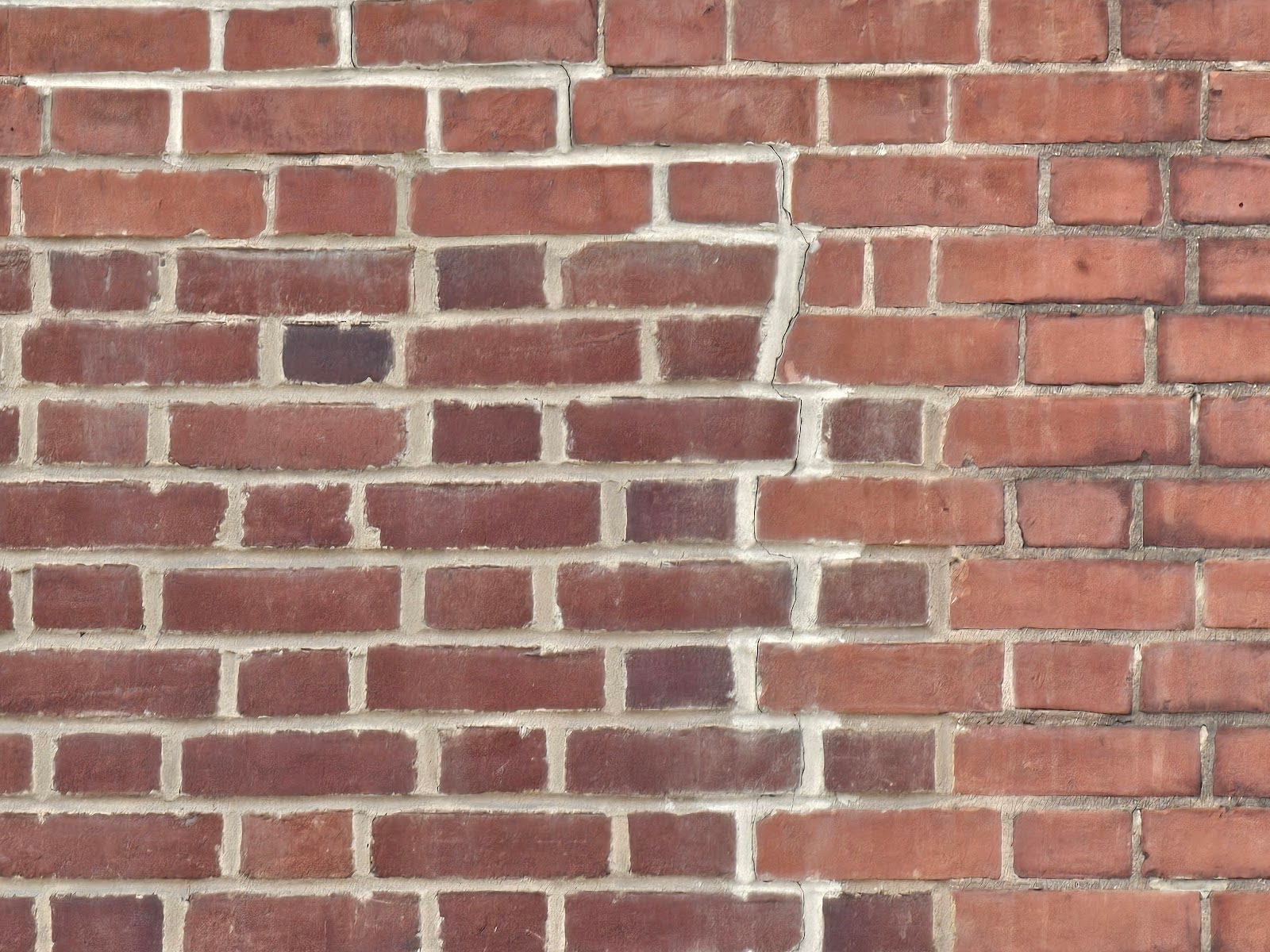
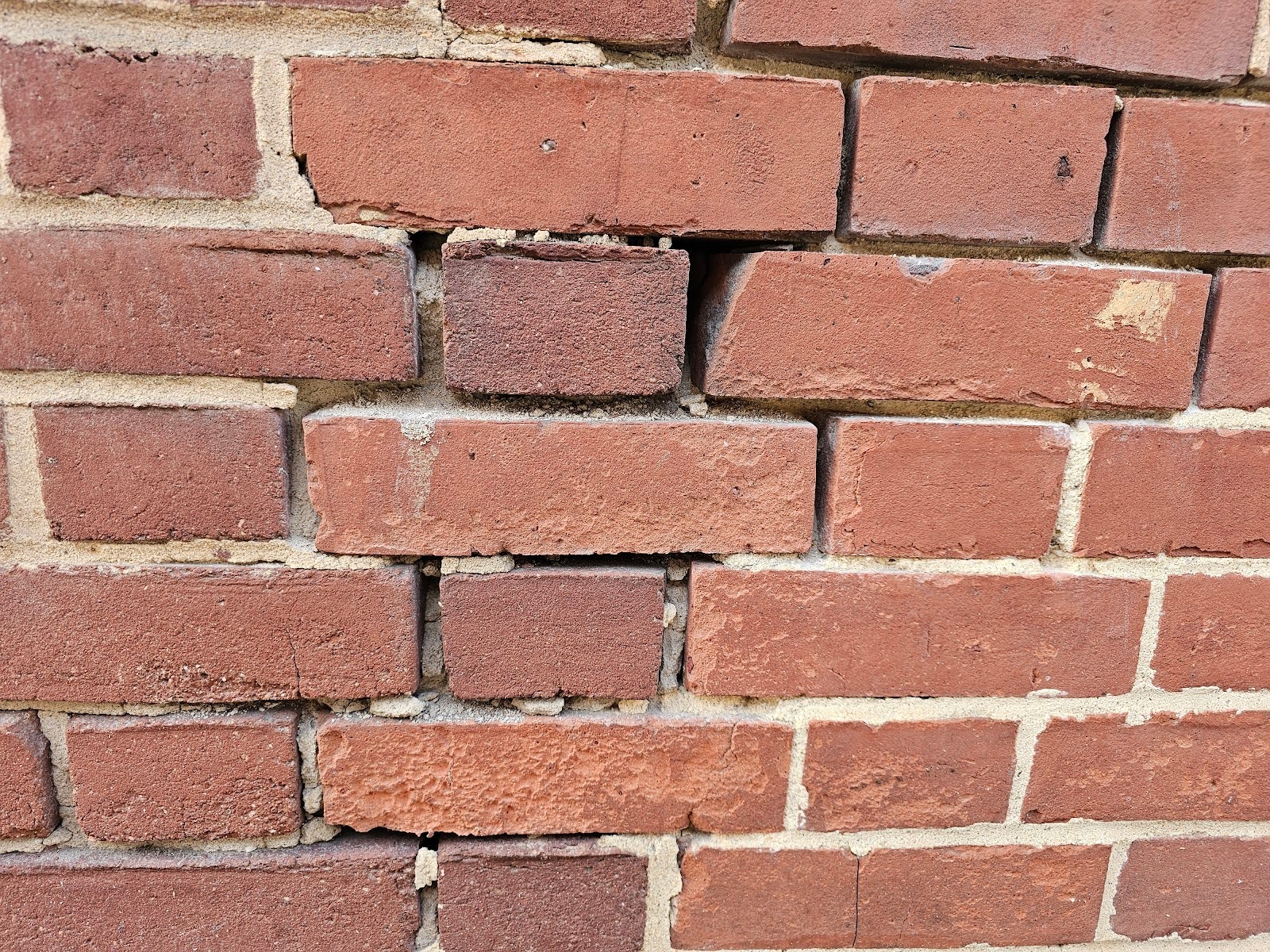
Many different partial approaches of restoration have been done at this facade. These repairs have been done at different times and to different extents, in the building’s history. There’s a patchwork of conditions. Here, where there are deep recesses in the mortar joints of the brickwork as you can see in the picture below, there are spots of danger. At these areas, water can enter, very easily, very deeply.
As that water enters into these cavities and openings at the brick facade, the water only dissipates and/or evaporates from those areas very slowly. For the entirety of the time that the water sits in that area, it causes dissolution and deterioration of the masonry and mortar subcomponents. Essentially, the water that is applied to that today stays for a very long time and causes damage all the while.
Above, we mentioned that this particular facade is built with a Flemish bond. A Flemish bond is normally designed or made for a double wythe brick partition. A Flemish Bond can also be used in a triple wythe configuration, but that bond and thickness is more often in a different shape brick. Bricks that are best fitting for Flemish Bonds in a triple wythe configuration are generally thinner and longer. The bricks that are most common here, in the USA, from the time around the later portion of the 19th century and the early 20th century are generally very similar to the most common shape today. The historic bricks are slightly different though.
They’re generally slightly larger than modern bricks. Modern bricks are roughly 3.5 inches deep by 2.25 inches tall and 7.58 inches wide, in a stretcher position.
The picture below shows the damage of wear and deterioration from excessive hydration, over years of exposure. You can see where the repointing has happened on the sides of this main area, but the center has deteriorated. In this coming week’s blog article, we’re going to talk about the benefit of the modular sizes of bricks compared to the historic bricks that were used throughout most of the historic parts of DC.
Since our company, Dupont Tuckpointing and Masonry, specializes in masonry restoration, historic brick repointing, and tuckpointing services in the Washington D.C. area, we make it a point to study these types of issues. These buildings are uniquely historic, and their preservation requires skilled masons who are technically trained in the best practices and knowledge of proper restoration techniques.
We understand the significance of maintaining the architectural integrity of these historic structures, and our team of experienced professionals is dedicated to delivering exceptional craftsmanship. Whether you require masonry restoration, tuckpointing, or brick repointing services, we are here to help.
At Dupont Tuckpointing and Masonry, we take pride in our work and strive to ensure that every project is executed with the utmost care and attention to detail. We are committed to preserving the rich heritage of Washington D.C.’s built environment for generations to come.
If you have any questions or needs regarding masonry restoration, historic brick repointing, or tuckpointing services, please do not hesitate to reach out to us. We would be delighted to assist you and provide you with the expertise and quality workmanship that your historic property deserves.
You can reach us by telephone at (202) 796-7644 and you can reach us by email from the contact form on our website at https://duponttuckpointingmasonrydc.com/contact-us/