Leaking Scuppers and Masonry Damage in DC – Part I
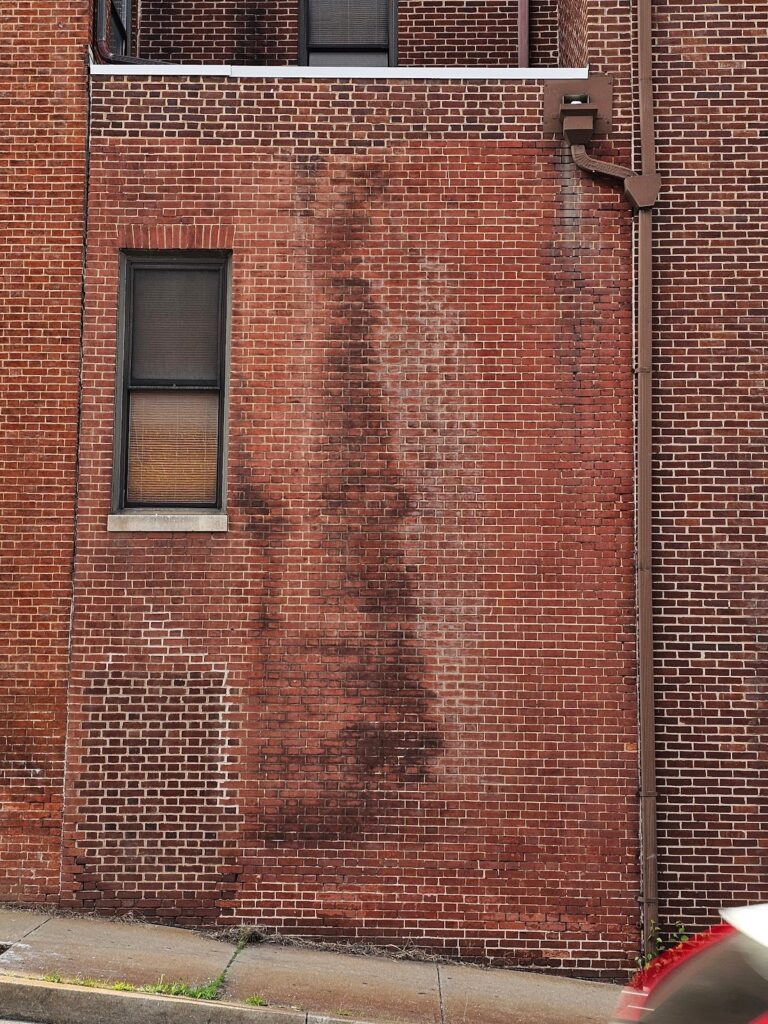
A while back, we looked at a few examples of historic masonry facades with leakage and the associated water trails. Today, we are looking at another historic brick facade with water trails left staining the masonry face of the building. These particular water trails, and many of the other ones that we’ve seen, are telling. They are not just signs of a single instance of water pathways. Instead, they are deposits and sediments of water left behind after many repeated cycles of water running down the face of the building.
Just to be clear, we want to explain that just because there are water trails on the facade of a building, it doesn’t necessarily mean there is leakage. Instead there can be water from rain that is misdirected and not being properly channeled and flowing away from the building. It doesn’t necessarily mean that the water is running into the building itself. In almost all cases of water trails like this though, it does accelerate deterioration at the areas that are being specifically over-hydrated.
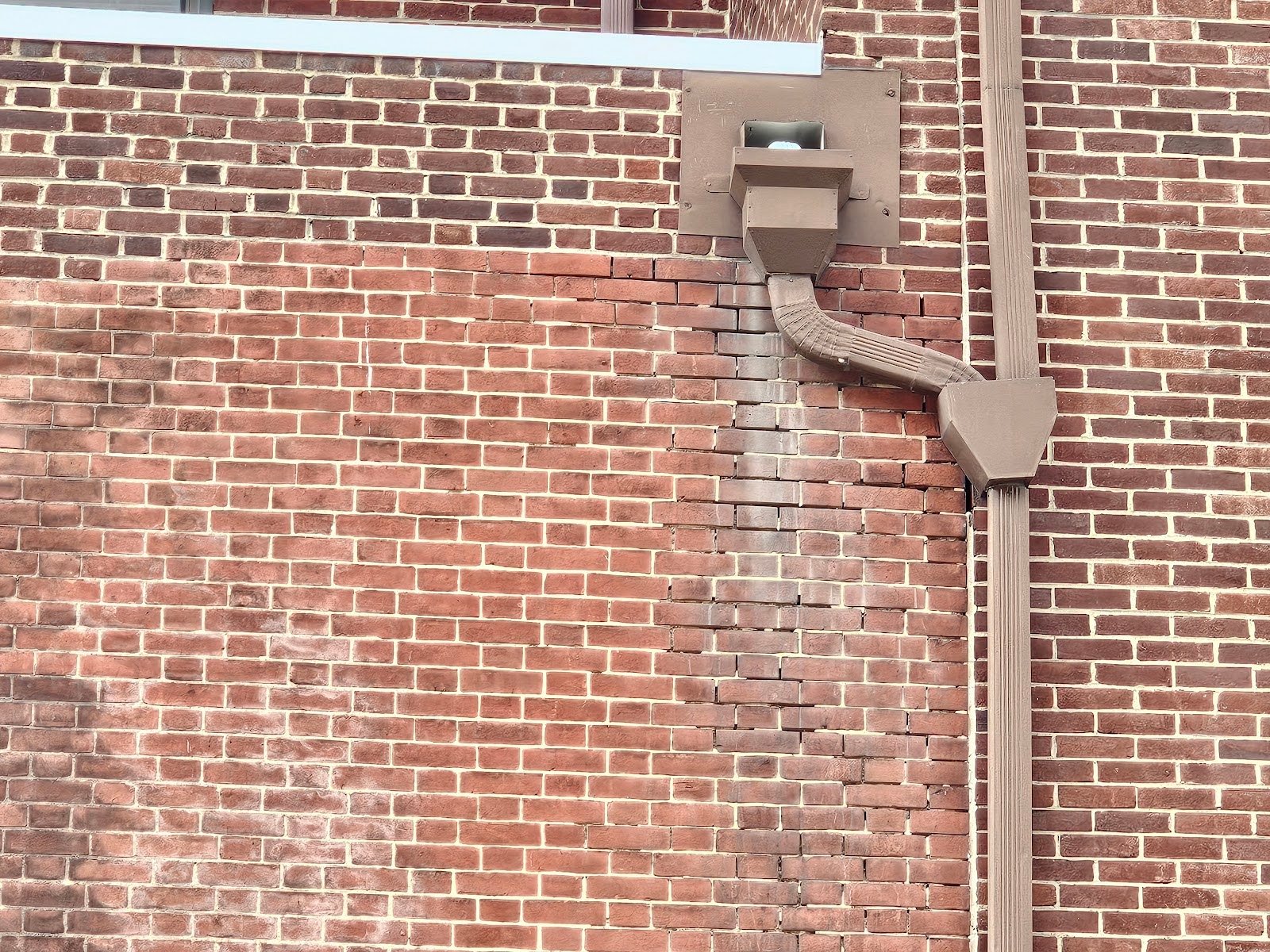
In this specific case, the water that is running down this building is related to both a coping that is misdirecting the water down the facade without a fully intact drip edge and from a leaking scupper collection box.
Scuppers are interesting because we don’t see them used in many different parts of construction, it’s mostly something that’s specific to flat roof construction. They occur more often in odd configuration buildings. Typical Washington DC buildings will often use a low rear termination for draining the water off of the roof. This configuration is so common and relatively simple. We see it at the vast majority of row homes here in Washington DC. The front of the main high roofs are normally higher in elevation and the rear of the main high roof is generally lower.
The entirety of the roof follows a relatively consistent grade or slope from the front towards the back. At the back of the roof, there is generally a rear termination drip edge. That drip edge should be flashed to continuously overlap the top of a rear gutter. The rear gutter then collects water and runs it into a downspout. The entire length of the gutter should have a relatively significant grade to run across the side of the building at the rear termination. It might sound relatively complex, but in reality this is so common that it feels commonplace and is not an excessively elaborate configuration or set up. By comparison, scuppers are more complicated.
Interesting side note, the word Scupper derives from the word escopir from old French or middle English. That word sounds really similar to the contemporary Spanish word esculpir. Both words mean to spit out, in contemporary English. So the word scupper basically has the same or similar root meaning as the modern day word for spitting, in Spanish.
To understand scuppers, it helps to also understand parapet walls. Flat roofs are basically at the very top of a building. It could be that simple. Instead though, Builders generally, at least in historic times, would build the walls higher than the top of the roof. This helps avoid having areas that calls the flow of water right off the edge of the building at random places. It also helps the aesthetics by providing an alternative to the collection of water along all facades of the building. Then they would install a coping on top of the roof and run the flat roof across the top of the building and then up the sides of those parapet walls.
The edges of the roof membrane are installed underneath of the coping. Even in modern construction, we often build in the same way. Most of the buildings here in the Washington DC area are historic, at least in the central area circling around the downtown, where the neighborhoods are built with row homes.
The scupper is basically like a hole through that wall that lets the water escape. The root etymology of the word’s original or predecessor meaning is similar to spitting [something] out. Basically, through this hole the water of the roof is spit out. The one distinction though is that spitting generally involves an active force that propels the water (or spit). Here, in contrast, even when the water flows with pressure or force, it’s force comes just from gravity. Gravity, while a force on buildings and the flow of water, is just a passive force.
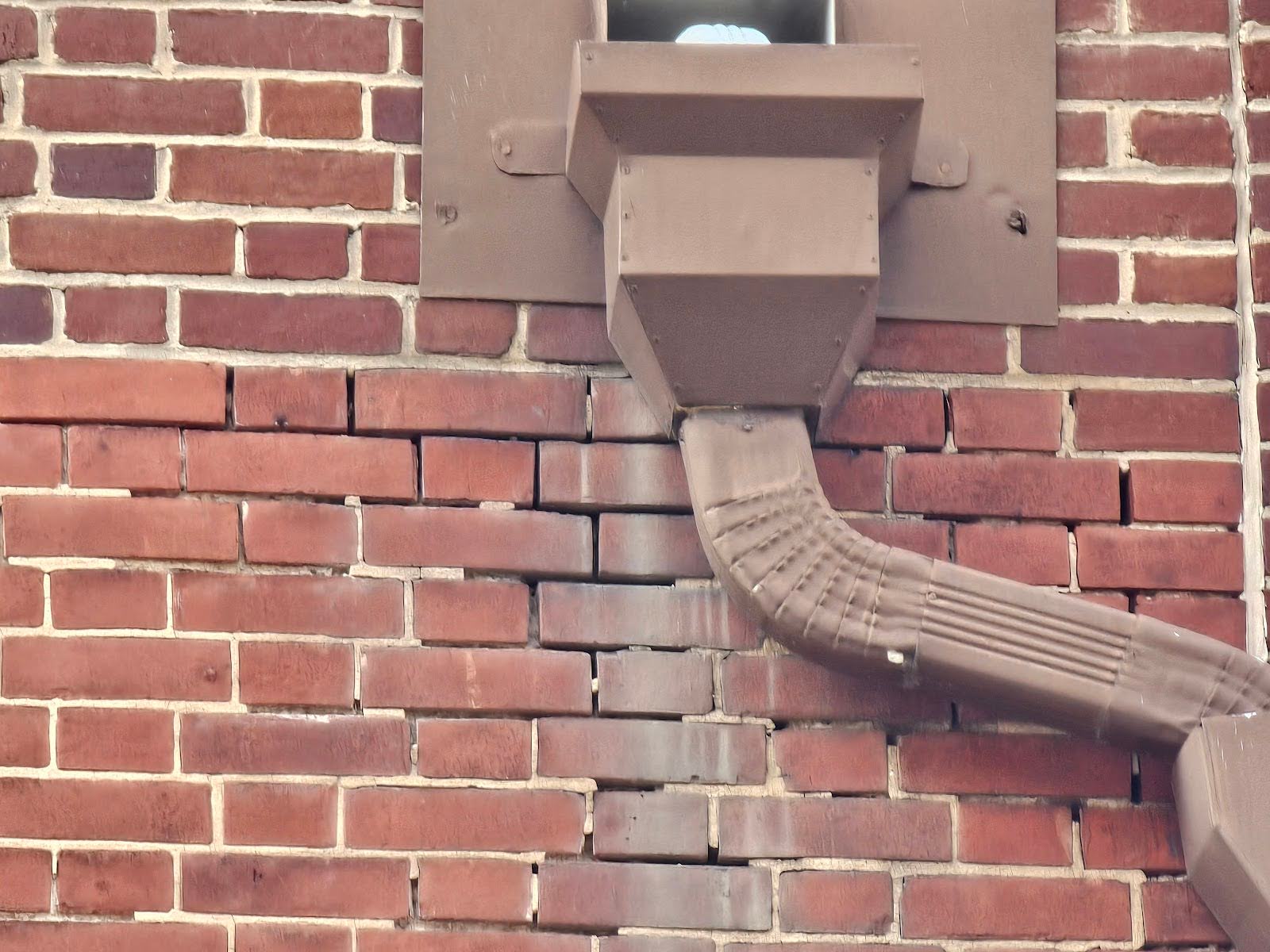
In the picture above, you can see the downspout that runs down the wall. There’s a collection box underneath the scupper. That collection box funnels the water that runs through the scupper into the downspout. You can also see the stains of efflorescence and the water trails around the area below the scupper collection box. That scupper collection box has been leaking for some time and has seriously damaged the masonry below. We’re going to talk more about that masonry damage in this coming week, and we’re also going to talk about essential restoration, maintenance, and upkeep on historic masonry buildings such as repointing and tuckpointing.
Since our company, Dupont Tuckpointing and Masonry, specializes in masonry restoration, historic brick repointing, and tuckpointing services in the Washington D.C. area, we make it a point to study these types of issues. These buildings are uniquely historic, and their preservation requires skilled masons who are technically trained in the best practices and knowledge of proper restoration techniques.
We understand the significance of maintaining the architectural integrity of these historic structures, and our team of experienced professionals is dedicated to delivering exceptional craftsmanship. Whether you require masonry restoration, tuckpointing, or brick repointing services, we are here to help.
At Dupont Tuckpointing and Masonry, we take pride in our work and strive to ensure that every project is executed with the utmost care and attention to detail. We are committed to preserving the rich heritage of Washington D.C.’s built environment for generations to come.
If you have any questions or needs regarding masonry restoration, historic brick repointing, or tuckpointing services, please do not hesitate to reach out to us. We would be delighted to assist you and provide you with the expertise and quality workmanship that your historic property deserves.
You can reach us by telephone at (202) 796-7644 and you can reach us by email from the contact form on our website at https://duponttuckpointingmasonrydc.com/contact-us/