How Intentional Recesses Affect Historic Brick Walls – Part II
This past week, we started looking at a historic brick wall with a recessed panel intentionally built into the face of the wall. The recess, likely, was for visual interest. Technically, also it does save a little bit of cost. Like a thickening of a wall top, at a corbel or at the base of a wall footing, selective tapering and thickening is sometimes are done not just for intentional functional purposes, but also to save costs.
Instead of building the wall thicker all the way down to a footing, it’s functionally pragmatic to just thicken particular spots. You could also potentially look at this wall panel, being built recessed, for this purpose as well: it saves costs by reducing unnecessary extra brick.
Maybe they did this also to save a little bit of cost. We can tell you though, the main purpose wasn’t costs. The cost savings was just a little bit of an added effect. Saving a bit of brick because instead of building the brick in a double wythe or two brick thick type configuration, here they just built it as a single brick thickness in the center by building it like that.
It essentially leaves a half brick thickness on the front and on the back omitted. Overall it still has a full brick in the center, all the way through. That’s important, from a structural perspective. In most cases full height, single wythe brick walls, will not work well.
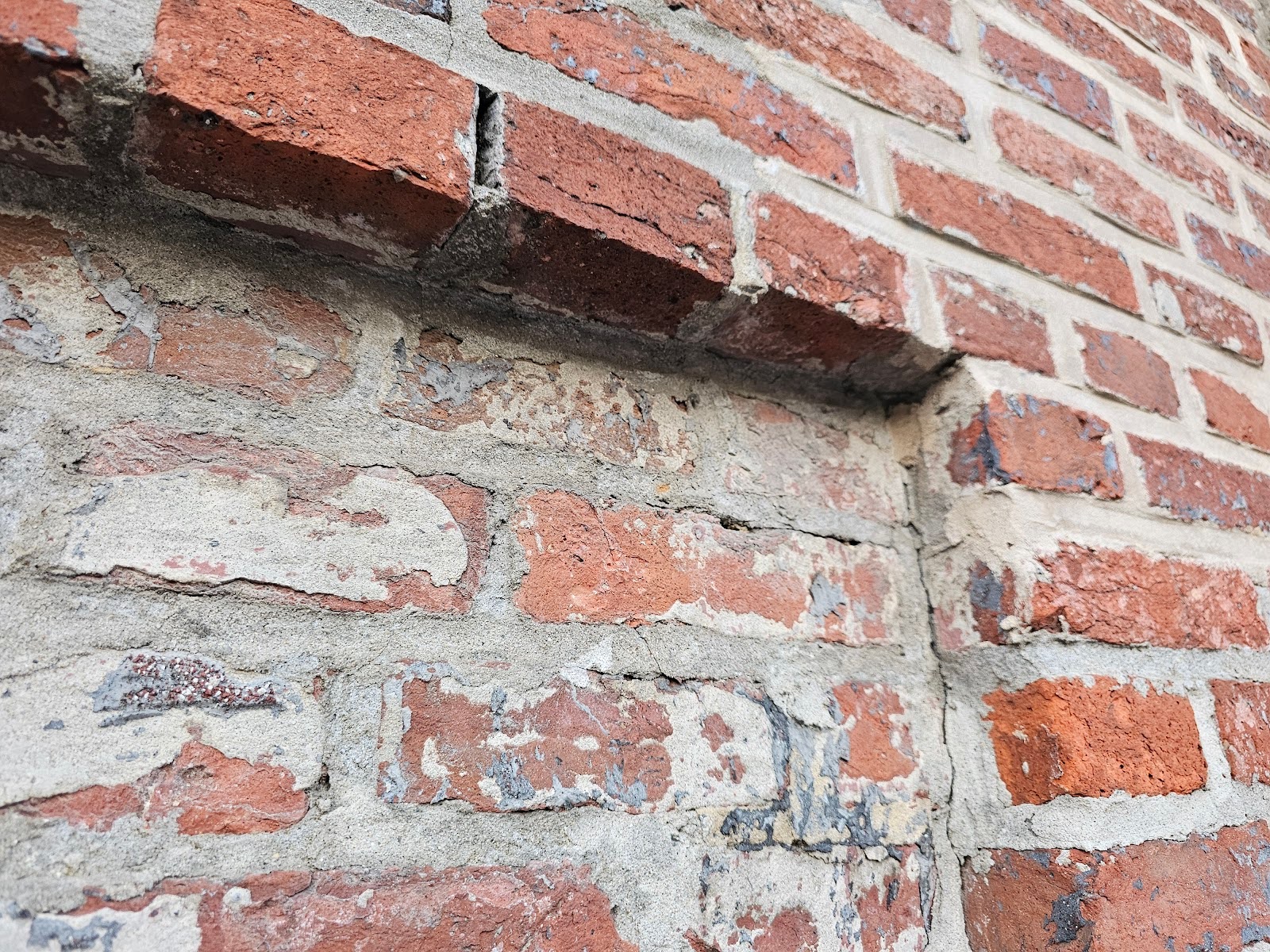
Later, in this coming year we’re also going to look at a particular case study where bricks were in-filled at a variety of different locations where there were previously openings. Here, we believe the scenario is different. You can see the protruding edge of the brick above and the brick at the side of the opening, in the picture below.
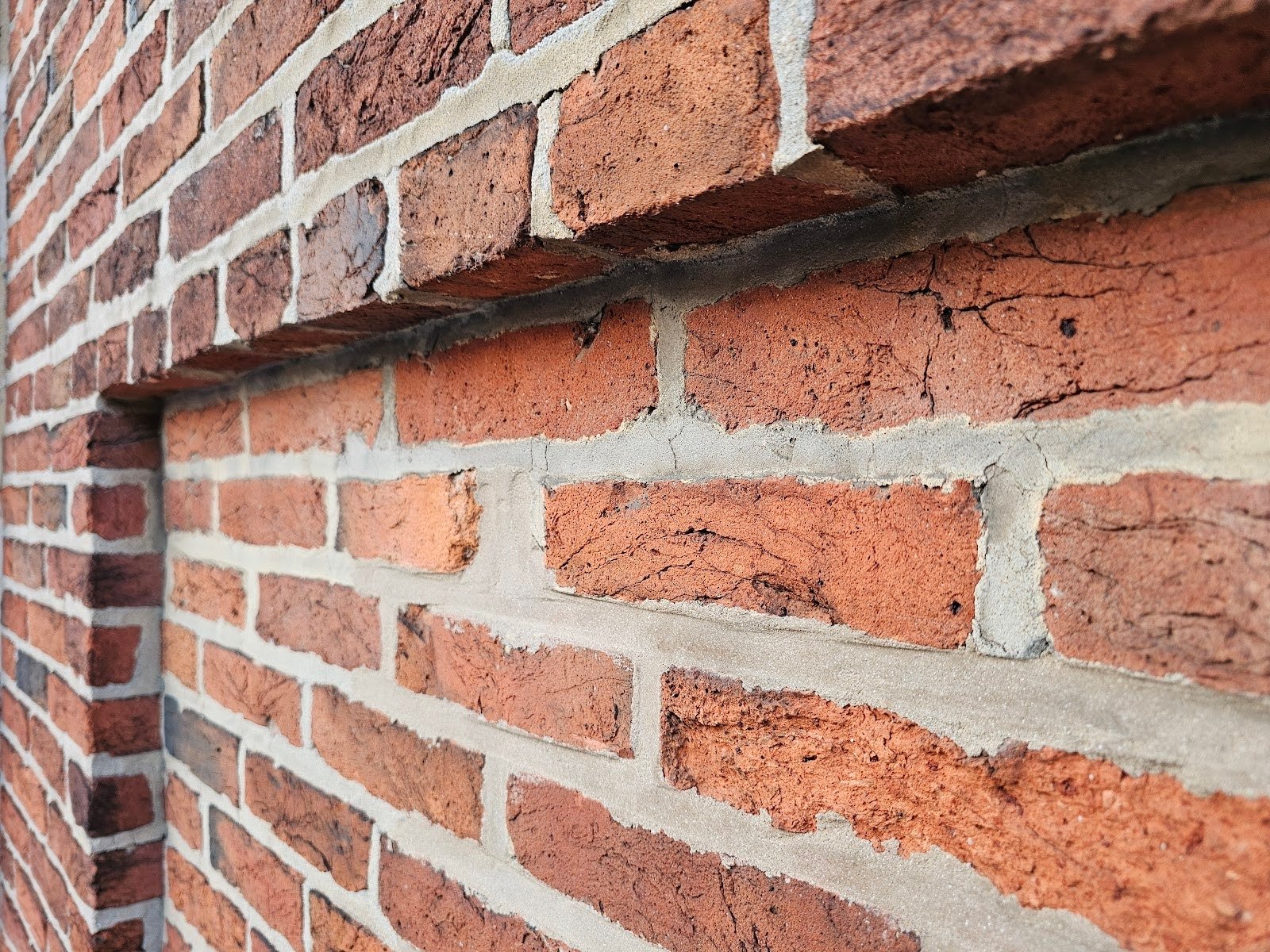
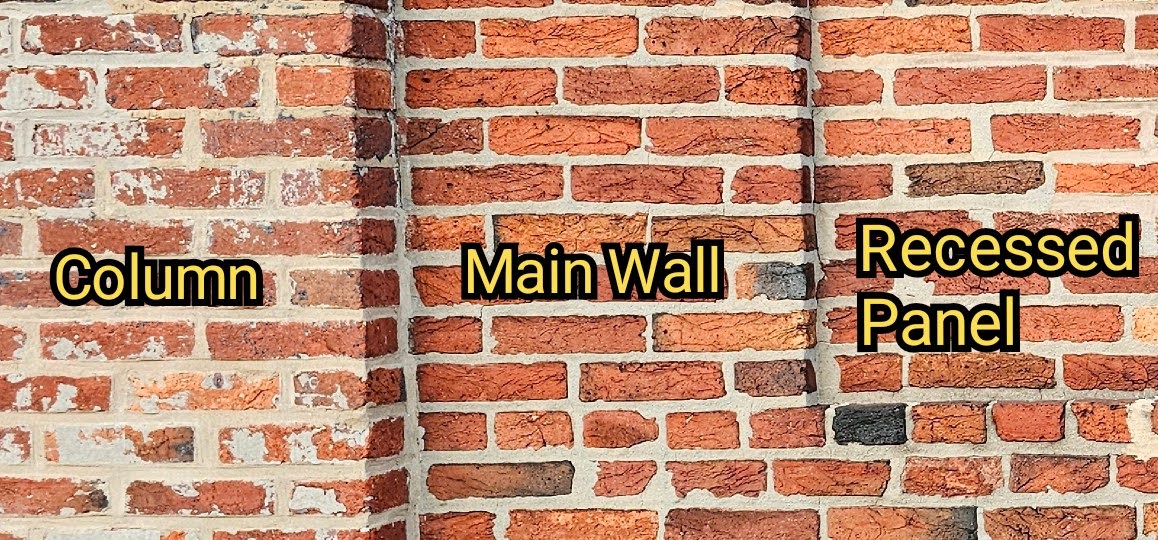
Another one of them interesting details at this particular historic wall is that there aren’t just two vertical wall planes, there’re actually three masonry or brick planes. At the right hand side of the picture below, you can see the recess panel that were referring to. To the left, or in the middle of the picture, there is the main field of the wall. That main field of the wall is essentially half a brick proud or standing out one half of brick thickness from the recess. That main portion of the wall wraps around the recessed panel. That thickness difference is roughly 2 inches.
The bricks are roughly three and a half or 4 inches thick, when setting a double wythe configuration, the wall has a total thickness of 8 to 9 inches. In a single wythe configuration, that recess panel portion of the wall is only 4 inches thick. When you keep that 4 inch center aligned with the 8 inch center, it leaves an additional 2 in on each side.
In a corbel brick footing or a corbelled brick cornice, the bricks only protrude out from the adjacent houses roughly up to 1/3 of a brick thickness. By adding too much more of a difference than this it can lead to a structural deficiency or instability. Here though, that’s not really an issue because it’s just a particular panel, not a building footing or a building cornice.
When you look at the leftmost portion of the picture, you see the column. This column runs vertically. Here, we’re just showing a section of it. The difference of the transition between the column and the main part of the wall though is different. Instead of just sticking out a partial brick thickness, the standout is an entire brick thickness. This is because the column is significantly thicker than even the main portion of the wall. The main portion of the wall is 8 inches thick, but the column is 16 inches thick.
With a 4-in additional thickness on each side, both front and back, it makes for a net total thickness of 16 in overall. That particular column creates a significant load path and adds a significant amount of stability to this particular wall.
The next few pictures show edges of the recessed panel. We believe that this particular wall, both the surrounding main wall and the recess panel have been repointed in recent decades. The mortar here doesn’t look original. We estimate that this particular wall was built roughly 110 years ago. That’s relatively in keeping or in line with many of the historic buildings, built with masonry in the majority of the historic neighborhood of the city here in Washington DC.

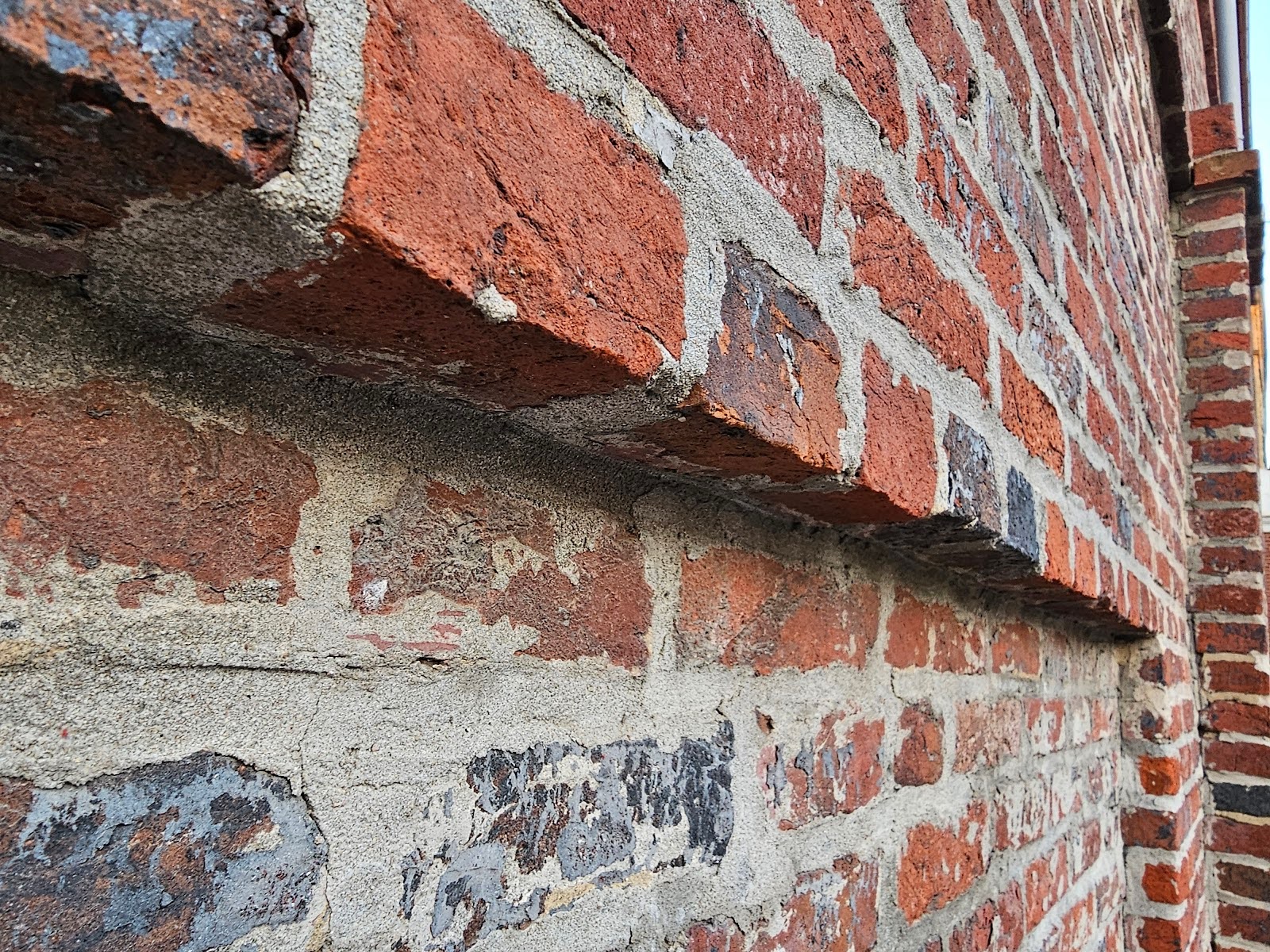
The next picture below shows a very different panel though. This panel is different because the brick is very dirty. It’s almost like it has a thin cement parge coat on top of the face of the brick.
We thought that the first wall (at the top of the article) was not an infill, here we’re not sure that it’s actually an infill. Instead, for decorative purposes or for posting of signage, painting or literature, they may have just stucco coated or even just painted the face of the brick at the recess.
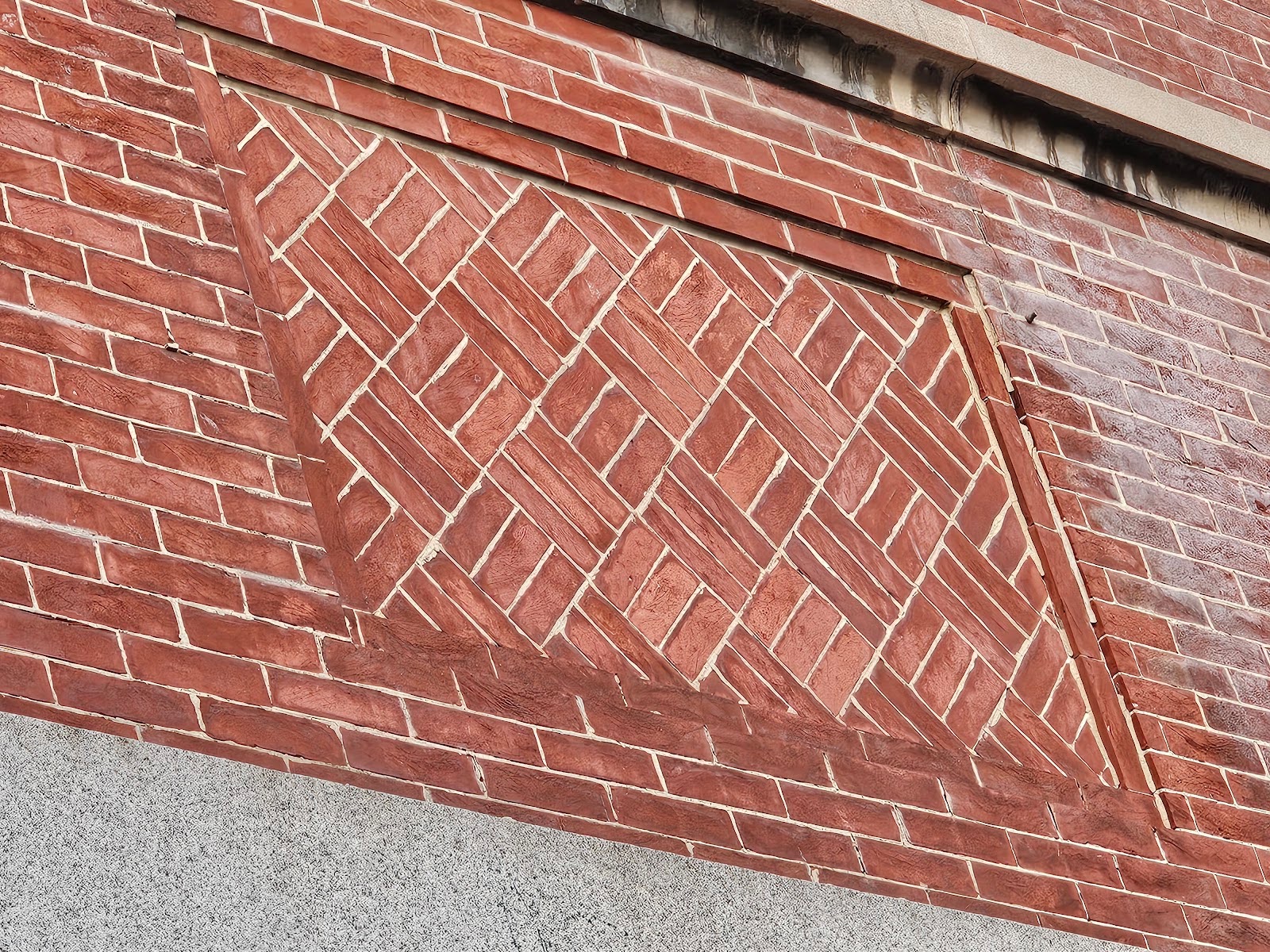
For comparison, the next picture below shows a different type of recessed panel. This particular panel is set similarly between each set of windows, in a vertical configuration. So at an upper level window, this panel occurs between the upper level window and the window below. You can see that there are a varying set of depths for the bricks so the panel here is also recessed. One of the big differences here though is that they’ve only recessed this panel slightly, just to provide a slight but distinct shadow line for aesthetic purposes. They’ve also changed the bond of the brick to make it stand out and accentuate these details, almost like a craftsman type of element.
Since our company, Dupont Tuckpointing and Masonry, specializes in masonry restoration, historic brick repointing, and tuckpointing services in the Washington D.C. area, we make it a point to study these types of issues. These buildings are uniquely historic, and their preservation requires skilled masons who are technically trained in the best practices and knowledge of proper restoration techniques.
We understand the significance of maintaining the architectural integrity of these historic structures, and our team of experienced professionals is dedicated to delivering exceptional craftsmanship. Whether you require masonry restoration, tuckpointing, or brick repointing services, we are here to help.
At Dupont Tuckpointing and Masonry, we take pride in our work and strive to ensure that every project is executed with the utmost care and attention to detail. We are committed to preserving the rich heritage of Washington D.C.’s built environment for generations to come.
If you have any questions or needs regarding masonry restoration, historic brick repointing, or tuckpointing services, please do not hesitate to reach out to us. We would be delighted to assist you and provide you with the expertise and quality workmanship that your historic property deserves.
You can reach us by telephone at (202) 796-7644 and you can reach us by email from the contact form on our website at https://duponttuckpointingmasonrydc.com/contact-us/