Managing Penetrations Through Historic Brick Walls – Part II
This past week, we looked at a few different plumbing penetrations that went right through a masonry brick wall. We think that these penetrations were created way after the original construction of the building. There was some sloppiness in these installations and they lacked a resilient seal. Sealing elements that pass through a masonry partition with just mortar isn’t normally a good idea. As well, the planar joints in masonry, when built with modern masonry, should have a resilient type sealant applied at the inside corner. If the sealant is well applied, it will not detract from the aesthetic of the remainder of the facade.
Resilient seals are materials that maintain flexibility. In this context, the term resilient refers to the material’s ability to spring back to its original shape and size after being deformed. This type of deformation generally refers to the material being stretched or compressed.
Buildings experience constant micro movements. Even though we can’t see these buildings actually move, with our eyes, there are microscopic movements that happen all the time. To a degree, these buildings and their subcomponent materials expand and contract. The core or central crux of the points where the expansion and contraction matters the most is often at planar joints and penetrations. Much of the type of movement we’re talking about is driven by thermal contraction and expansion. Materials around us throughout the world experience a degree of expansion and contraction as temperatures change. All materials have a property called a coefficient of thermal expansion.
It varies between different materials because different materials have different coefficients of thermal expansion. They physically change size as temperature changes. Aluminum and certain types of metal alloys have extremely high amounts of thermal driven movement. In other words, they highly expand or contract with changes in temperatures. Some types of plastics also have high amounts of inherent thermal movement. In comparison the amount of movement of historic brick masonry is relatively low. Nonetheless, over many years as movements constantly happen, particularly at planar joints in masonry facades, it’s important to use sealants at critical areas to keep the partitions sealed.
Some of the characteristics of the best performing sealants are elasticity, recovery, and durability. Mortar alone isn’t a good material for these types of unions or joints between similar materials at planar joints or between penetrations of dissimilar materials. At the fulcrum points of these movements, materials like mortar are brittle and weak in tensile strength. They will crack and break. Elastomeric sealants maintain a high degree of flexibility,for years, in most cases. Some of these elastomeric sealants are engineered or designed to last for more than nine years.
The actual longevity depends on exposure to external elements like moisture and ultraviolet light. Brick and masonry are basically unaffected by exposure to ultraviolet. Wood and and plastic / polymer type materials like elastomeric sealants are highly susceptible to damage from exposure to ultraviolet. In recent years, chemical formulations have changed considerably to make these materials perform better with exposure to ultraviolet, but they still have inherent weakness in resistance to breakdown from exposure to ultraviolet.
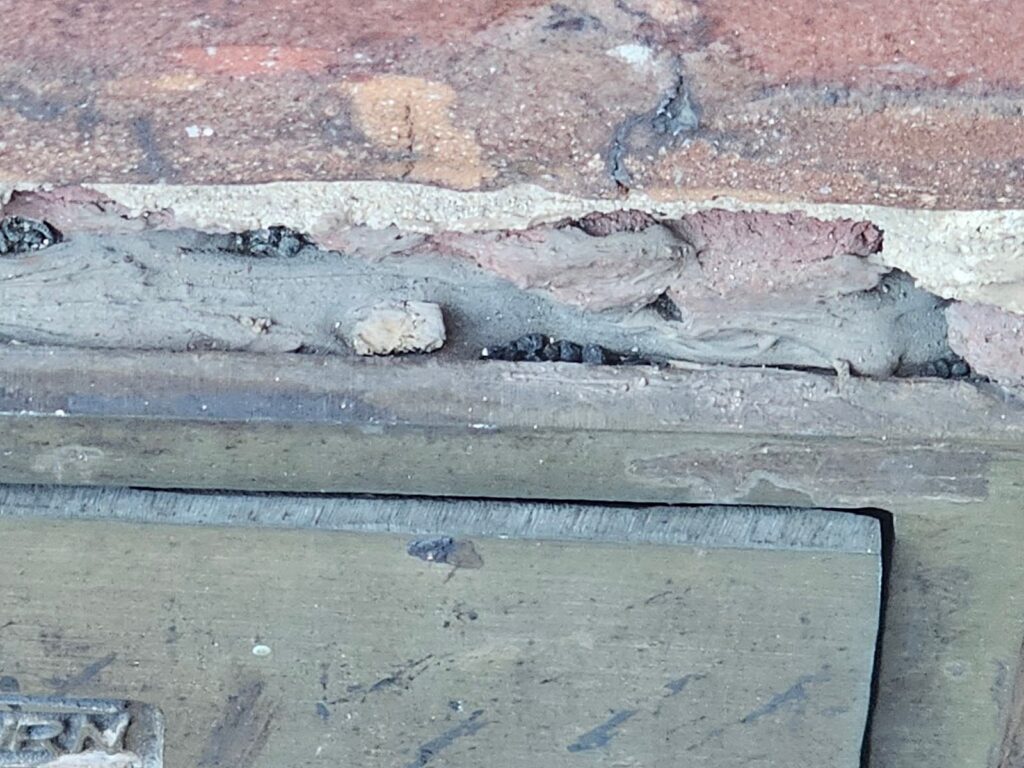
The picture below shows an access panel installed in an exterior brick facade. Behind the access panel door, a water shut-off valve has been installed. This type of water shut off valve can be used to cut off the building water main to allow works to be conducted on the piping. Access panels and or shut off valves can also be used to winterize select branches of piping so that exterior plumbing devices like hose spigots do not freeze and break from water expansion during the bleak wintery cold months here in the USA.
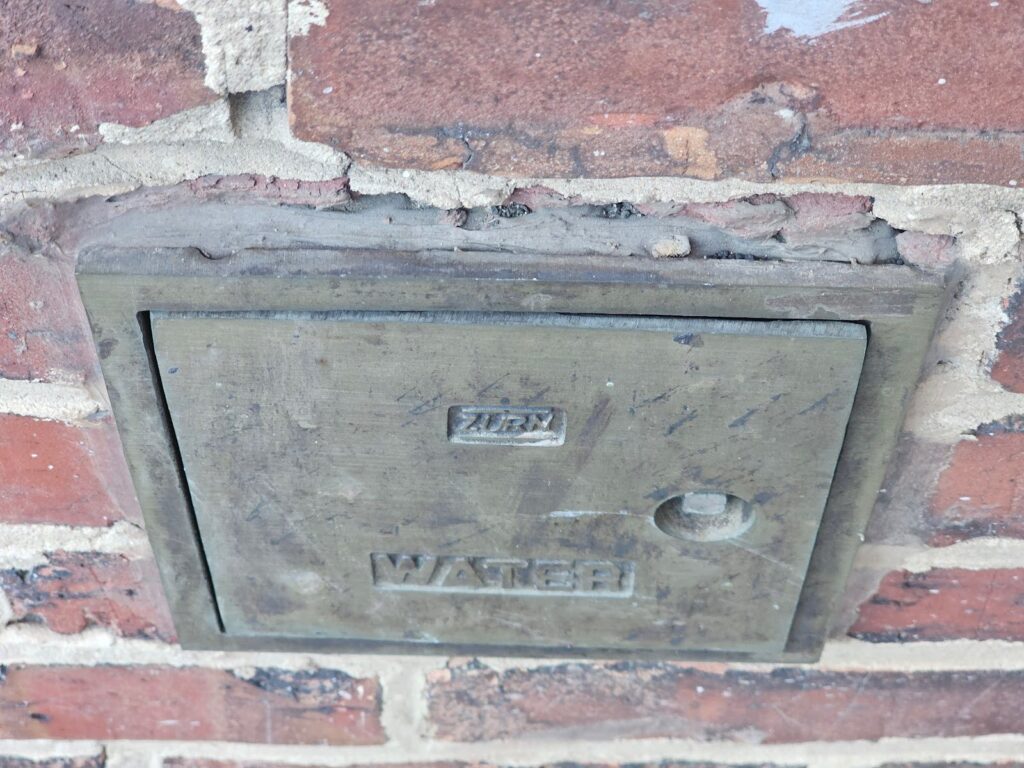
The top of this access panel has been sealed to the masonry substrate with a sealant, years ago. At this point, the sealant has become brittle and debilitated from exposure to the elements and needs to be removed or overlaid to have a new sealant applied.
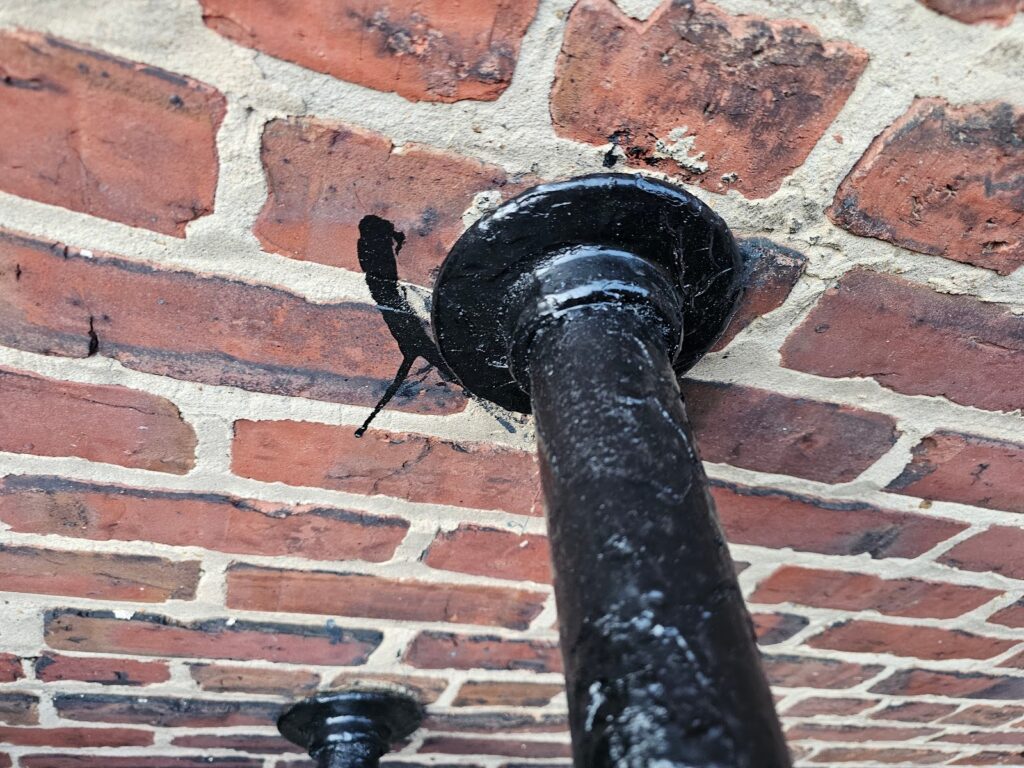
A floor flange has been installed at a screw pipe so that it can be used as a type of handrail at a set of steps. Generally, the building code requires a guardrail to be installed at a height of over 30 in, depending on the particular area and building classification. Here, a guard has not been installed, just a pair of horizontal rails. During the painting of the guardrail, a separate painting contractor has likely come and applied a sloppy application of paint onto the masonry facade. They should have instead masked the area around the connecting flange to avoid over painting onto the brick.
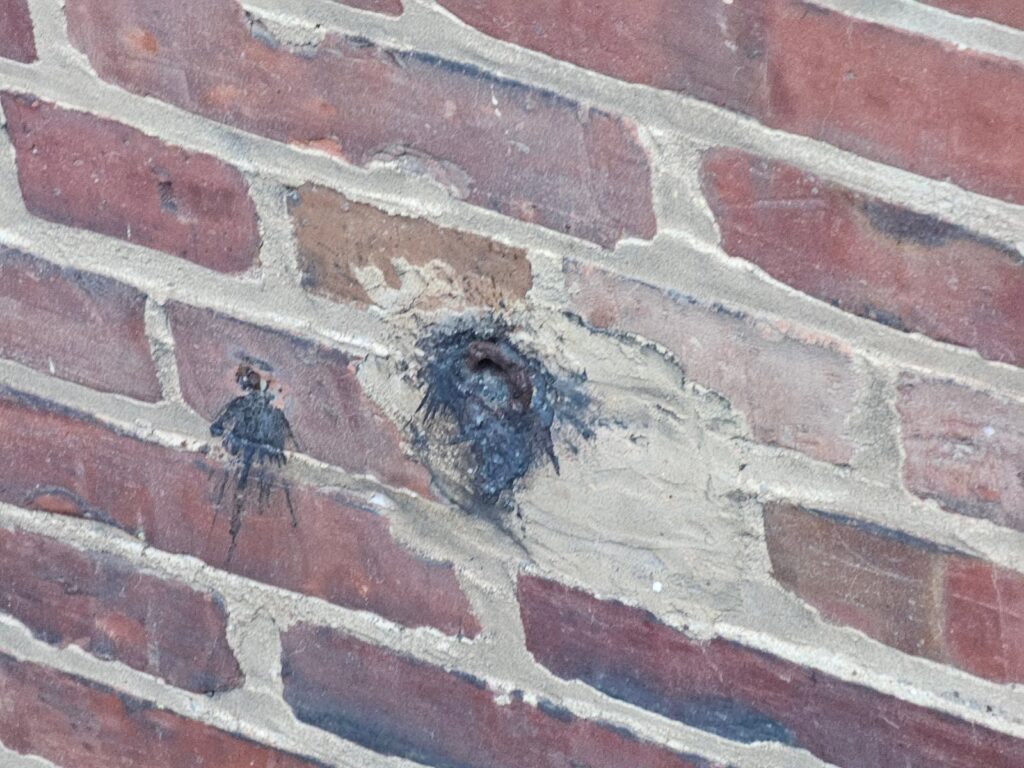
At other locations of the exterior brick facade, foreign materials have been stuffed or jammed into holes to create a mounting location. Since original installation though, these mounting areas have been abandoned. At this point, during routine upkeep and maintenance such as repointing, these elements should be removed.
Since our company, Dupont Tuckpointing and Masonry, specializes in masonry restoration, historic brick repointing, and tuckpointing services in the Washington D.C. area, we make it a point to study these types of issues. These buildings are uniquely historic, and their preservation requires skilled masons who are technically trained in the best practices and knowledge of proper restoration techniques.
We understand the significance of maintaining the architectural integrity of these historic structures, and our team of experienced professionals is dedicated to delivering exceptional craftsmanship. Whether you require masonry restoration, tuckpointing, or brick repointing services, we are here to help.
At Dupont Tuckpointing and Masonry, we take pride in our work and strive to ensure that every project is executed with the utmost care and attention to detail. We are committed to preserving the rich heritage of Washington D.C.’s built environment for generations to come.
If you have any questions or needs regarding masonry restoration, historic brick repointing, or tuckpointing services in Washington DC, please do not hesitate to reach out to us. We would be delighted to assist you and provide you with the expertise and quality workmanship that your historic property deserves.
You can reach us by telephone at (202) 796-7644 and you can reach us by email from the contact form on our website at https://duponttuckpointingmasonrydc.com/contact-us/