Why Real Repointing Is Often the Best Solution
Here on our blog and on our website we talk a lot about the proper masonry restoration techniques. It’s our focus in work and life. Considering how important it is, especially to us since we’re focused on this work, it’s probably not surprising how passionate we are about doing things right. We explain a lot of the proper versus improper techniques, and we even talk a lot about best practices. Today we’re looking at something that is so bad it’s almost Outlandish.
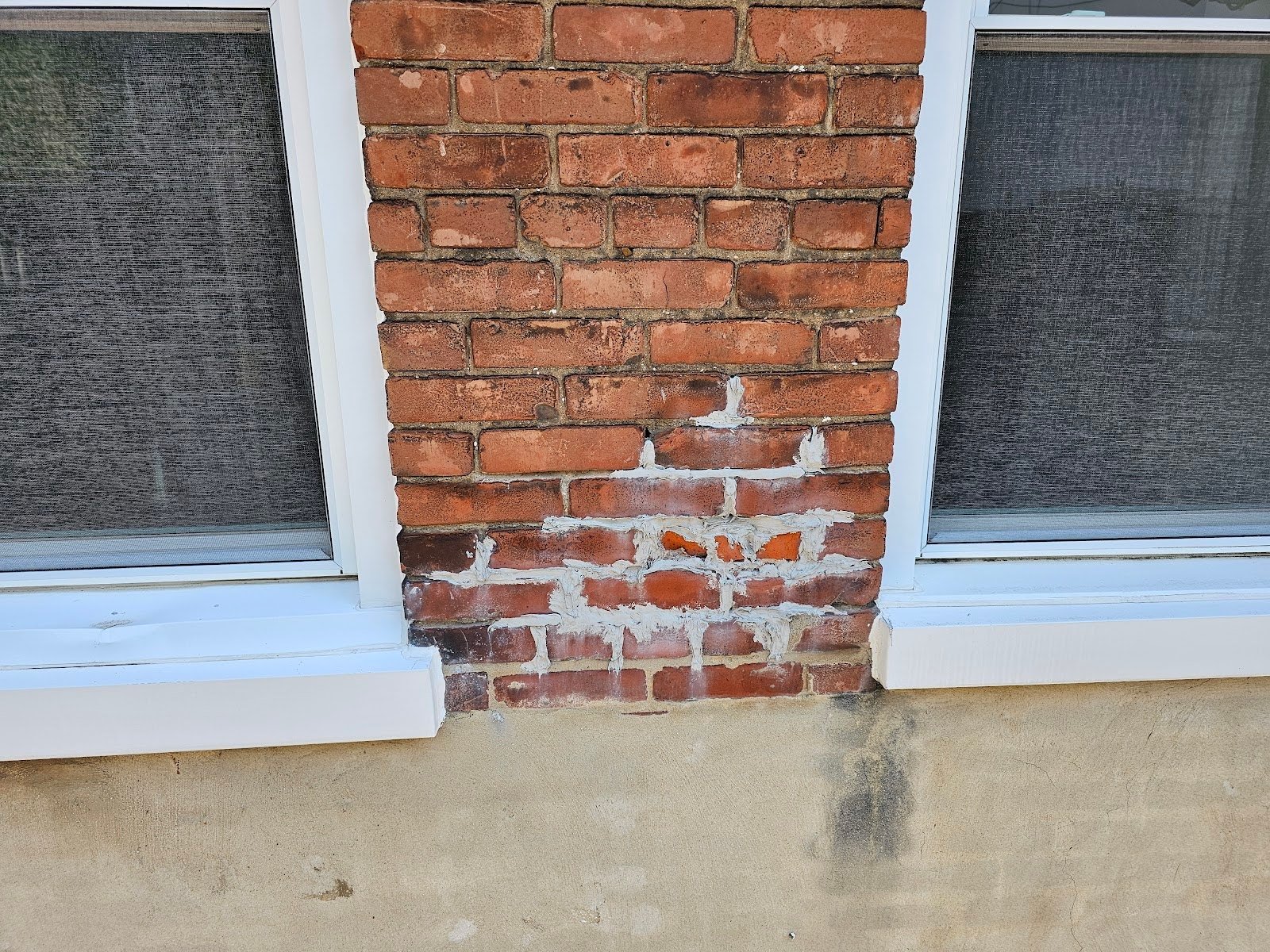
We’re looking at an area where some other contractors or real estate developers flipped the property and or did some kind of quick makeshift repair in mortar joints using caulking. Caulking really should never be used to seal up over defunct or deteriorated mortar joints.
For something really small and limited and temporary, like a single spot, it might not be as bad, but when people use caulking as a method of repair, they’re actually hurting the building. Plus, in this particular case, as shown in the picture below, it just looks terrible. So it can be a little bit more understandable, today we’re going to explain the reasons why improper caulking can hurt the building.
Historic brick masonry is built with bricks from many decades ago. Decades ago, before high temperature modern production kilns using natural gas and hydraulics were invented, they would fire these bricks using organic materials such as wood. Those materials can sometimes burn at relatively high temperatures, but they do not get nearly as hot as some of the modern methodologies. Without high temperature kiln firing, the masonry has a higher porosity, a lower degree of vitreousness, and therefore is a bit more permeable. It’s not so permeable though that it leads to leakage through the bricks themselves, when the building is properly maintained. It’s permeable enough though that it must be treated and with compatible materials.
In this particular case, the caulking has a high degree of impermeability. By using a caulking to fill a joint between less permeable materials, it causes the backup of water which in freeze-thaw cycles can lead to expanding ice that can damage the bricks. This isn’t just a problem in the winter. Even in the summer it’s still a problem. The problem happens to be different in nature because there’s no risk of damage through freeze-thaw cycles, but there’s still deterioration that happens from overhydration.
Essentially putting caulking into those joints backs up the flow of moisture. The more porous masonry allows water to enter and it gets blocked at the inside face of the caulkings. Then as it sits there longer, it leads to increased and accelerated deterioration. That’s very bad for the bricks.
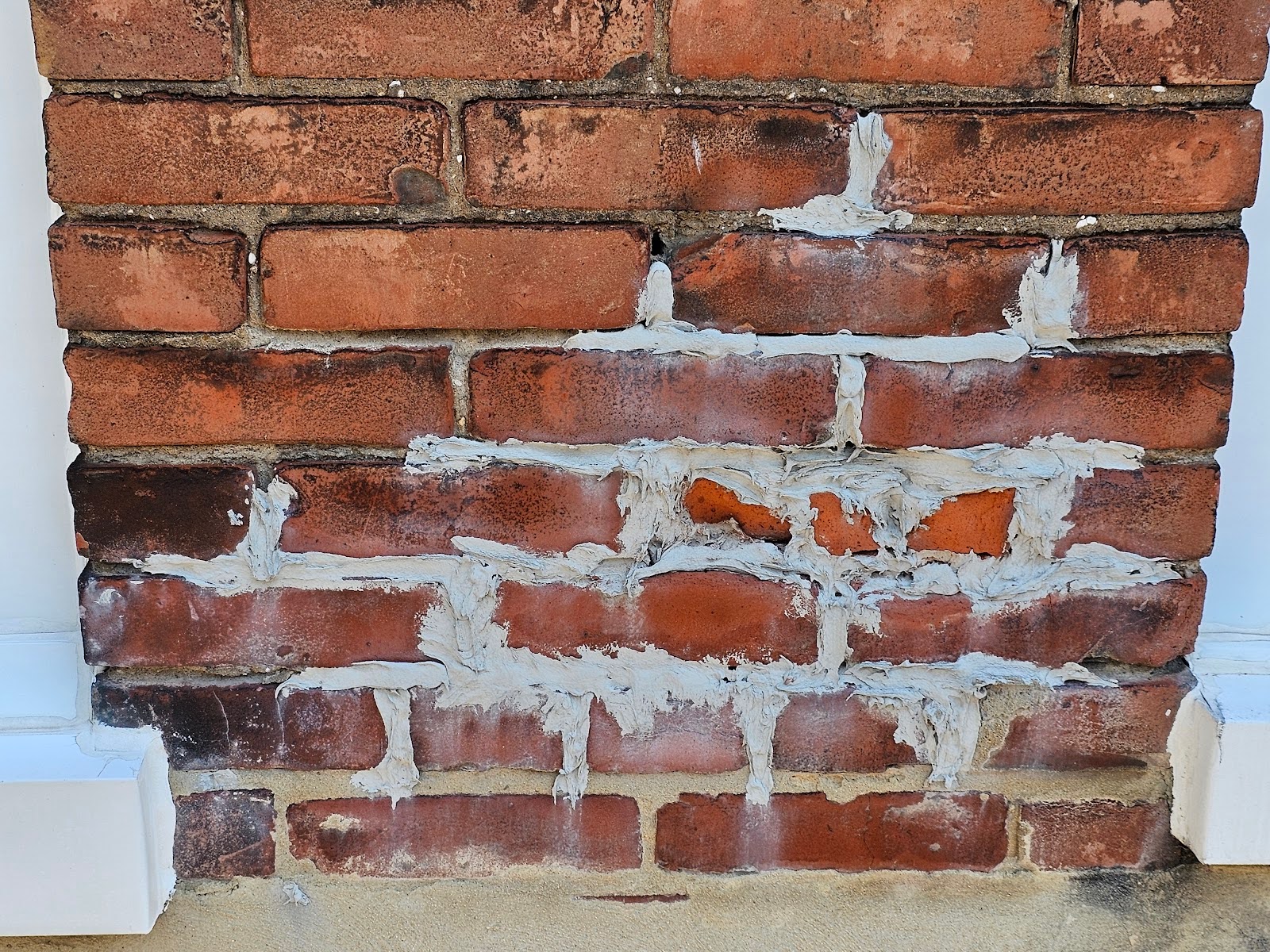
If people were working on this building, who had any idea of how to do proper construction and restoration, they could have fixed this properly. It needs to be repointed. Repointing is a process of removing old, deteriorated mortar at the outer face of the bricks and replacing it with proper mortar. There are multiple different types of mortar. Particularly, for historic masonry like this, the characteristics of compressive strength and porosity of that new mortar are very important. By using the wrong mortar it can damage the bricks.
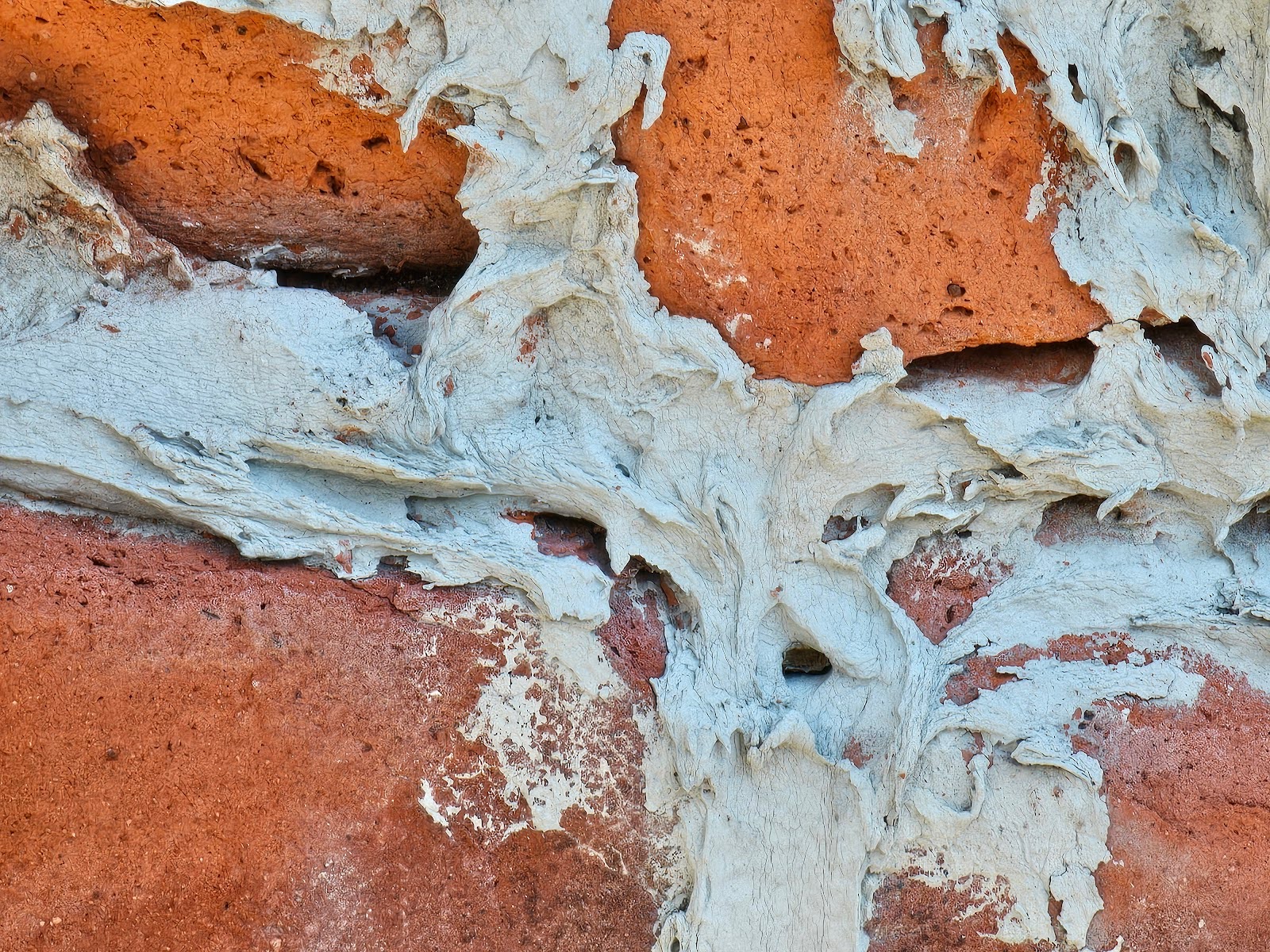
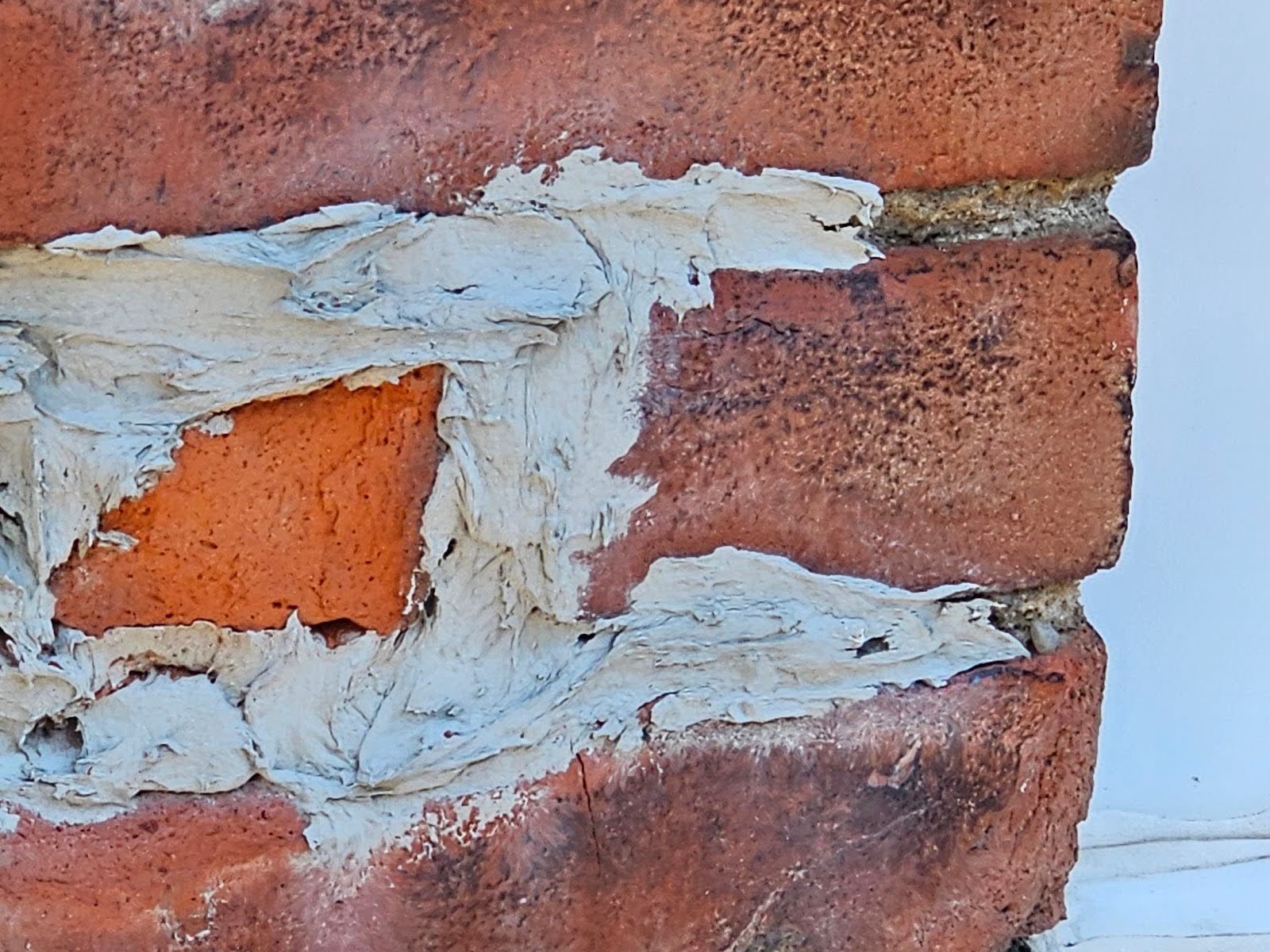
When a proper restoration contractor comes back to fix this historic masonry, they’ll do repointing. This is what our company does, for example. But it’s difficult after somebody’s gone and put caulking on like this. They’ve done it so poorly that they’ve smeared the caulking all over the face of bricks. Once it’s been messed up like this it’s hard to remove the messy old mortar off of the face of the bricks.
It is easy to say just hire good contractors from the start, but that doesn’t always happen easily in real life. In an area like Washington DC, you can discern good contractors from bad ones. Good contractors care a lot about quality and in our case, you can tell, just by reading our blog, that these details matter. We pay attention to them and we have strong opinions about them because they matter so much.

Since our company, Dupont Tuckpointing and Masonry, specializes in masonry restoration, historic brick repointing, and tuckpointing services in the Washington D.C. area, we make it a point to study these types of issues. These buildings are uniquely historic, and their preservation requires skilled masons who are technically trained in the best practices and knowledge of proper restoration techniques.
We understand the significance of maintaining the architectural integrity of these historic structures, and our team of experienced professionals is dedicated to delivering exceptional craftsmanship. Whether you require masonry restoration, tuckpointing, or brick repointing services, we are here to help.
At Dupont Tuckpointing and Masonry, we take pride in our work and strive to ensure that every project is executed with the utmost care and attention to detail. We are committed to preserving the rich heritage of Washington D.C.’s built environment for generations to come.
If you have any questions or needs regarding masonry restoration, historic brick repointing, or tuckpointing services, please do not hesitate to reach out to us. We would be delighted to assist you and provide you with the expertise and quality workmanship that your historic property deserves.
You can reach us by telephone at (202) 796-7644 and you can reach us by email from the contact form on our website at https://duponttuckpointingmasonrydc.com/contact-us/