Understanding Random Ashlar Veneer Stone Masonry
The particular masonry wall that we’re looking at today is intended to look like a precisely cut drystack stone. The stone shapes are irregular and inconsistent throughout, yet it looks like particularly well crafted masonry work. In traditional types of applications, this stone masonry facing would be solid all the way through. Here though, part of the artifice is that these stones are actually thin slices, almost like a tile application. This type of installation actually blurs the line, a bit, between tile and masonry.
Interestingly, particularly here in Washington DC, in the old days, when these historic buildings were originally built, much of what we would consider to be tile work, today, was actually done by masons. As the technology and methods and materials changed, the trades changed as well. Today, we consider tile work in masonry work to be separate disciplines of construction.
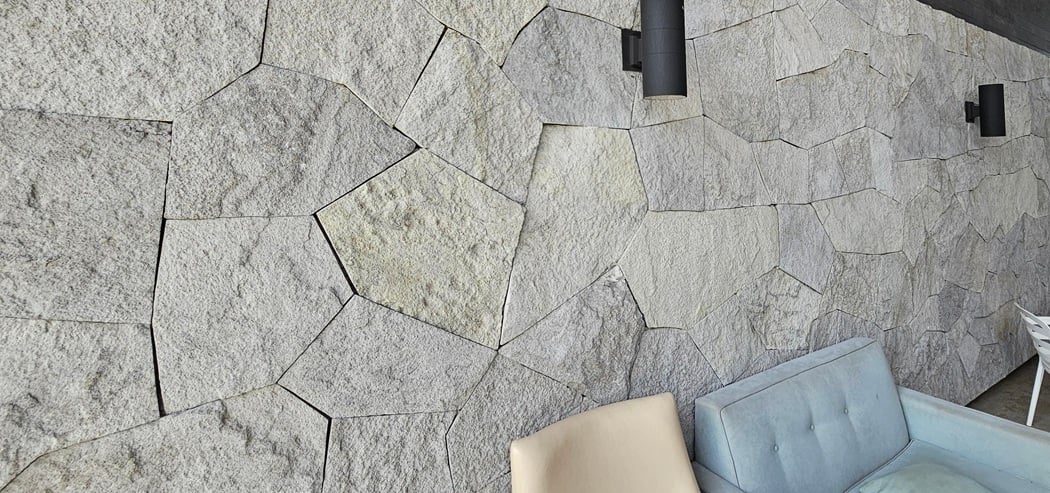
The work we’re looking at today is a stone that’s applied on a thin bed of mortar, to the wall substrate, a lot more like a tile than typical masonry. This type of modern embellishment or modern shortcut makes the installation a little bit easier, but it isn’t actually easy. Although a bit easier, it still requires a significant amount of precision in the installation.
Above, we mentioned the concept of dry stack masonry. Essentially, one of the big differences between dry stack masonry and traditional masonry is that the dry stack masonry does not use much mortar. Particularly at the exterior facings of the stonework, mortar is not shown or applied. Dry stack masonry can also be referred to as mortarless or dry stonemasonry. A true dry stack type of masonry partition, instead of using areas of interstitial mortar as a cohesive bonding element, uses gravity, the resulting friction of the mass, and the tight fit to hold the elements of the wall in place.
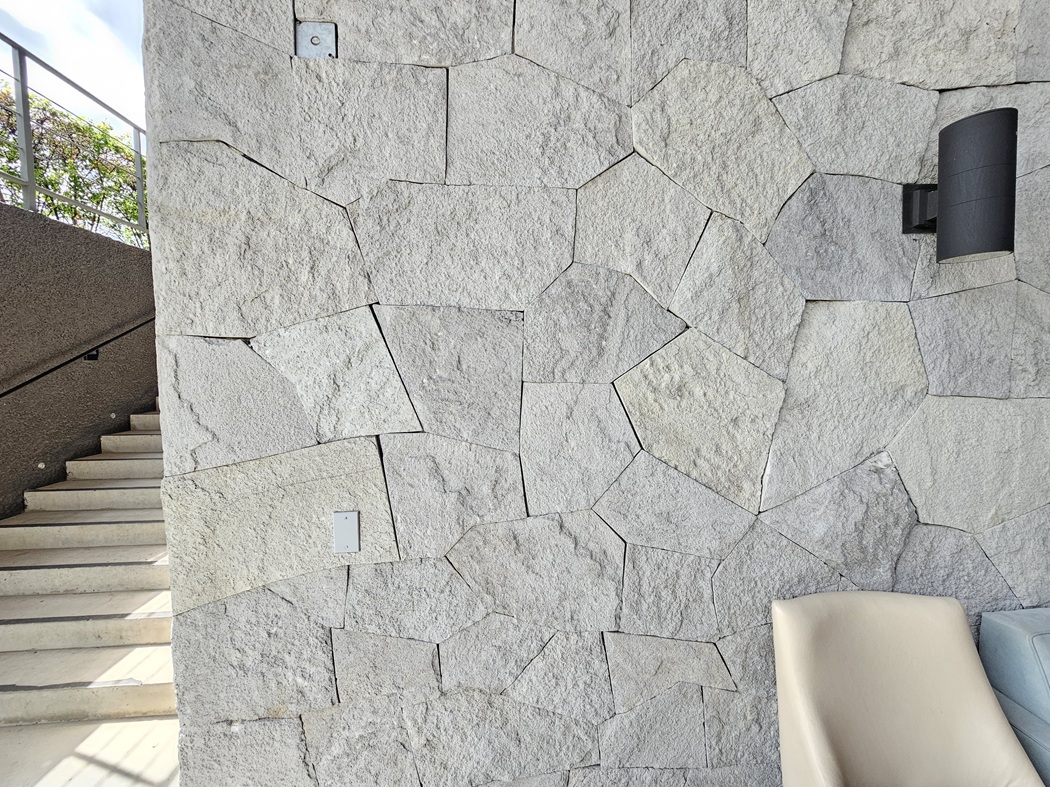
We’ll talk about the particular corner this coming week. If you look at it though, in the picture below, you can see it here from a wide view. From this angle, the corner almost looks perfect. It’s not easy to build a corner that is true and plumb, consistently, with almost no variation, when using individually cut masonry units, in a wide variety of shapes.
Above, we also talked about the mortarless nature of this wall. This type of wall is, in some ways, a complete opposite to the walls we often talk about and look at here in Washington DC. These historic masonry walls, here in Washington, DC, are not just built with a combination of brick and mortar and other masonry elements, but they are highly dependent upon that mortar. The cohesive nature of that mortar holds that entire assembly together. In most cases, the historic brick assemblies of Washington DC are built to be multiple levels tall. In a dry stack type configuration, the walls could not maintain multiple levels or even a significant amount of height.
The buildings that we see all around the city require the use of very consistent individual masonry elements. There are exceptions of course, such as corbels, headers, quoinings, and decorative protrusions, however provisions are made to accommodate these elements where they are used. These historic brick walls, in DC, also require a good mortar binder to make up for anomalies and inconsistencies between the brick elements. Consider, we’re talking about very small inconsistencies. Unlike natural stone that is used in a random type of configuration, these historic Washington DC bricks are made using wooden brick molds.
The molds were used again and again and built to be consistent. Even with slight variation, they were highly consistent compared to the natural (replicating) stone that we’re looking at today. The difference is that real drystack masonry was never intended to support roofs, above ground foundations, or building floor systems.
(As a side note, as we mentioned above, this particular stone isn’t actually real. Instead of actually being made with natural stone, it’s a replica made from cementitious materials. That particular difference isn’t highly relevant though to the majority of the topics we’re talking about and discussing here. In fact, even though it happens to be a cementitious type of replica stone, many of the principles of installation and construction work similarly. One of the big differences though happens to be related to restoration, long term upkeep and maintenance, and repointing.)
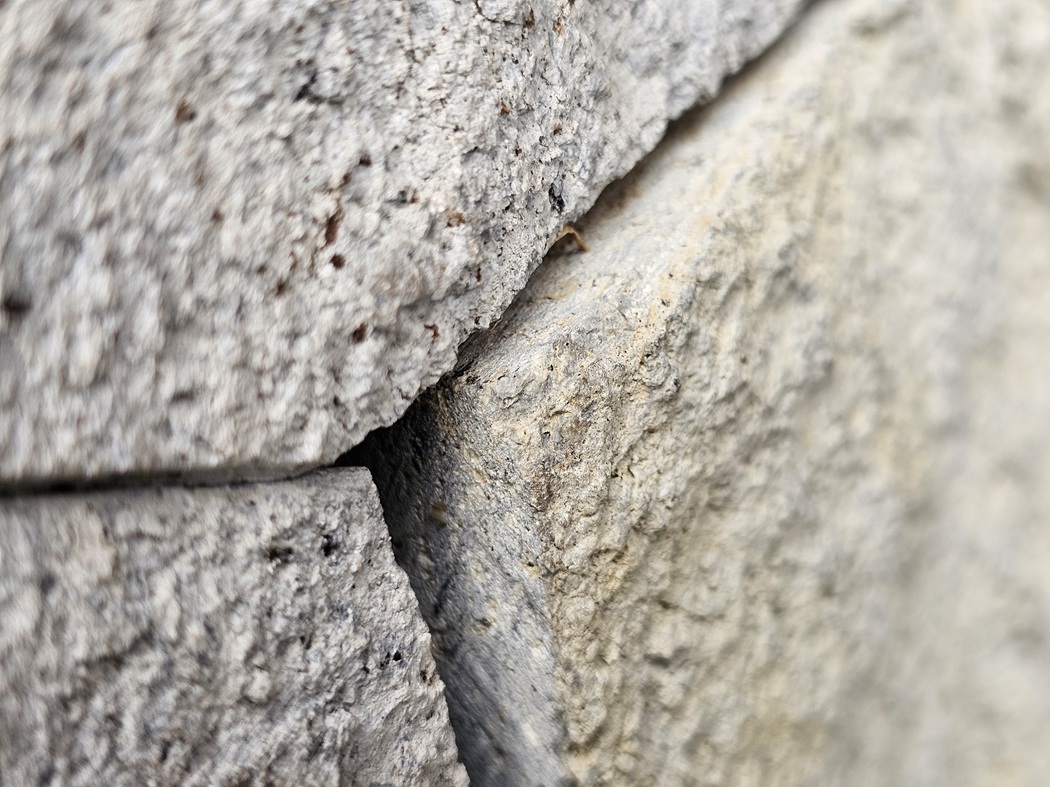
If you look closely into the cut edge between the stones, you’ll see that these masonry units were not cut using historic methodologies. Instead, they were cut with modern high power tools and machinery.
Our company, Dupont Tuckpointing and Masonry, specializes in masonry restoration, historic brick repointing, and tuckpointing services in the Washington D.C. area. These buildings are uniquely historic, and their preservation requires skilled masons who are technically trained in the best practices and knowledge of proper restoration techniques.
We understand the significance of maintaining the architectural integrity of these historic structures, and our team of experienced professionals is dedicated to delivering exceptional craftsmanship. Whether you require masonry restoration, tuckpointing, or brick repointing services, we are here to help.
At Dupont Tuckpointing and Masonry, we take pride in our work and strive to ensure that every project is executed with the utmost care and attention to detail. We are committed to preserving the rich heritage of Washington D.C.’s built environment for generations to come.
If you have any questions or needs regarding masonry restoration, historic brick repointing, or tuckpointing services in DC, please do not hesitate to reach out to us. We would be delighted to assist you and provide you with the expertise and quality workmanship that your historic property deserves.
You can reach us by telephone at (202) 796-7644 and you can reach us by email from the contact form on our website.