Brick Deterioration in a Distinct Band: What Causes It?
This week and the next, we’re going to look at a particular condition at a building that isn’t entirely unique. There are a handful of cases like this where we find historic masonry buildings which have a specific type of brick deterioration. Particularly where buildings aren’t restored proactively the damage to masonry through breakdown over time can be significant. We’ve seen examples that are so extreme that entire buildings have collapsed due to lack of masonry repointing and restoration.
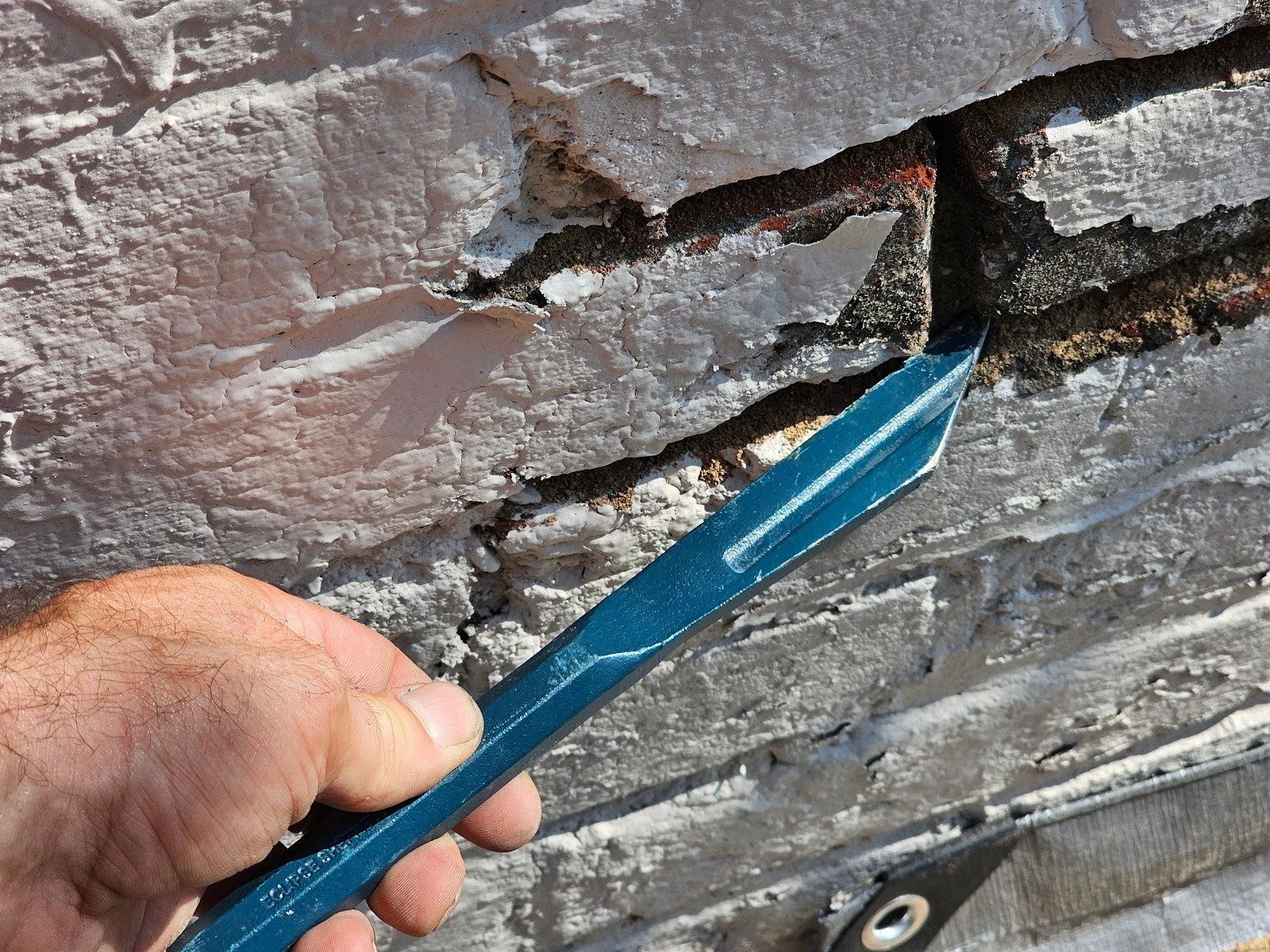
Here, in this particular example this type of damage looks really unique but we’ve seen it several times. The deterioration has happened not just within individual bricks here and there like it was sporadically interspersed throughout the facade, but instead at distinct bands that run horizontally.
We have some specific theories on why this is happening here and in other places. Like many types of deterioration, often, the causes are multifactorial. In other words, they are caused by a variety of different factors and conditions that happen to the brick simultaneously. Nonetheless, even in cases where there are multiple causes of deterioration, things can be done to specifically treat the greatest of those factors. Once those precautions or preparations are taken, the masonry can last a much longer periods of time between phases of restoration. As well, when restoration and upkeep is applied at a proactive timetable, the building can last almost indefinitely.
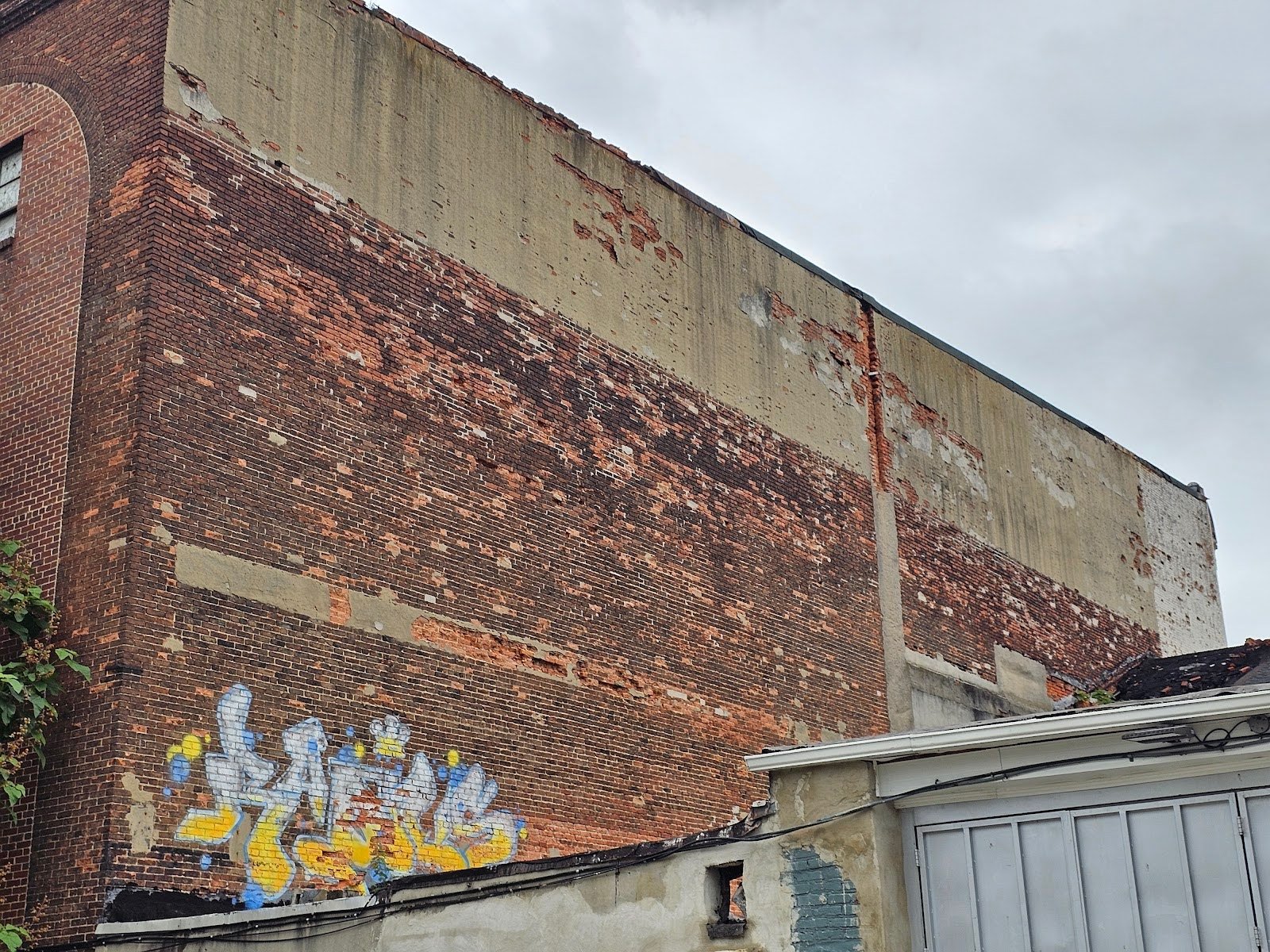
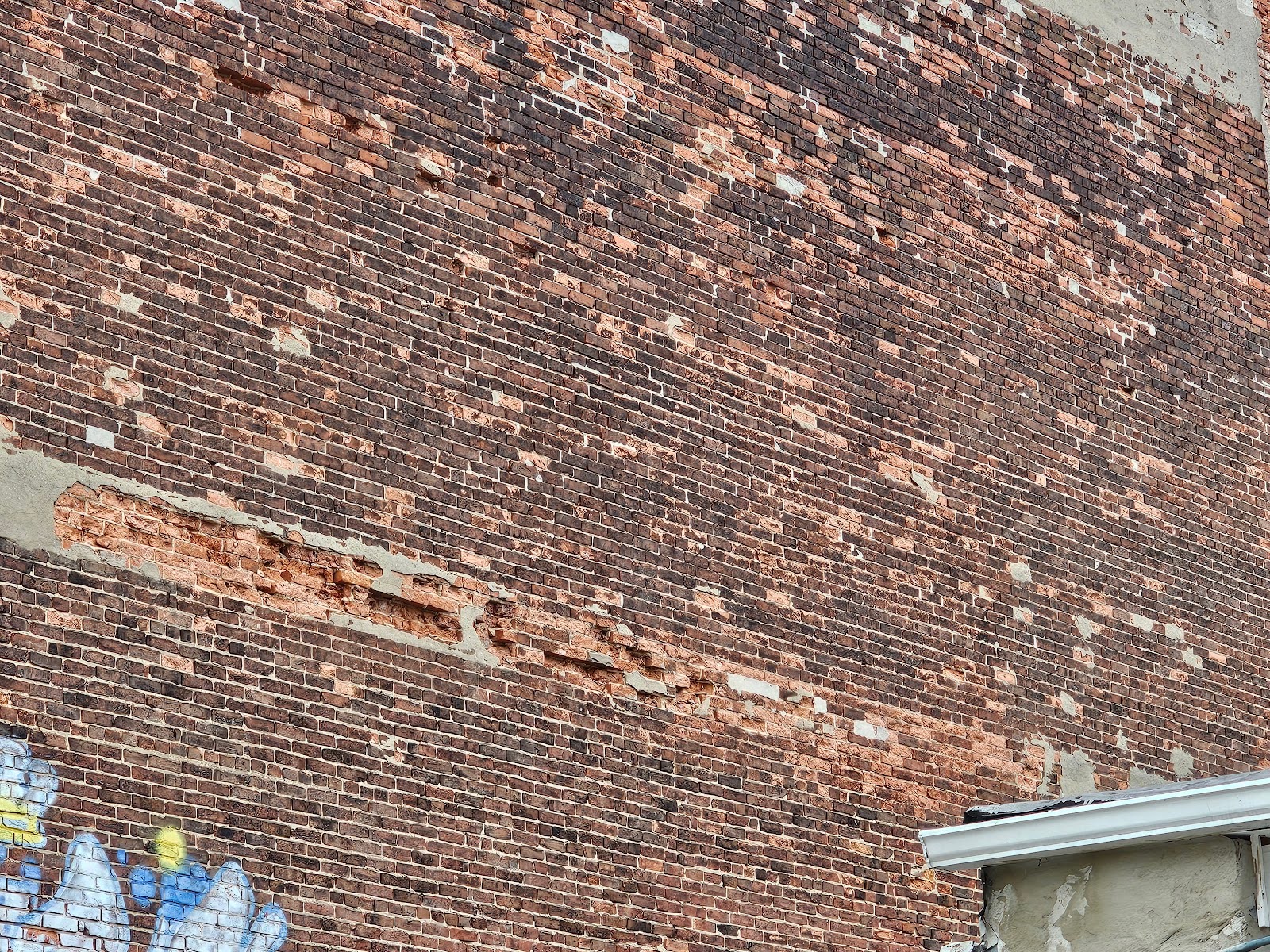
If you look closely at the lower left hand side of the picture below, there are about 10 to 12 brick courses above the graffiti where you can see a horizontal band that runs a great distance across this facade with significant masonry deterioration. It looks like the brick here is a much lighter color. This brick is more of a pink color than the brick above and below. In the areas above and below, the brick is a mostly reddish brown color. It isn’t really that these bricks are a different color though.
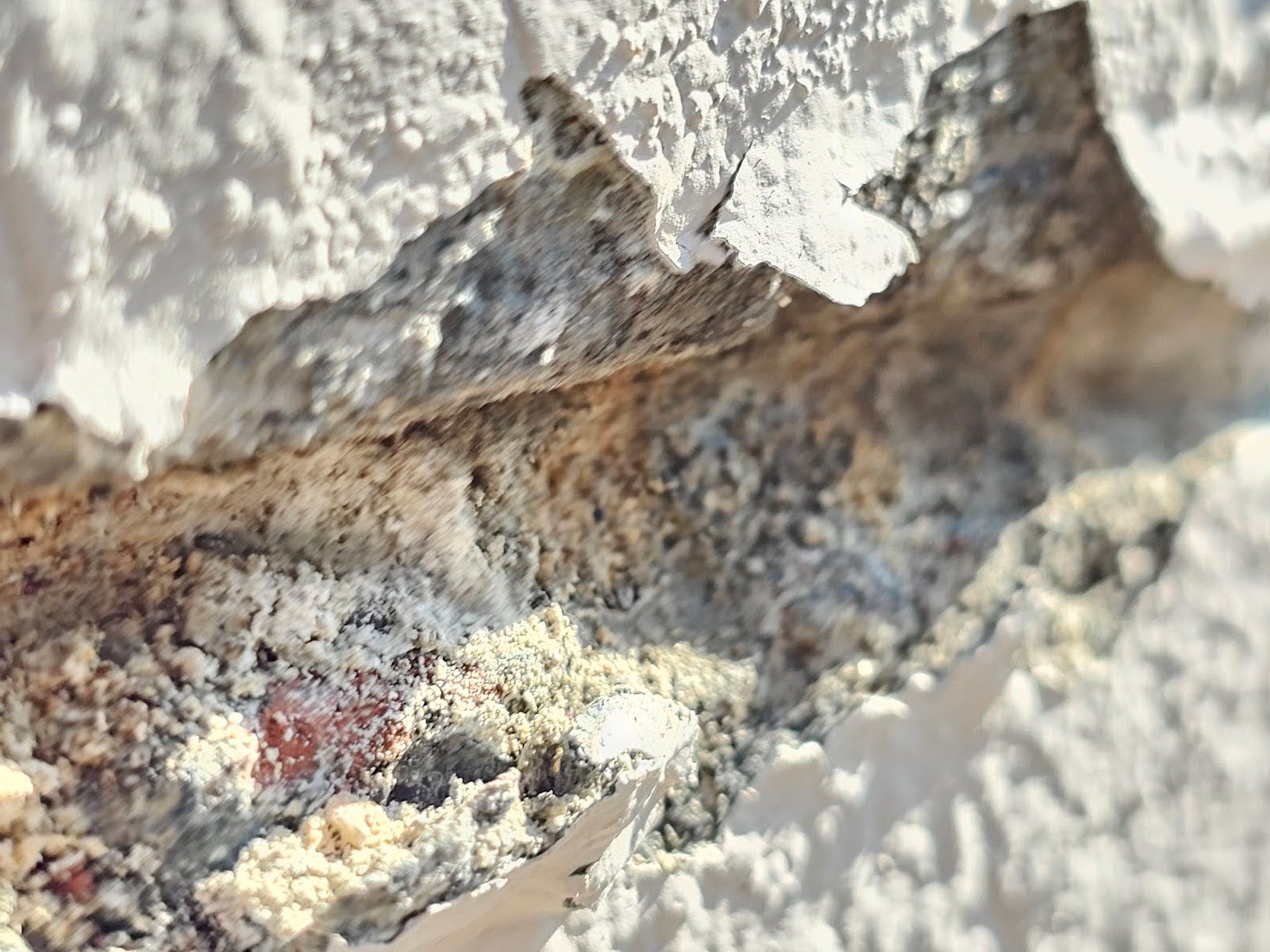
The exterior face of this masonry has spalled away at the pink-ish sections. Spalling is when the exterior face of a brick or masonry unit breaks off. Sometimes people refer to them as exploding bricks but really it’s just a fracture that happens without any type of explosion. The remnants are often found on the ground in many pieces but generally they flake off as one as if from a cleavage point inside of a stone or block. In masonry and in stone, the cleavage point, in this context, refers to a plane or gradient that runs through the masonry unit where it will follow a natural pathway of least resistance to shear and break away.
Here at our company, we had an internal discussion about this particular issue and consulted with a few different experts on the specific issues. The confusion, in the general public including the building owners, our clients, and their research and discussion with other professionals is really surprising. It’s surprising because it’s so misunderstood.
Things are changing quickly with technology, and we even saved the information from the client’s research using AI on this issue. AI is incredibly smart, but it is so far off on this issue that it shows it’s going to be a while still before technology alone will be able to replace the hard-earned lessons learned in the field over a career of doing this type of work.
We saved the files and details of this issue just so we can go back and look at it in the future. We think that as technology changes it will be interesting to compare and contrast from today. It might only be 10 years away from now, where it can actually be of some use in this area, right now though, they just cannot help at all in the specific point of diagnostics.
In fact, this is one of those examples where not understanding the core fundamentals can lead to incorrect information that’s just as bad as misinformation. It essentially sends people like our clients into circles in the wrong direction instead of giving them useful help. In this coming week, we will examine the different points of potential causes of deterioration.
Our company, Dupont Tuckpointing and Masonry, specializes in masonry restoration, historic brick repointing, and tuckpointing services in the Washington D.C. area. These buildings are uniquely historic, and their preservation requires skilled masons who are technically trained in the best practices and knowledge of proper restoration techniques.
We understand the significance of maintaining the architectural integrity of these historic structures, and our team of experienced professionals is dedicated to delivering exceptional craftsmanship. Whether you require masonry restoration, tuckpointing, or brick repointing services, we are here to help.
At Dupont Tuckpointing and Masonry, we take pride in our work and strive to ensure that every project is executed with the utmost care and attention to detail. We are committed to preserving the rich heritage of Washington D.C.’s built environment for generations to come.
If you have any questions or needs regarding masonry restoration, historic brick repointing, or tuckpointing services, please do not hesitate to reach out to us. We would be delighted to assist you and provide you with the expertise and quality workmanship that your historic property deserves.
You can reach us by telephone at (202) 796-7644 and you can reach us by email from the contact form on our website