Professional Brick Spot Repointing with Plug Chisels
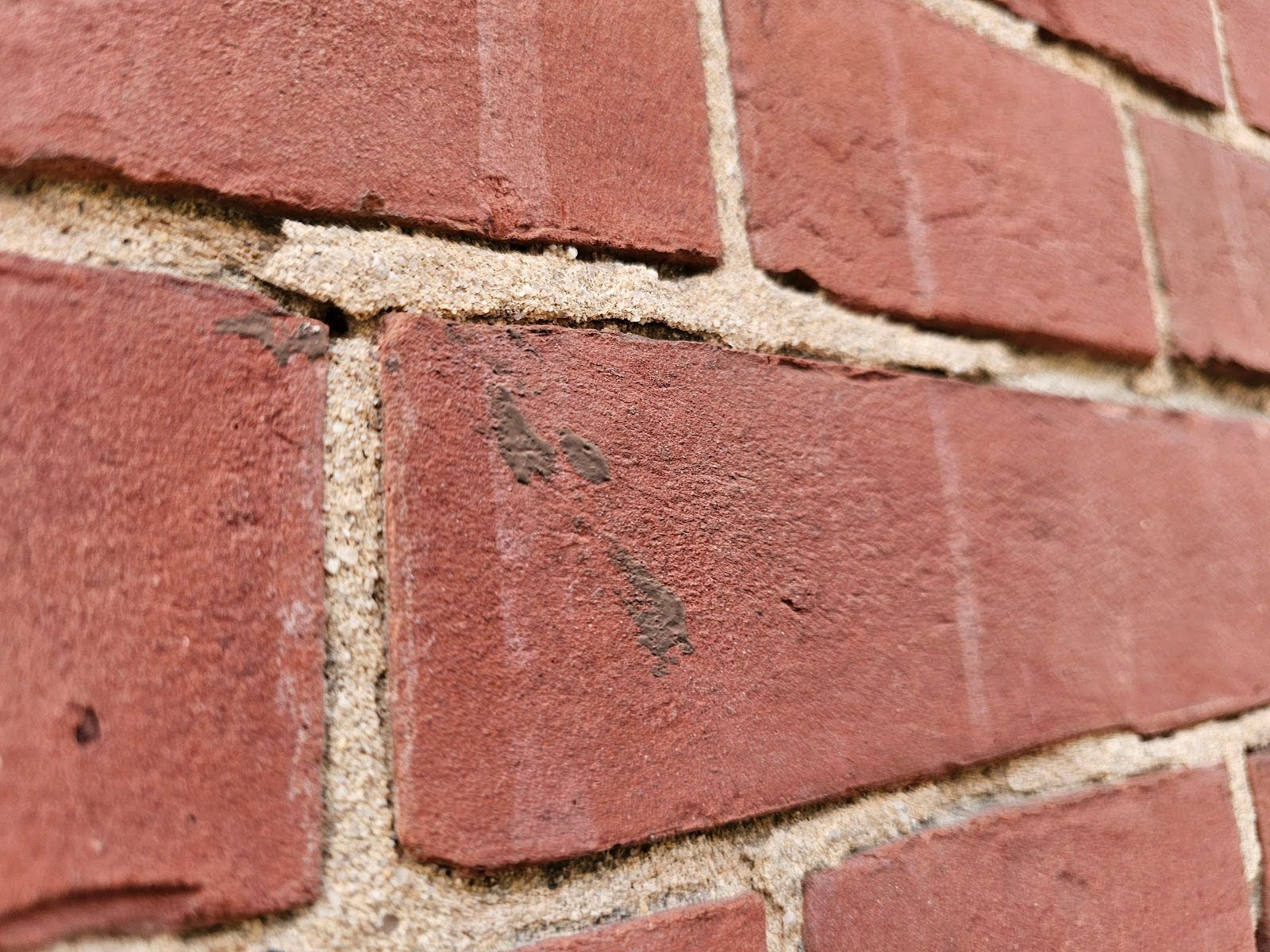
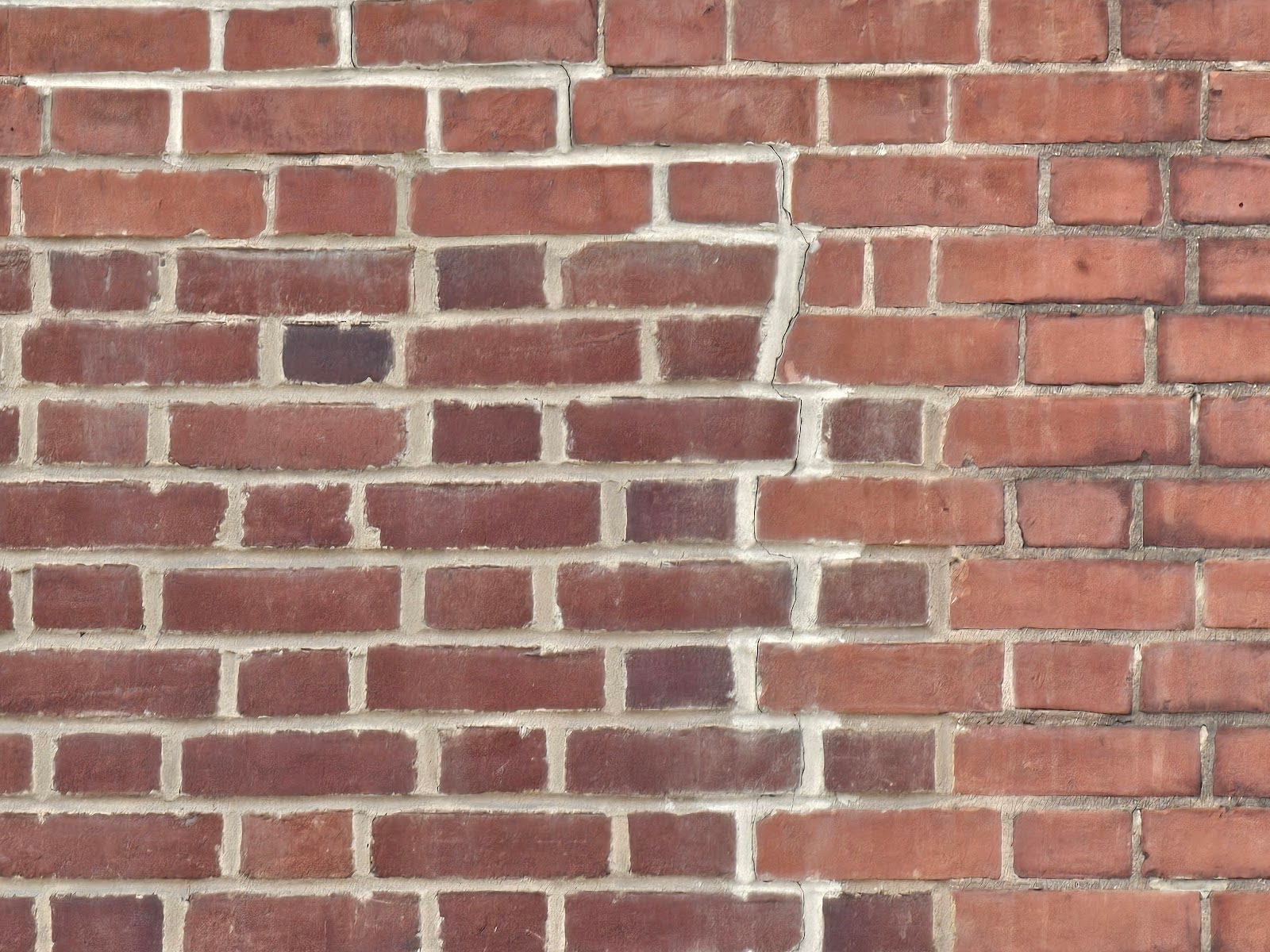
A wide range of different tools are used in historic masonry repointing. In typical brickwork, the joints are relatively consistent. In stonemasonry repointing, there’s a wide range of different sizes of mortar joints, even within just one limited area of stonework. This particularly applies to non-ashlar or less-ashlar masonry (we mention “less-ashlar” because there are many hybrid examples). Here in Washington DC, there are two different main types of historic brick joints: the common brick joint and the pressed brick joint.
The pressed brick joint is much thinner. The common joint is more prolific. Common joints range from roughly a half of an inch all the way up to over an inch thick. (The pressed brick joints are even thinner than that!) In most of those cases, with pressed brick or stone brick mortar, we would recommend, in repointing, that the mortar be removed up to 1.25 inches deep from the surface of the wall. In large stone joints, the depth of the raking, which means the removal of the mortar, must be done even deeper.
The raked mortar joint, for historic pressed brick, generally looks like an elongated rectangle. That means that the tip of the chisel must enter into that recess. A typical chisel has a taper and when fully embedded into the depth of the raked joint, the width of the chisel may be larger than the opening between the bricks permits. Essentially, that wedge type shape of the chisel may not allow the point to access all the way deeply into the mortar joints. To get to an inch and a quarter depth, the chisel needs to either be thin enough to reach or we use a special type of chisel called a plug chisel.
By and large, the plug chisel is much better for most types of repointing. A picture of a typical plug chisel follows below. You can see that there is a pointed edge, but unlike most chisels, that pointed edge does not follow along the typical flat cutting axis. Instead it’s at a tapered thin point and rotated 90 degrees.
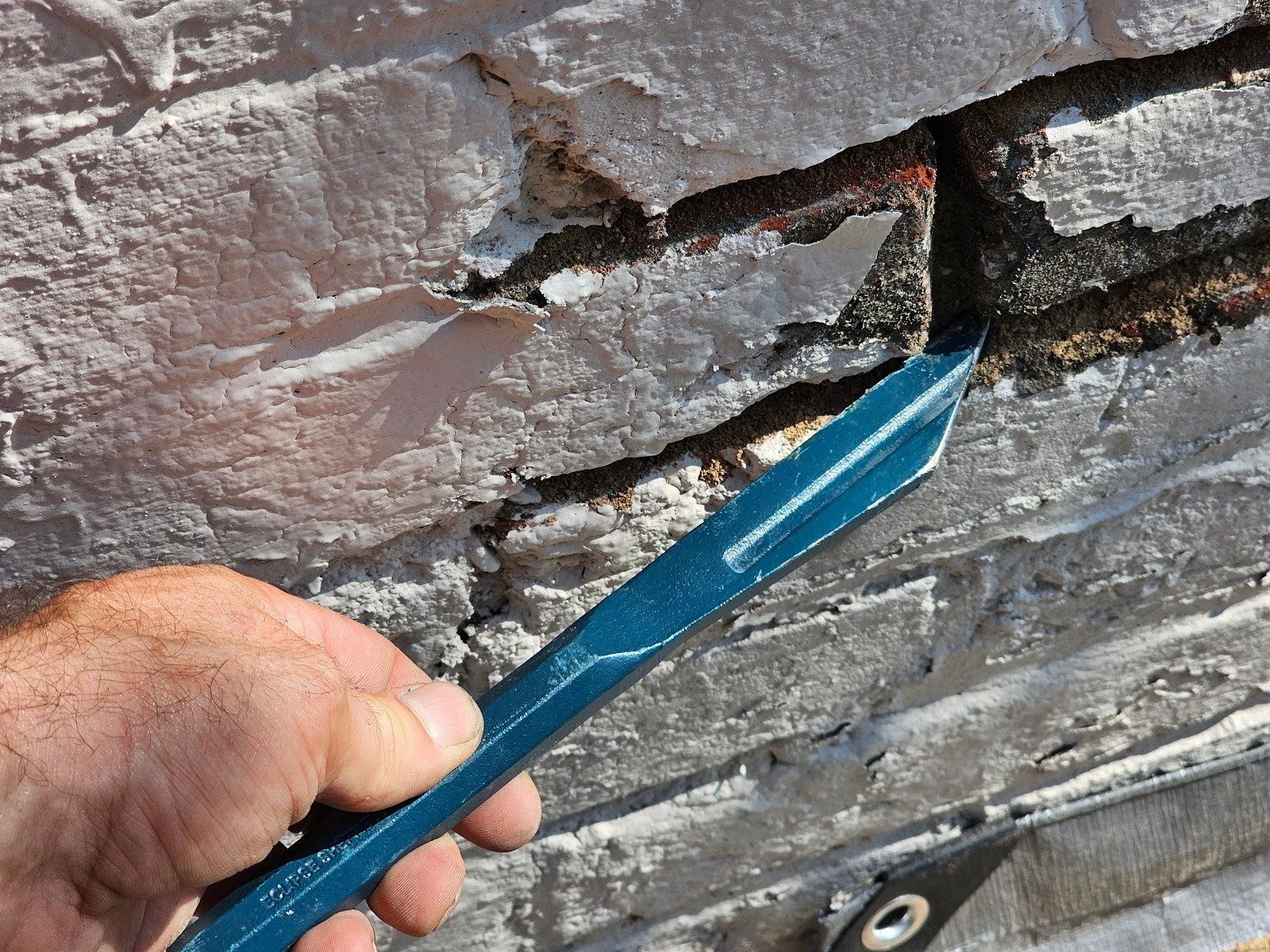
We are talking about the plug chisel today, in conjunction with a discussion on spot pointing. The plug chisel can be used for wholesale repointing as well. There are some even larger tools that we often use for larger joint raking though. Some of these tools are handmade by our company and affiliates here in the United States. Many of the tools used for historic masonry restoration and repointing were never really made here in the United States, though. There isn’t a large commercial market for many of these tools. That’s why we make them ourselves. In modern times, today, most manufacturing is done outside of the United States.
For many decades though, the hand made tools that we’re discussing today were actually made in places like England, not China. England has buildings that are over a thousand years old. That means that even when our country was brand new and some of the first colonial era masonry buildings were being built, England already had buildings that were many hundreds of years old there, they’ve been doing repointing for centuries longer than we have. Also, their urban areas are made more with historic masonry buildings than our urban areas are.
Even here in Washington DC, the historic portion of the city only encompasses roughly less than a half of the total area. This is also one of the reasons why, here in the USA, there aren’t many companies like ours who specialize in historic masonry restoration. It’s a trade that has been largely lost to time, particularly where nowadays so much focus is on making cheap plastic and cardboard tract homes in the sprawling suburbs outside of the cities.
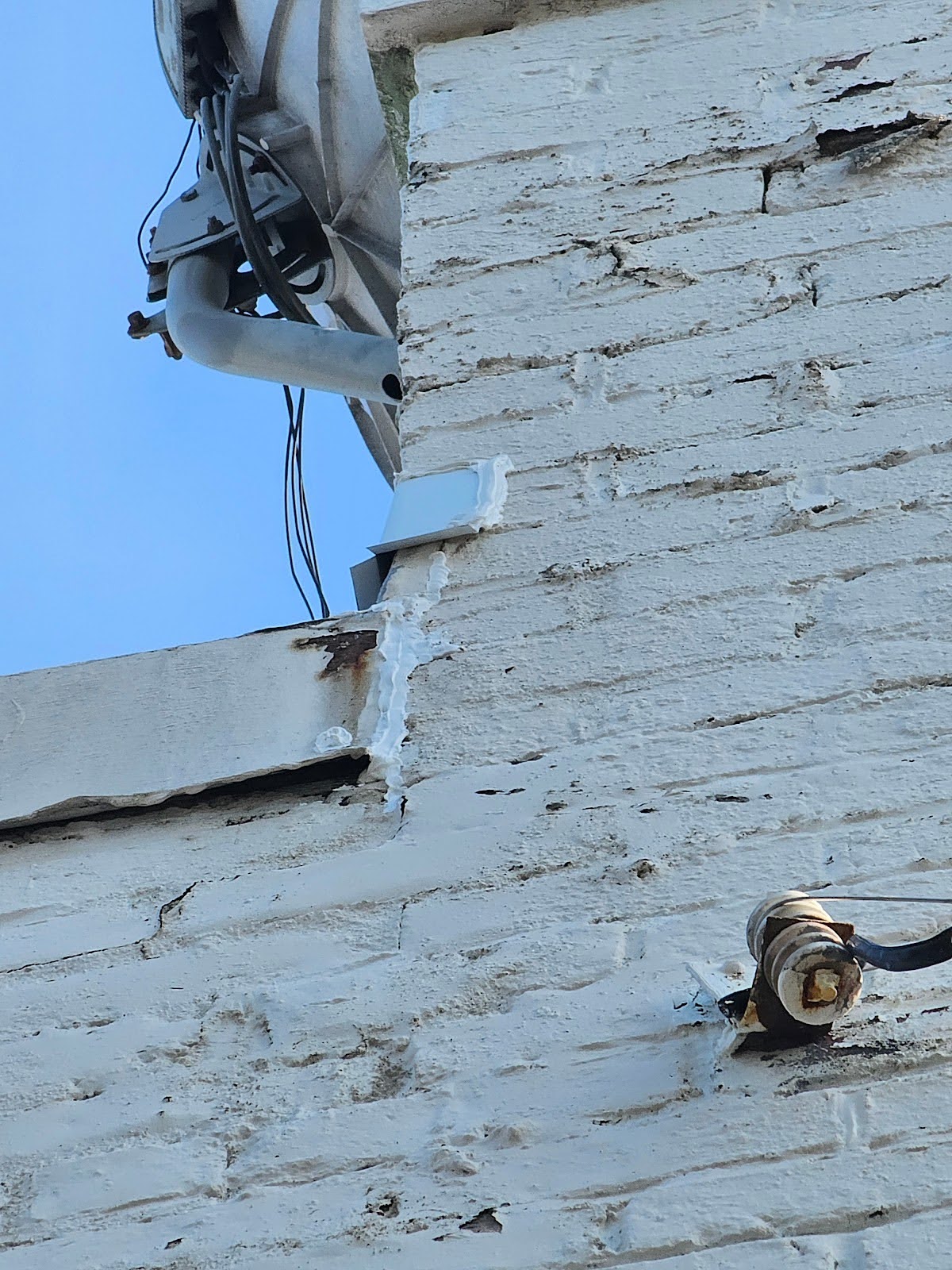
Most historic DC buildings are old enough to require repointing in wholesale large areas, we simply recommend full reporting. Sometimes though, because of budgetary constraints, and because of priorities, spot pointing just makes sense. In some cases spot pointing will focus on repointing the areas of highest need. In those cases the plug chisel may be the right tool. Because of the elongated end of the chisel, without a taper at the end, it won’t break the edges of the bricks and it allows the work to be done properly.
In this coming week, we’ll talk more about the design of the plug chisel and more about spot repointing and types of mortar and processes used for historic masonry restoration.
Our company, Dupont Tuckpointing and Masonry, specializes in masonry restoration, historic brick repointing, and tuckpointing services in the Washington D.C. area. These buildings are uniquely historic, and their preservation requires skilled masons who are technically trained in the best practices and knowledge of proper restoration techniques.
We understand the significance of maintaining the architectural integrity of these historic structures, and our team of experienced professionals is dedicated to delivering exceptional craftsmanship. Whether you require masonry restoration, tuckpointing, or brick repointing services, we are here to help.
At Dupont Tuckpointing and Masonry, we take pride in our work and strive to ensure that every project is executed with the utmost care and attention to detail. We are committed to preserving the rich heritage of Washington D.C.’s built environment for generations to come.
If you have any questions or needs regarding masonry restoration, historic brick repointing, or tuckpointing services, please do not hesitate to reach out to us. We would be delighted to assist you and provide you with the expertise and quality workmanship that your historic property deserves.
You can reach us by telephone at (202) 796-7644 and you can reach us by email from the contact form on our website.