Understanding Penetrations in Historic Brick Walls – Part I
Today we’re going to look at a handful of different penetrations and openings that have been cut into or items that have been driven into historic brick walls. We generally recommend against this type of cutting through and driving into historic brick. It damages the brick and it’s difficult and costly to repair. Sometimes it’s necessary though. Starting with the picture below, we’re looking at a wasteline that was at least partially added or modified after the initial building construction.
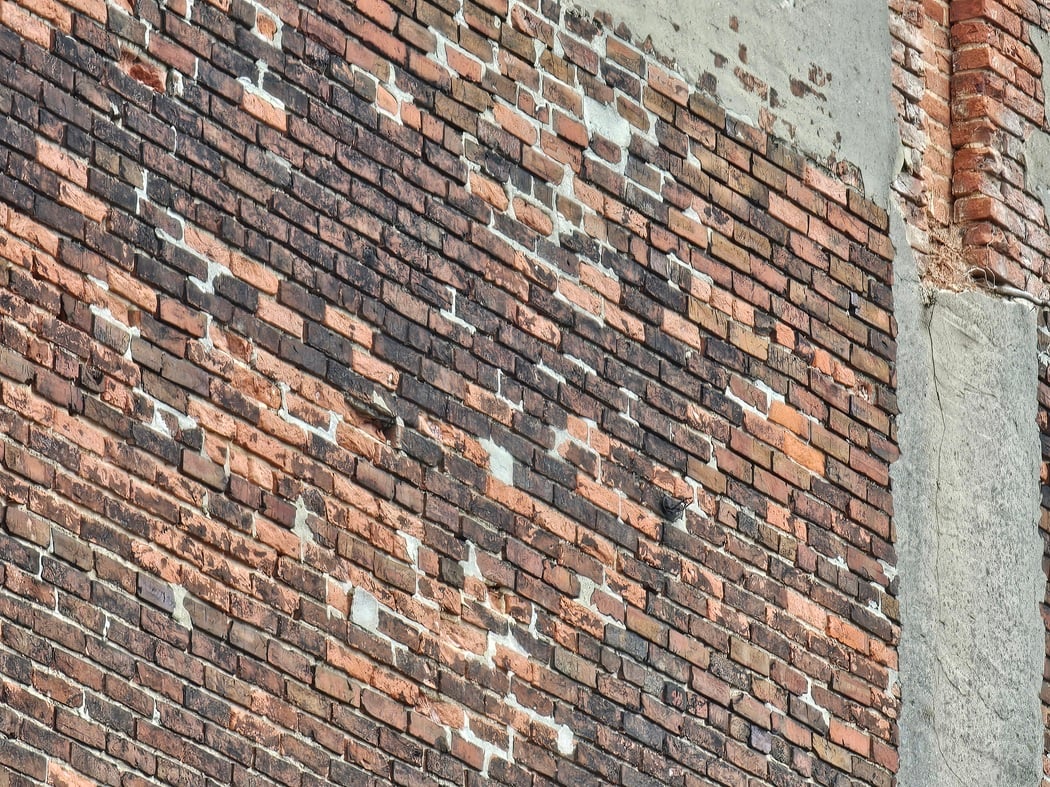
The particular building facades that we are looking at are at the exterior were built with a common brick on a common bond. As we’ve mentioned in the past though the common bond used is only one type of brick bond, there are many others. It does happen to be a relatively prolific bond in historic buildings, but other ones are common, as well. For example, the Flemish Bond and even the English Bond are very common in historic buildings here in Washington DC.
Once in a while we’ll see a building built with a running bond but it’s less common with the historic buildings. For double wythe walls, even back in historic times, Builders knew that the running bond was a relatively weak method of building with bricks.
The main limitation of the running bond is that it’s one of the few bonds that doesn’t connect between a double wythe wall. It works okay in hollow bricks brick walls. These historic bricks were built with solid brick though, not in a framed cavity wall.
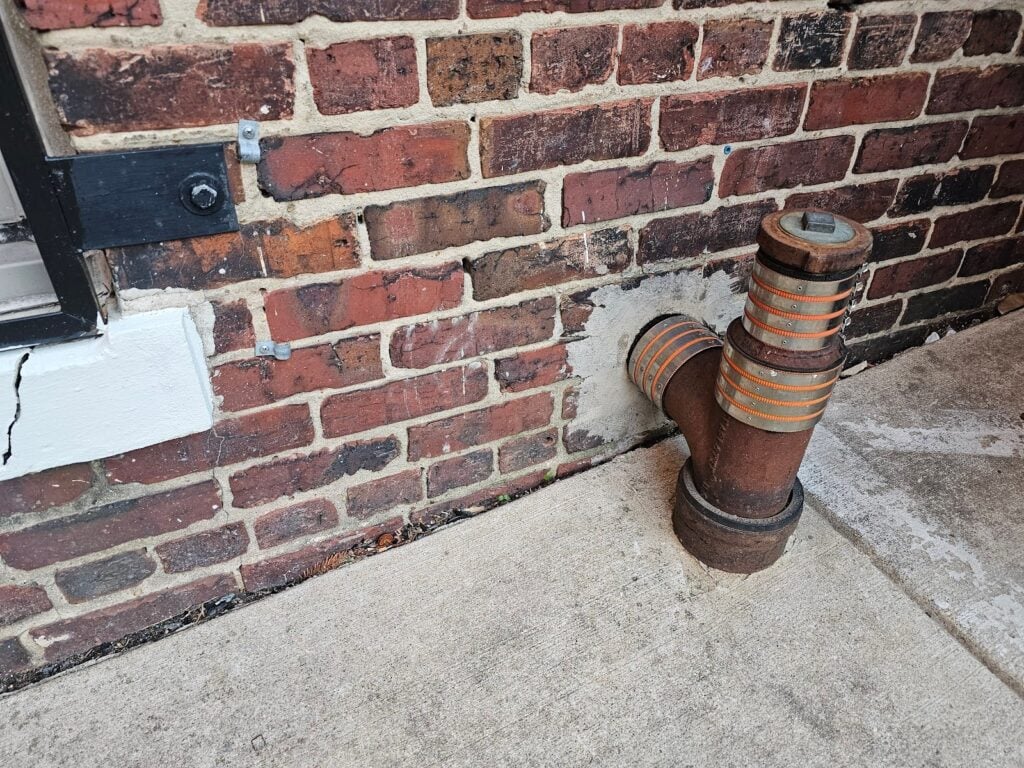
In the picture below you can tell that it’s a common bond because near the top of the picture in the bottom of the exposed portion of the brick, just above the sidewalk, you can see the header course. The rest of the courses shown in between those header courses are more typical stretcher courses. In this picture, you can see the sewer drain clean out pipe assembly that goes through the base of the wall. That pipe is a 4-inch diameter cast iron pipe. The lower portion of the pipe, where it goes underground or comes just above the sidewalk, is a hub and spigot connection.
The other connections are made with hub-less or no-hub fittings. Those fittings have a stainless steel shielded neoprene wrap that is tightened on both ends of the connection with band clamps. The removable cover at the top of the vertical section has a square/hex indentation for a wrench, so it can be opened to snake the line if cloggages occur. The turn that goes from the vertical position to transfer to the horizontal run is a wye, used like a graduated elbow.
Cast iron piping, of the type shown at the base of the assembly, may be as old as the building. The upper portions of hub-less connections have likely been modified or added in more recent decades. However, with the mortar or cement applied around the outside of the penetration, it looks like there has at least been rework in more recent decades. The type of cementitious patching or overlay used here appears to be a portland type mortar.
There are several potential problems or issues with this type of patching. When making a penetration through an exterior partition, it helps to fill in the area around the penetration with a mortar or cementitious patch. Coordination is needed between different trades. It may be a practical necessity to make the opening slightly larger than the piping that is used to pass through the partition. That’s just a simple reality of building construction. However, with good coordination, the opening size can be generally located with a reasonable amount of accuracy. If the sizing is done appropriately then there isn’t necessarily a large amount of area to patch in afterwards.
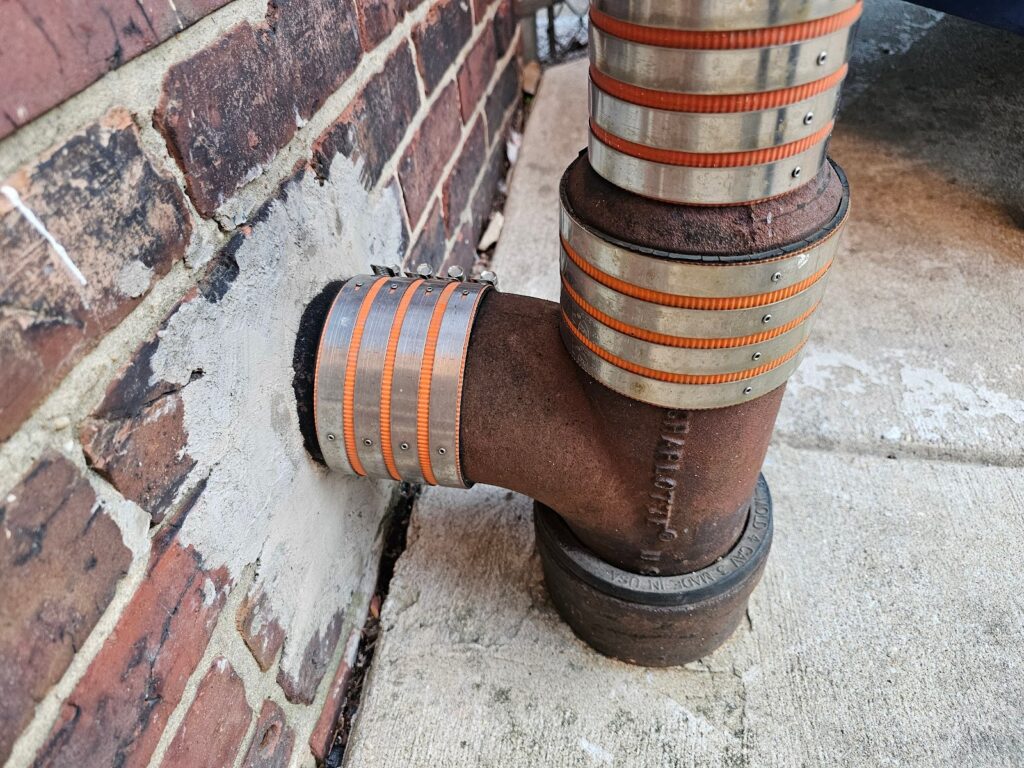
Here though, instead of making a relatively small patch, they smeared mortar all over the face of the brickwork. This particular brick work is unpainted and therefore the cement looks like a mistake, it is not part of the original building plan and is applied sloppily as well. And also causes a functional problem. Aside from the aesthetics, it’s actually bad for the brickwork. This particular cement, since it is Portland based, is incompatible with the substrate masonry. It’s essentially blocking the natural permeation of moisture and causing an area of build-up. Will become a problem during cyclical freeze-thaw cycles.
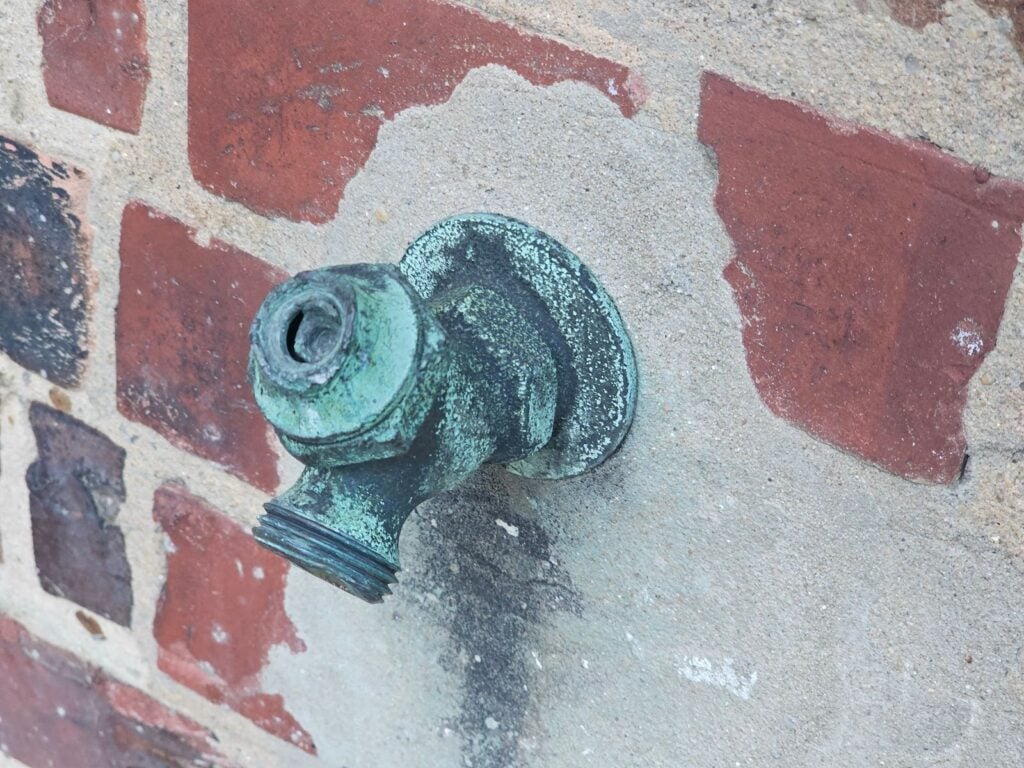
A similar type of patch has been done at a hose spigot shown in the picture below. This type of hose spigot no longer meets the building code requirements because it does not come with an integral anti-siphon device or a frost-free type of deep seating valve an anti-siphon device can be added separately, and an internal control may be added to isolate the piping during winter months, but new construction requires the deep seating valve to be integral with the faucet.
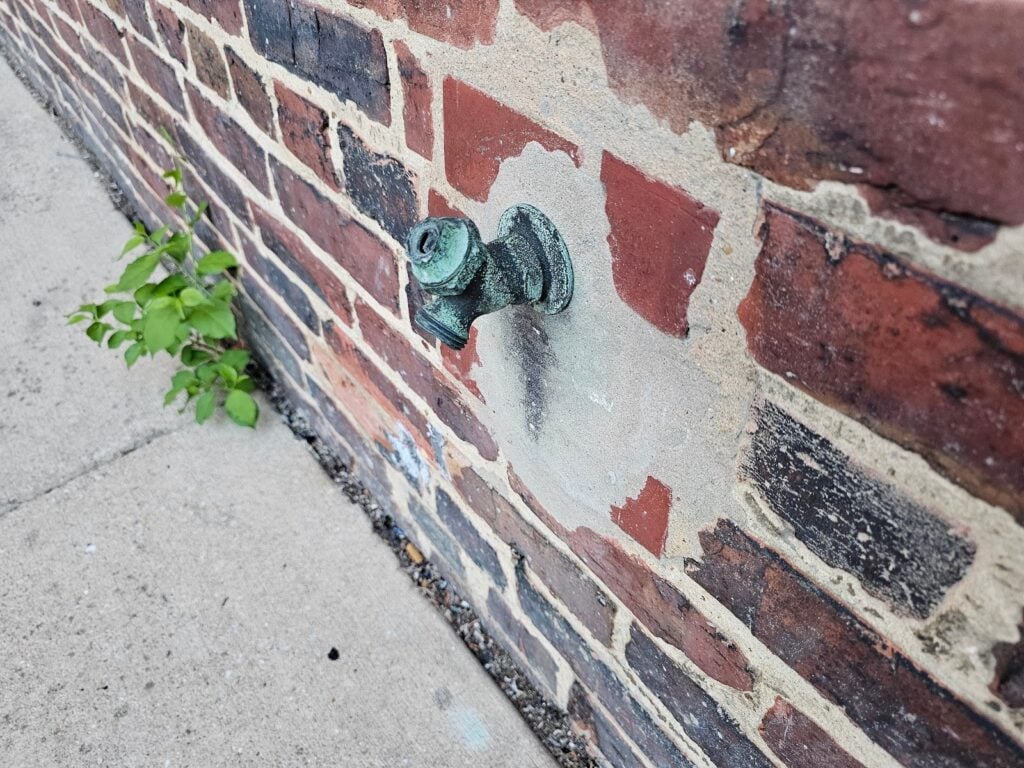
Even though this particular faucet, a brass plumbing fixture, is covered with a rich blue patina, we know that this has been installed after the original construction of the building. It’s clear to see that the bricks have been knocked out and then changed with a more modern brick around the point of the penetration. This looks bad, as if they didn’t care at all about the aesthetics of the masonry facade. However, aside from not using modern components and that the valve handle is broken, functionally this might have been appropriate for the time.
They did not need to knock out those bricks, just to install a hose connection though. They did more work than necessary, by making a simple installation more complicated and now it looks aesthetically like an area of bad workmanship.
In this coming week we’ll take a look at an antique type water valve access door and handrail or guardrail type mountings into the facade and areas where wood embedments have been created to receive fasteners. We’ll talk more about how this brick work has been modified over the years and some of the problems inherent with having other trades doing masonry repairs.
Since our company, Dupont Tuckpointing and Masonry, specializes in masonry restoration, historic brick repointing, and tuckpointing services in the Washington D.C. area, we make it a point to study these types of issues. These buildings are uniquely historic, and their preservation requires skilled masons who are technically trained in the best practices and knowledge of proper restoration techniques.
We understand the significance of maintaining the architectural integrity of these historic structures, and our team of experienced professionals is dedicated to delivering exceptional craftsmanship. Whether you require masonry restoration, tuckpointing, or brick repointing services, we are here to help.
At Dupont Tuckpointing and Masonry, we take pride in our work and strive to ensure that every project is executed with the utmost care and attention to detail. We are committed to preserving the rich heritage of Washington D.C.’s built environment for generations to come.
If you have any questions or needs regarding masonry restoration, historic brick repointing, or tuckpointing services, please do not hesitate to reach out to us. We would be delighted to assist you and provide you with the expertise and quality workmanship that your historic property deserves.
You can reach us by telephone at (202) 796-7644 and you can reach us by email from the contact form on our website at https://duponttuckpointingmasonrydc.com/contact-us/.