How Faux Timeworn Masonry Enhances Historic Aesthetics
This past week, we began looking at pictures of this particular stucco facade. We talked about the visual illusion of shutters on the wall. It’s like a type of faux painting but it wasn’t intended. It’s interesting that it ended up looking like there are shutters still there. It only looks like this because of an unintentional application of paint. This past week, we talked about how stucco can be applied on top of brick, block, and even stone masonry substrate surfaces. Another interesting detail about stucco is that it can even be applied on top of stick framed building facades. Stick frame construction is a building made just with wood framing.
There’s a few different types of stick framing and two of the most common and popular types over the past 100 years are balloon framing and California platform framing. California platform framing was the most common method up until pretty recently. Currently, derivatives of this style of framing are most common in the typical tract home construction. The type of construction you find in the suburban and sprawling country regions of America.
We haven’t even seen the inside of this building, nor have we cut a hole through the wall to see how it was constructed. Nonetheless, we will show some signs of how and why we think we know how it was actually built. We can’t say for sure. There are some visual signs here though. Generally, in masonry walls, there is a greater recess between the outer surface of the wall and the plane of the window itself. Here, the window is set very close to the outer wall surface.
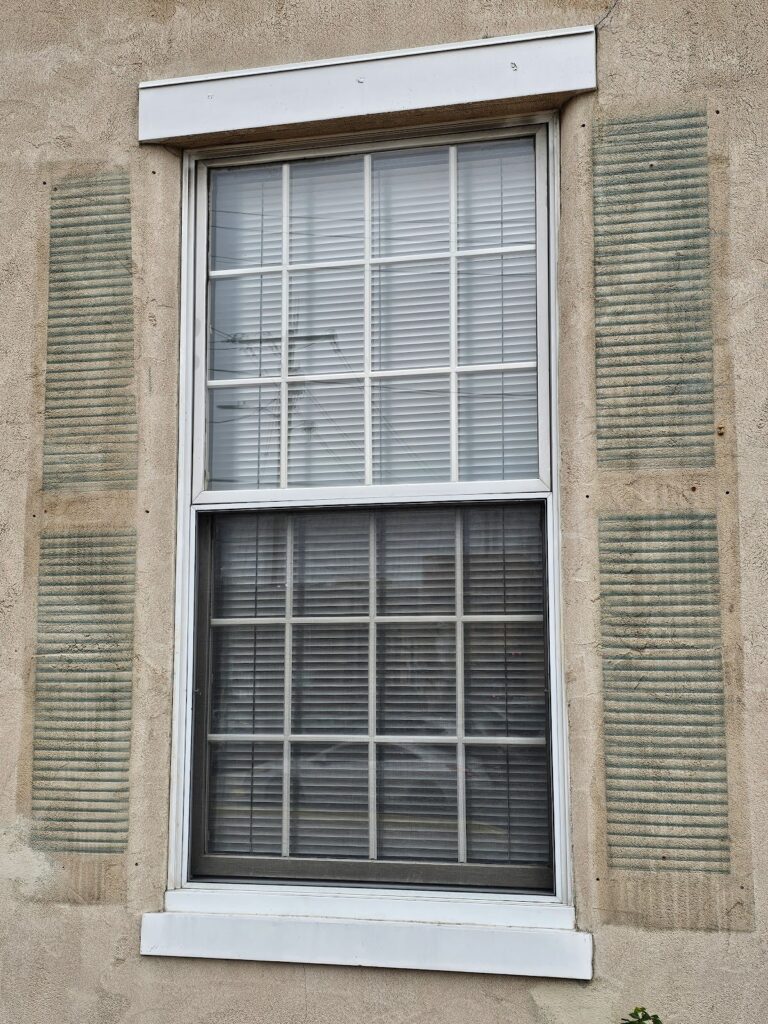
In the next picture below, you can see this from a little bit of a skewed angle and you can tell that the frame of the window is very close to the outer edge of the face of the wall. It’s likely that this means that the wall is thinner than a typical masonry wall. Masonry wall buildings can be built in a variety of thicknesses. Generally, bricks are roughly 3.5 inches thick. When built in a historic type assembly where there’s at least two bricks together, we call that a double wythe wall.
In those cases, there is generally at least a half inch to 1 inch of mortar between the bricks in the side by side position. All together, when you add up these dimensional elements, of 3.5 in + 1 in + 3.5 in, the double wythe brick wall would be roughly 8 in thick. That dimension is relatively typical for most masonry walls. There are exceptions and there are even stick framed buildings that are built with masonry veneers at the outer face.
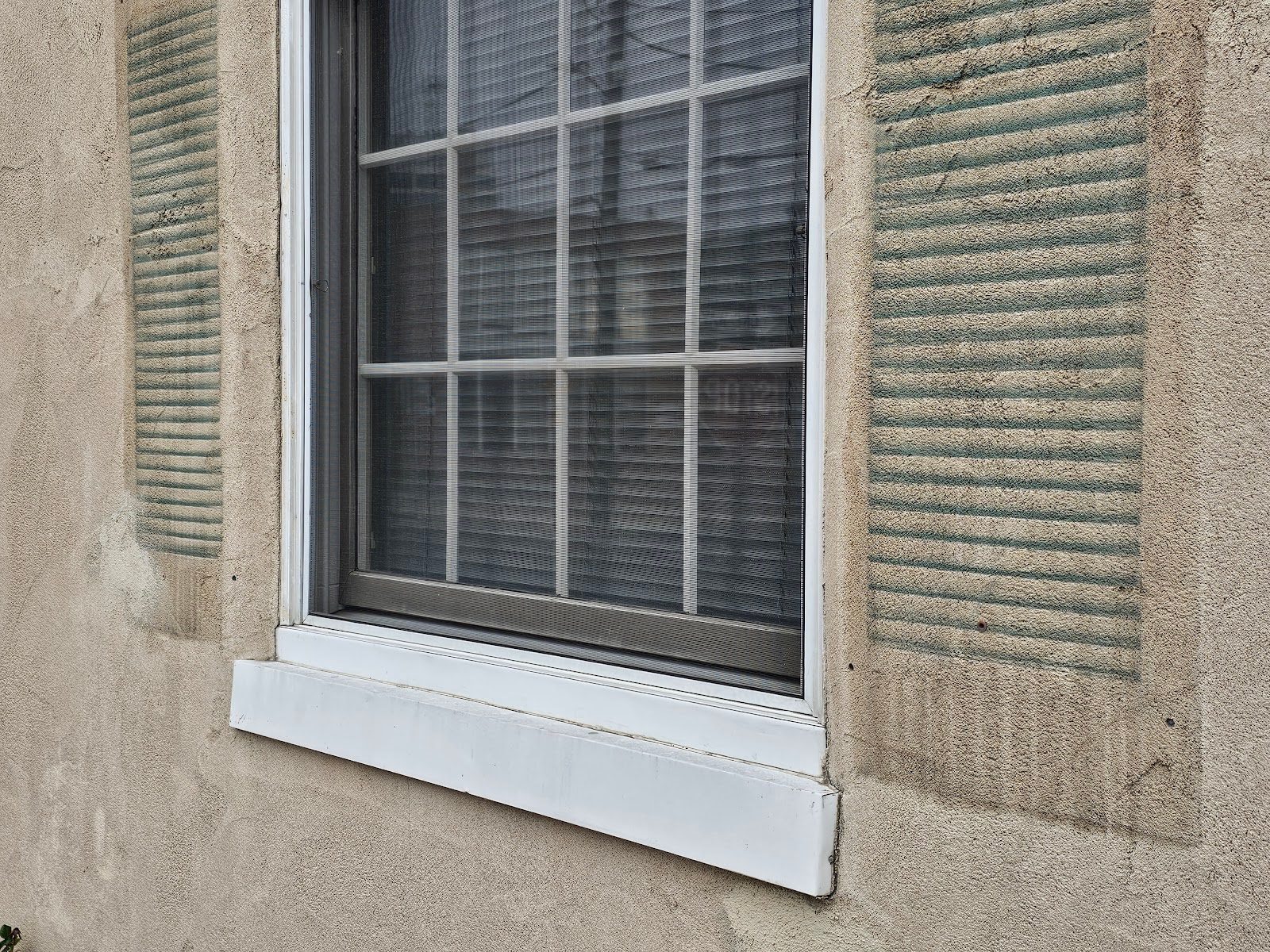
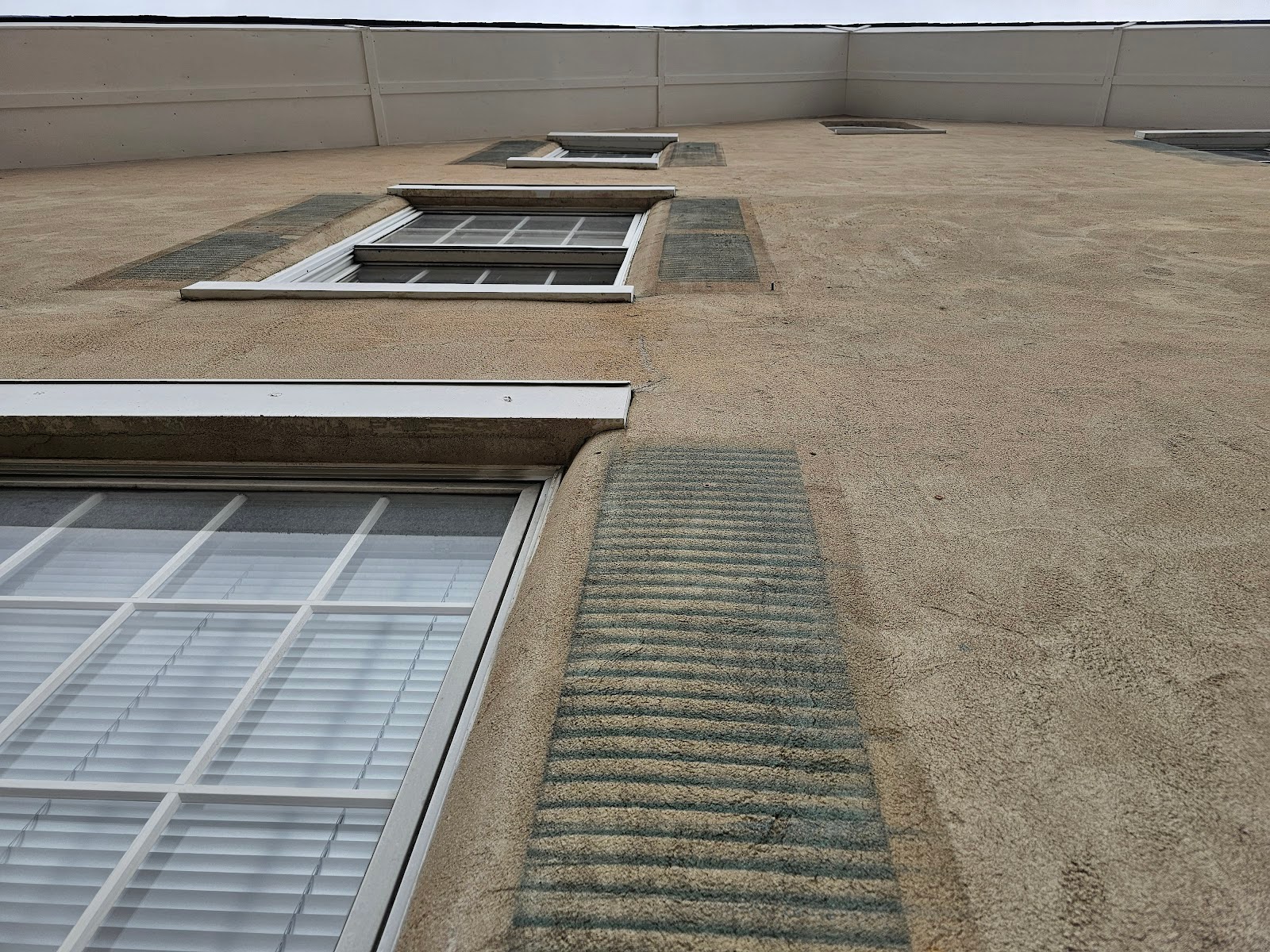
It’s only when you get really close to the facade that you can see perfectly clearly that there are no shutters at the sides of these windows. Instead, it’s just overspray that went between the individual louvers and sash of the former shutters. There’s a couple different types of shutters that are available in the market today. Some of them are real and some are fake vinyl replicas.
The vinyl options are cheap, cheap looking, but also relatively low maintenance. And they don’t actually have to be painted. They have a degree of UV resistance but will still fade a bit with exposure to sunlight. Different facades have different amounts of exposure to sunlight. North facing facades have very low exposure, in our area. South facing facades have the most amount of exposure to sunlight, here in DC.
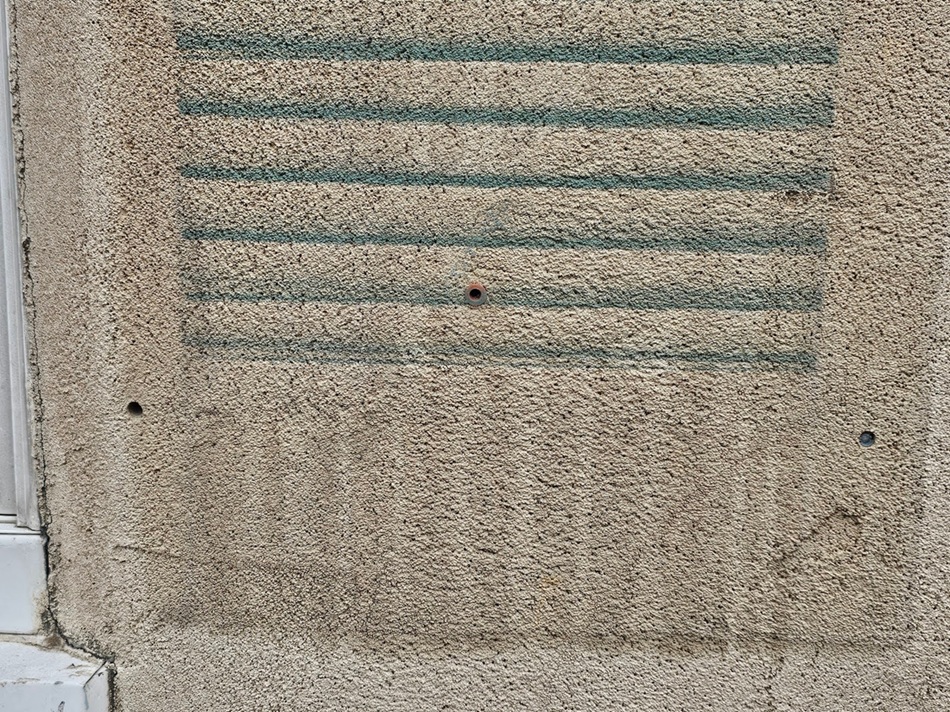
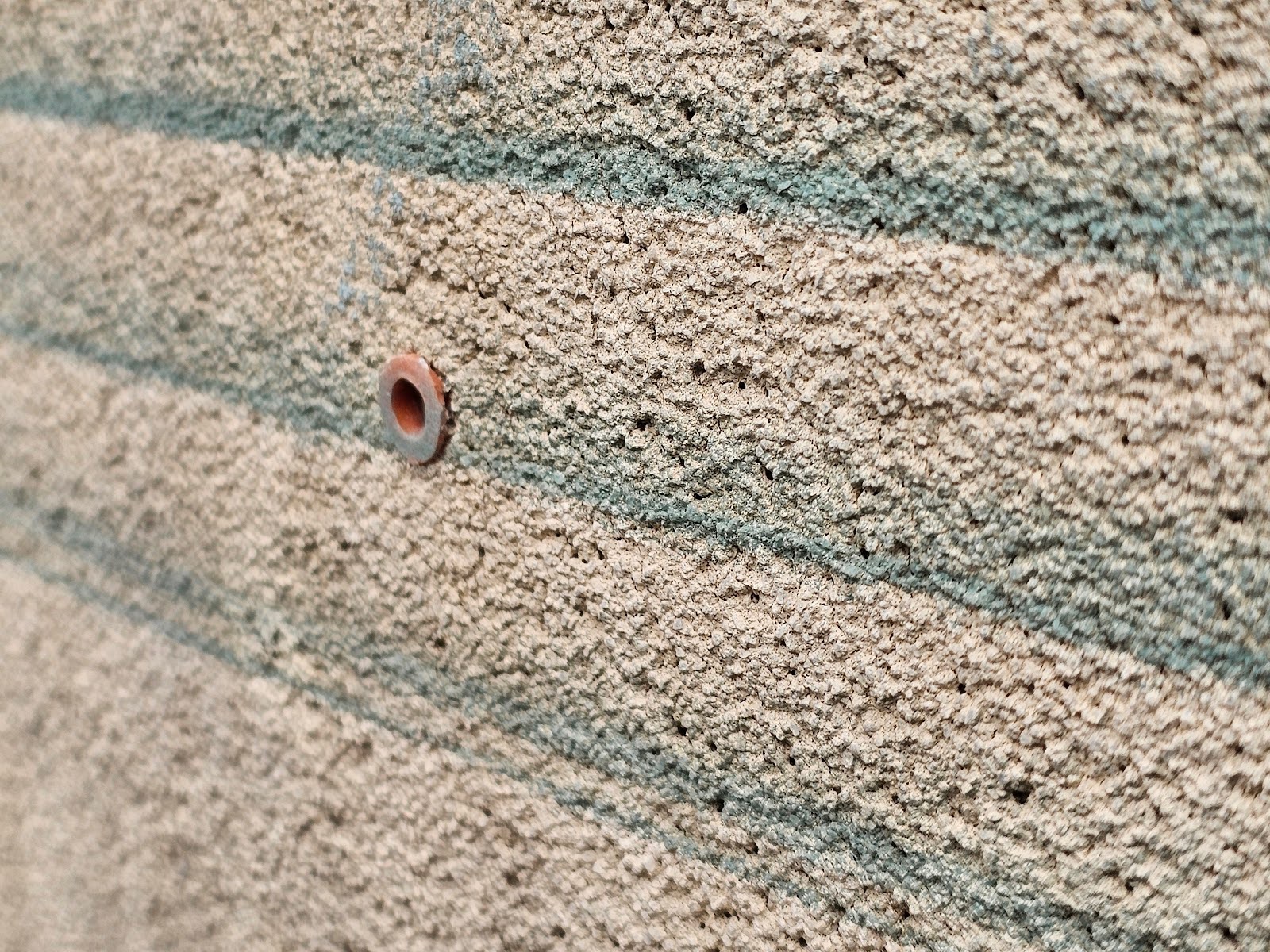
The next picture below shows the closest view. Almost all although the lines of paint are faint, they look particularly real because they also have a bit of a gradient. The gradient, in this case refers to a slight amount of diffusion where they go from a more concentrated line to a line that slightly disappears away from the core center. It also helps that none of the lines are excessively crisp. Too much emphasis might look exaggerated. You can see a plastic screw mounting sleeve has been installed through these stucco surface. Not all fasteners can mount well into cementitious masonry substrates.
Cementitious masonry substrates could include a wide range of typical masonry materials like brick, concrete, stone, cinder block, and even stucco. Often, instead of installing a regular fastener directly into a masonry substrate, it helps to install an anchor or sleeve first. From the anchor or sleeve, the fastener can apply pressure more evenly in all directions.
The last picture below shows a view looking upwards, towards the top of the facade. In this angle it is perfectly clear that there are no shutters there. You can see the planar face of the wall is perfectly flat.
Since our company, Dupont Tuckpointing and Masonry, specializes in masonry restoration, historic brick repointing, and tuckpointing services in the Washington D.C. area, we make it a point to study these types of issues. These buildings are uniquely historic, and their preservation requires skilled masons who are technically trained in the best practices and knowledge of proper restoration techniques.
We understand the significance of maintaining the architectural integrity of these historic structures, and our team of experienced professionals is dedicated to delivering exceptional craftsmanship. Whether you require masonry restoration, tuckpointing, or brick repointing services, we are here to help.
At Dupont Tuckpointing and Masonry, we take pride in our work and strive to ensure that every project is executed with the utmost care and attention to detail. We are committed to preserving the rich heritage of Washington D.C.’s built environment for generations to come.
If you have any questions or needs regarding masonry restoration, historic brick repointing, or tuckpointing services, please do not hesitate to reach out to us. We would be delighted to assist you and provide you with the expertise and quality workmanship that your historic property deserves.
You can reach us by telephone at (202) 796-7644 and you can reach us by email from the contact form on our website at https://duponttuckpointingmasonrydc.com/contact-us/.